
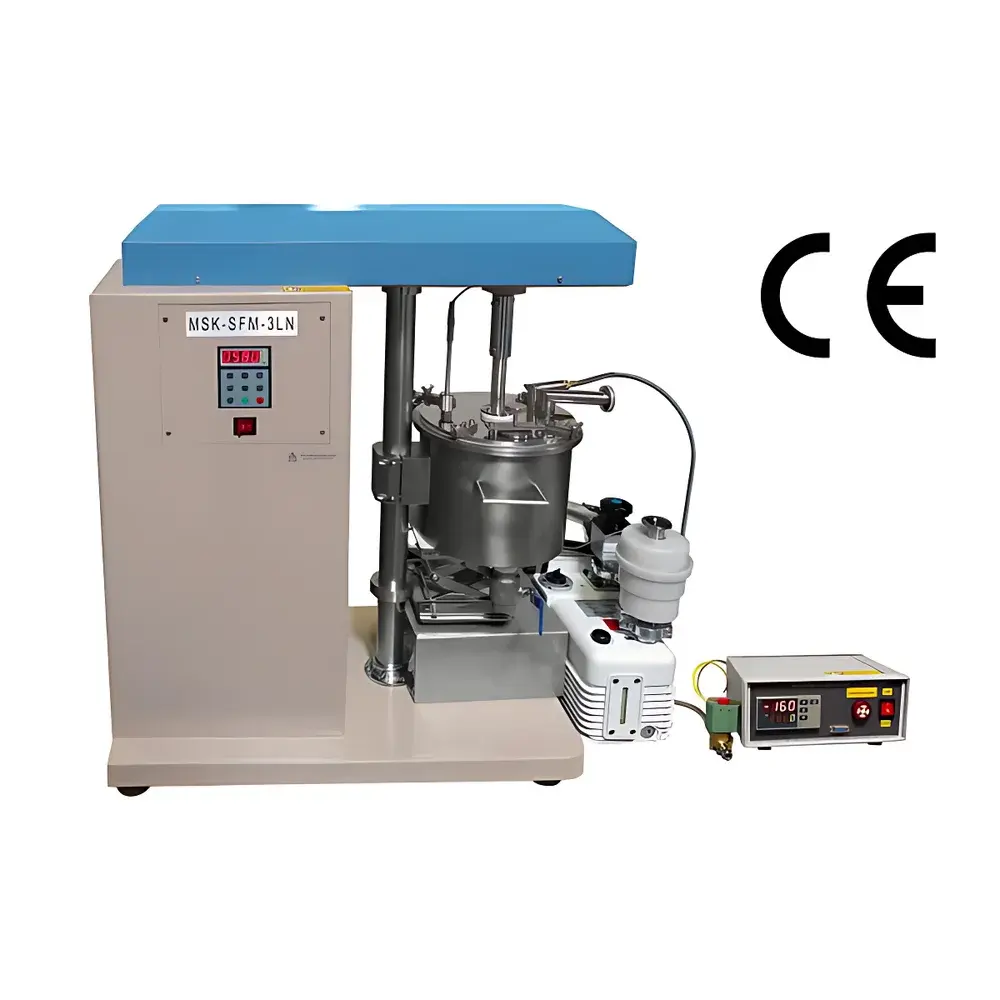
KJ GROUP MSK-SFM-3LN Liquid Nitrogen-Cooled Stirring Mill
| Brand | KJ GROUP |
|---|---|
| Origin | Liaoning, China |
| Manufacturer Type | Authorized Distributor |
| Country of Origin | China |
| Model | MSK-SFM-3LN |
| Pricing | Available Upon Request |
| Vessel Capacity | 3 L |
| Temperature Range | −180 °C (achievable with LN₂) |
| Stirring Speed | 0–1200 rpm |
| Final Particle Size | ≤1 µm |
| Power Supply | 220 V AC, 1250 W |
| Dimensions (L×W×H) | 700 × 600 × 1100 mm |
| Weight | 90 kg |
| Vessel Material | 304 Stainless Steel |
| Vacuum Jacket | KF25 Flange + Needle Valve |
| Temperature Sensing | Internal Thermocouple |
| Grinding Media | Zirconia Beads |
| Max Sample Size | 20 mm |
Overview
The KJ GROUP MSK-SFM-3LN Liquid Nitrogen-Cooled Stirring Mill is a precision-engineered cryogenic milling system designed for the controlled size reduction of temperature-sensitive, ductile, or thermoplastic materials that deform or agglomerate under ambient grinding conditions. Unlike conventional ball mills or planetary mills, this unit integrates active liquid nitrogen (LN₂) cooling directly into the grinding chamber via a vacuum-insulated double-wall vessel, enabling sustained operation at temperatures as low as −180 °C. The system operates on the principle of cryogenic mechanical stirring—where embrittlement induced by deep cooling permits efficient particle fracture through high-shear agitation rather than impact-dominated comminution. This approach preserves chemical integrity, minimizes thermal degradation, and avoids phase transitions in polymers, pharmaceutical actives, elastomers, and biological tissues. Its architecture supports both batch processing and process development workflows in R&D laboratories and pilot-scale material synthesis facilities.
Key Features
- Vacuum-insulated 3 L stainless steel (304) grinding vessel with KF25 flange and adjustable needle valve—enabling high-efficiency thermal isolation and optional use as a cryogenic cold trap
- Multi-blade stainless steel impeller with variable-speed control (0–1200 rpm), delivering consistent shear profiles across viscosity and brittleness gradients
- Programmable controller supporting time-, speed-, and direction-based sequencing (forward/reverse rotation) to optimize dispersion homogeneity and prevent media stratification
- Integrated thermocouple probe mounted directly inside the grinding chamber for real-time, closed-loop temperature monitoring and manual LN₂ flow regulation
- Robust mechanical design rated for continuous operation at cryogenic temperatures; all load-bearing components engineered for thermal contraction compatibility
- No internal electrical components within the cryo-chamber—ensuring intrinsic safety during LN₂ handling and eliminating condensation-related failure modes
Sample Compatibility & Compliance
The MSK-SFM-3LN accommodates a broad range of challenging matrices, including but not limited to: thermoplastic polymers (e.g., PEEK, PVDF), rubber compounds, frozen tissue specimens, waxy botanical extracts, and low-melting-point organic crystals. Its cryogenic embrittlement strategy aligns with ASTM D5630 (plastic ash content determination), ISO 13320 (laser diffraction particle sizing methodology), and USP (drug substance particle size distribution). While the instrument itself does not carry CE or UL certification out-of-the-box, its modular construction allows integration into GLP-compliant environments when paired with validated SOPs, audit-trail-capable external logging systems, and documented calibration protocols for thermocouple and tachometric sensors.
Software & Data Management
The MSK-SFM-3LN utilizes an embedded microcontroller interface with tactile keypad and LED display—designed for operational simplicity and reliability in glovebox or fume hood installations. It does not feature network connectivity or proprietary software; instead, it supports manual parameter logging and repeatable method recall (up to 10 stored protocols). For regulatory traceability, users may integrate external data acquisition systems (e.g., LabVIEW, MATLAB, or SCADA platforms) via analog voltage outputs (0–10 V) for RPM and temperature signals. All parameter changes are timestamped locally, and power-cycle persistence ensures method retention without battery backup. The absence of cloud dependency satisfies requirements for air-gapped lab networks governed by FDA 21 CFR Part 11 Annex 11 and ISO/IEC 17025 clause 7.7.
Applications
- Preparation of ultrafine polymer powders for selective laser sintering (SLS) feedstock qualification
- Cryogenic homogenization of biopolymer composites prior to rheological or DSC characterization
- Size reduction of heat-labile APIs without polymorphic conversion or decomposition
- Generation of submicron dispersions for TEM sample preparation of soft matter systems
- Controlled fragmentation of frozen biological samples for metabolomic or proteomic extraction workflows
- Development of cryo-milled nanocomposites where interfacial adhesion is preserved via non-thermal energy input
FAQ
Is liquid nitrogen supplied with the instrument?
No. The MSK-SFM-3LN requires an externally sourced liquid nitrogen dewar and compatible transfer lines; these are not included in the standard configuration.
Can the vacuum jacket be evacuated independently of LN₂ flow?
Yes—the KF25 flange and needle valve permit connection to a vacuum pump for enhanced thermal insulation, even during non-cryo operation.
What grinding media are recommended?
Zirconia (ZrO₂) beads are supplied as standard due to their high density, low thermal conductivity, and chemical inertness; alternative media (e.g., stainless steel or tungsten carbide) may be used subject to compatibility validation.
Does the system support automatic LN₂ dosing control?
No—it relies on manual adjustment of the liquid nitrogen flow valve, with temperature feedback provided solely by the internal thermocouple display.
What maintenance intervals are recommended for the drive motor and sealing system?
Motor inspection and grease replenishment are advised every 1,000 operational hours; O-ring integrity in the vessel lid assembly should be verified before each cryogenic run per manufacturer’s preventive maintenance checklist.



