
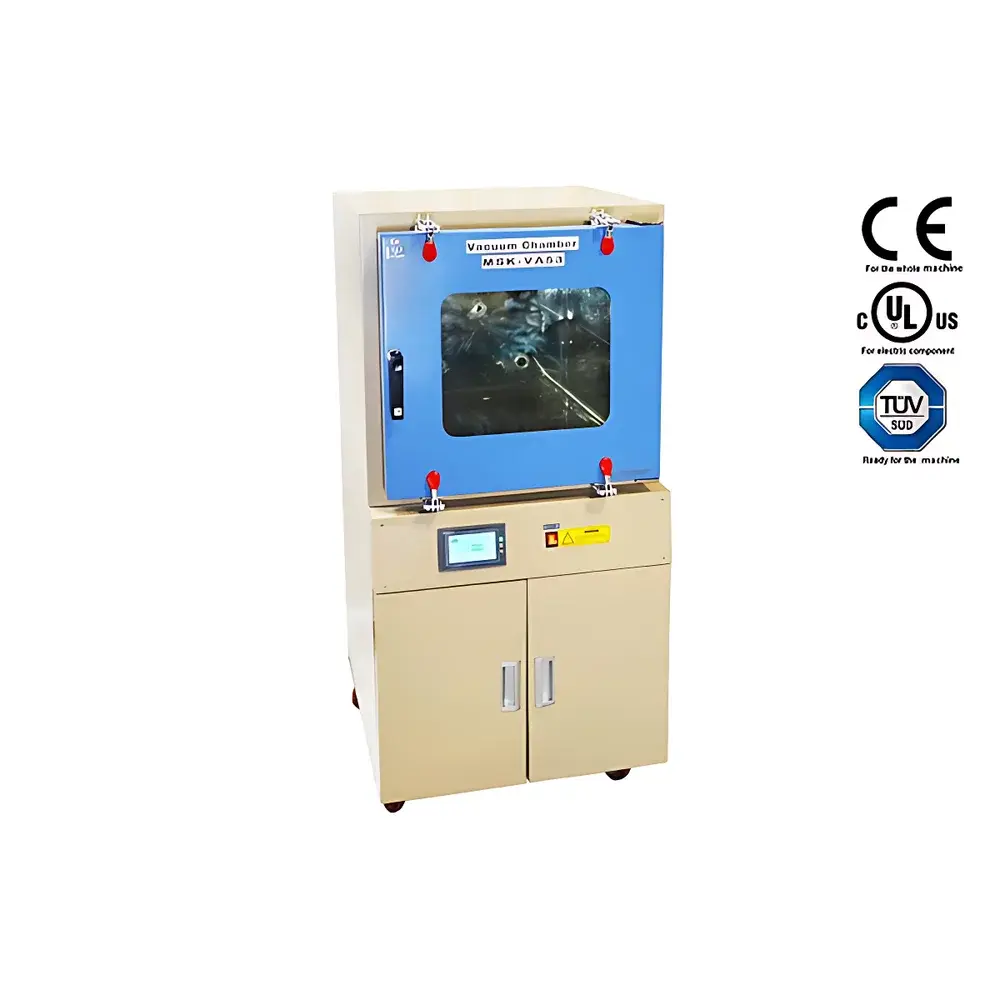
KJ GROUP MSK-VA53 Explosion-Proof Vacuum Storage Chamber (53 L)
| Brand | KJ GROUP |
|---|---|
| Origin | Liaoning, China |
| Manufacturer Type | Authorized Distributor |
| Country of Origin | China |
| Model | MSK-VA53 |
| Pricing | Upon Request |
| Chamber Volume | 53 L |
| Construction Material | 304 Stainless Steel + Explosion-Resistant Tempered Glass |
| Operating Temperature | Ambient (20–25 °C) |
| Ultimate Vacuum | < 1000 Pa (7.5 mTorr) |
| Pressure Control Setpoint | 11.6 kPa (87 Torr) |
| Vacuum Pump | Integrated Dual-Stage Rotary Vane Pump, 226 L/min Pumping Speed |
| Control System | PLC-Based with 6" Touchscreen HMI |
| Power Supply | 110/220 VAC, 50/60 Hz |
| Certification | CE Compliant |
| External Dimensions | 710 × 560 × 550 mm |
| Internal Chamber Dimensions | 415 × 345 × 370 mm |
| Warranty | 12 Months (Parts & Labor), Lifetime Technical Support |
Overview
The KJ GROUP MSK-VA53 Explosion-Proof Vacuum Storage Chamber is an engineered environmental test and storage system designed for controlled low-pressure operation in safety-critical applications—particularly lithium-ion battery development, qualification testing, and long-term vacuum stabilization of sensitive electrochemical components. It operates on the principle of active vacuum generation and closed-loop pressure regulation, utilizing a built-in dual-stage rotary vane pump to achieve and maintain precise sub-atmospheric conditions inside a hermetically sealed chamber. The system meets the mechanical and operational requirements outlined in UN Manual of Tests and Criteria, Part III, Section 38.3.4.1 (Altitude Simulation Test), enabling standardized evaluation of cell integrity, electrolyte volatility, and seal performance under simulated high-altitude conditions (equivalent to ~15,000 m). Its explosion-proof architecture—including 304 stainless steel structural housing and laminated anti-shatter tempered glass viewing window—ensures physical containment during potential thermal runaway events, making it suitable for use in R&D labs, QC facilities, and pilot-scale battery manufacturing environments where functional safety and regulatory traceability are mandatory.
Key Features
- Integrated dual-stage rotary vane vacuum pump (226 L/min nominal pumping speed) eliminates need for external vacuum sources and ensures rapid evacuation cycles.
- PLC-based control system with 6-inch resistive touchscreen HMI enables intuitive programming of vacuum setpoints, dwell times, ramp rates, and multi-step profiles.
- Real-time digital pressure monitoring and closed-loop PID regulation maintain stable chamber pressure at user-defined levels (e.g., 11.6 kPa ±0.3 kPa) with repeatability better than ±0.5% FS over extended durations.
- Explosion-resistant construction: 304 stainless steel chamber body rated for static overpressure up to 0.5 MPa; laminated tempered glass viewport certified to IEC 62471 for impact resistance and thermal shock tolerance.
- Zero-leakage chamber design verified via helium mass spectrometry leak testing (<1×10⁻⁹ mbar·L/s), ensuring long-term vacuum integrity without manual intervention.
- CE-marked electrical architecture compliant with EN 61000-6-2 (immunity) and EN 61000-6-4 (emission) standards; internal wiring conforms to IEC 60204-1 for industrial machinery safety.
Sample Compatibility & Compliance
The MSK-VA53 accommodates cylindrical, prismatic, and pouch-format lithium-ion cells (up to 300 mm height), battery modules (≤40 kg), and ancillary test fixtures such as thermocouple arrays, gas sampling ports, and vent tube interfaces. Chamber interior geometry allows unobstructed access for insertion/removal while maintaining uniform pressure distribution. The system supports compliance workflows aligned with UN 38.3, IEC 62133-2, UL 1642, and GB/T 31485–2015. All operational parameters—including pressure setpoints, cycle timestamps, pump runtime, and alarm logs—are timestamped and stored locally, supporting GLP/GMP documentation requirements. Though not inherently 21 CFR Part 11 compliant, audit-ready data export (CSV/Excel) and optional password-protected user roles facilitate integration into validated laboratory information management systems (LIMS).
Software & Data Management
The embedded HMI firmware provides local data logging at 1-second intervals for pressure, elapsed time, pump status, and temperature (via optional PT100 sensor input). Historical datasets are retained onboard for ≥30 days and exportable via USB 2.0 interface. No cloud connectivity or remote access capabilities are included by default—consistent with secure lab network policies. For traceability, each test record includes operator ID (manually entered), batch identifier, and digital signature confirmation prior to profile execution. Firmware updates are delivered via encrypted USB stick and require administrative authentication, ensuring version control and change management per ISO/IEC 17025 Clause 5.9.
Applications
- Lithium-ion battery altitude simulation testing per UN 38.3.4.1 (low-pressure exposure at 11.6 kPa for ≥6 hours).
- Vacuum degassing of electrode slurries and separator coatings prior to calendaring or lamination.
- Controlled atmosphere storage of moisture-sensitive cathode/anode materials (e.g., NMC, Li-metal, sulfur composites).
- Accelerated aging studies involving combined vacuum and ambient thermal stress.
- Leak integrity verification of hermetically sealed battery cells and module housings.
- Pre-conditioning of sensors, optical components, and MEMS devices requiring outgassing stabilization.
FAQ
Does the MSK-VA53 support automated pass/fail reporting for UN 38.3 tests?
No. The system records raw pressure vs. time data but does not perform algorithmic pass/fail evaluation. Users must compare logged profiles against UN 38.3 acceptance criteria manually or via external analysis software.
Can the vacuum setpoint be adjusted below 11.6 kPa?
Yes—the controller allows user-defined setpoints from 1 kPa to atmospheric pressure (101.3 kPa); however, sustained operation below 1 kPa requires extended pump runtime and may affect long-term pump oil life.
Is the chamber suitable for inert gas purging?
Not natively. The MSK-VA53 lacks gas inlet/outlet valves and flow controllers. Retrofitting requires third-party engineering validation and voids CE certification.
What maintenance is required for the integrated vacuum pump?
Oil changes every 500 operating hours or annually (whichever occurs first); inlet filter cleaning every 100 hours; periodic calibration of the piezoresistive pressure transducer using NIST-traceable reference standards.
Can multiple MSK-VA53 units be synchronized for parallel testing?
No. Each unit operates independently with no inter-unit communication protocol or master-slave configuration capability.



