
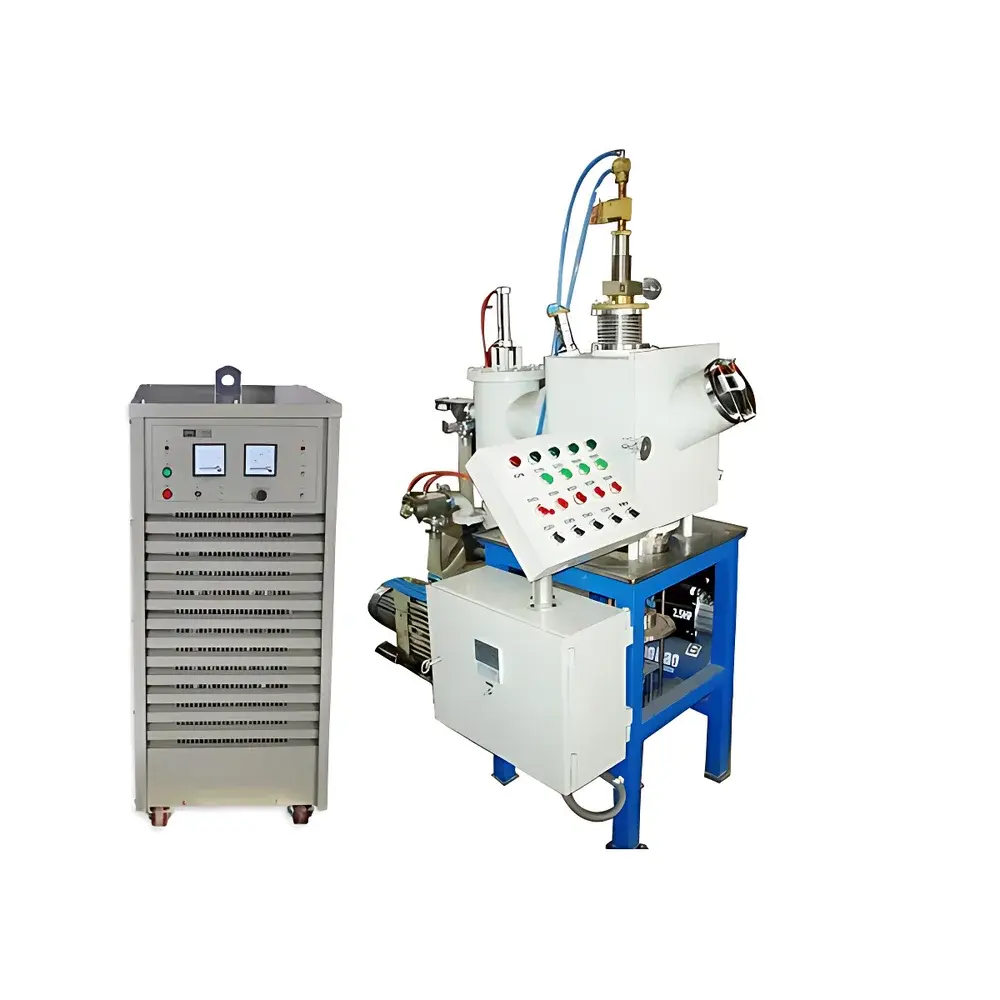
KJ GROUP MSM-250/250A Non-Consumable Vacuum Arc Melting Furnace
| Brand | KJ GROUP |
|---|---|
| Origin | Liaoning, China |
| Manufacturer Type | Authorized Distributor |
| Country of Origin | China |
| Model | MSM-250/250A |
| Capacity (as steel) | 0.25 kg |
| Tilt Capability | Yes (for ingot casting) |
| Pressure Rise Rate | 0.133 Pa/min |
| Ultimate Vacuum | 6×10⁻³ Pa |
| Operating Vacuum | 6×10⁻² Pa |
| Input Power | 380 V, 3-phase, 50 Hz |
| Rated Power | 34 kW |
| Output Current | 1000 A |
| Output Voltage | 34 V |
| Cooling Water Consumption | 0.8 m³/h |
| Cooling Water Pressure | 0.2 MPa |
| Inlet Water Temperature | 20 °C |
Overview
The KJ GROUP MSM-250/250A Non-Consumable Vacuum Arc Melting Furnace is a laboratory-scale metallurgical processing system engineered for high-purity alloy synthesis under controlled vacuum or inert gas atmospheres. It operates on the principle of direct-current (DC) non-consumable electrode arc melting—where a high-current, low-voltage arc is struck between a water-cooled tungsten or molybdenum upper electrode and a conductive metallic charge placed in a refractory crucible on the lower electrode. Unlike consumable arc furnaces, the upper electrode remains intact during operation, eliminating contamination from electrode erosion and enabling precise stoichiometric control over alloy composition. Designed for research-intensive environments—including university materials science departments, national laboratories, and advanced metallurgy R&D centers—the furnace supports batch processing of 20–250 g of reactive or refractory metals (e.g., Ti, Zr, Nb, Ta, Ni-based superalloys, and rare-earth-containing intermetallics) with minimal oxidation, nitrogen pickup, or carbon ingress. Its dual-chamber vacuum architecture, integrated thermal management, and fail-safe interlocks ensure reproducible melt homogeneity, solidification microstructure control, and compliance with foundational requirements for GLP-compliant alloy development workflows.
Key Features
- Double-walled, water-cooled stainless steel/carbon steel hybrid furnace body with optimized thermal inertia and structural rigidity for stable arc ignition and sustained high-current operation.
- Adjustable vertical positioning of both upper and lower electrodes: upper electrode traverses via precision lead-screw mechanism; lower electrode lifts vertically and fully withdraws for rapid crucible exchange—minimizing downtime between runs.
- Seven-position crucible holder (standard) with optional tilting mechanism (MSM-250A variant) enabling directional solidification and gravity-fed ingot casting into copper molds under vacuum or argon backfill.
- Dual-stage vacuum system comprising a 2X-30 mechanical rotary vane pump and a K-200 oil diffusion pump, supported by water-cooled baffle, electromagnetic vent valve (prevents oil backstreaming during power loss), and calibrated leak-tightness verification per ISO 2859-1 sampling protocols.
- SCR-controlled DC power supply delivering up to 1000 A at 34 V with real-time current regulation, overcurrent cutoff, and integrated coolant flow monitoring with automatic shutdown on flow interruption or temperature deviation beyond ±2 °C of setpoint.
- Two borosilicate observation ports fitted with DIN-certified #10 shade filter glass (EN 171:2002 compliant) for safe visual arc stabilization and melt pool monitoring without compromising vacuum integrity.
Sample Compatibility & Compliance
The MSM-250/250A accommodates a wide range of conductive feedstock forms—including elemental powders, pre-alloyed granules, chip turnings, and master alloy segments—provided bulk resistivity remains below 100 µΩ·cm. Crucibles are supplied in high-purity graphite, tungsten, or water-cooled copper variants depending on melting point and reactivity requirements. The system meets essential safety and performance benchmarks outlined in ASTM F2697-20 (Standard Guide for Vacuum Metallurgical Processing), ISO 14001 environmental interface provisions for oil-based pumping systems, and EU Machinery Directive 2006/42/EC for interlocked access and emergency stop functionality. All vacuum and cooling circuit components are rated for continuous operation at 0.2 MPa pressure and certified to ASME B31.9 for low-pressure piping systems.
Software & Data Management
While the base configuration features analog current/voltage meters and manual vacuum gauge readouts, optional digital instrumentation packages include RS-485 Modbus RTU interfaces for integration into centralized lab automation platforms. Optional data logging modules record time-stamped values for arc current, chamber pressure, cooling water temperature differential, and electrode position at 1 Hz resolution—supporting traceability requirements under FDA 21 CFR Part 11 when paired with validated electronic signature workflows. All firmware adheres to IEC 61508 SIL-2 functional safety standards for critical protection circuits.
Applications
- Synthesis of prototype refractory metal alloys (e.g., Mo–Si–B, Nb–Ti–Si) for aerospace turbine component evaluation.
- Preparation of master alloys for subsequent investment casting or powder metallurgy feedstock production.
- Phase diagram validation studies requiring rapid, repeatable remelting of multi-component systems under identical thermal histories.
- Isotopic tracer experiments in nuclear materials research where ultra-low background contamination is mandatory.
- Development of amorphous precursor alloys via rapid quenching from arc-melted buttons using twin-roller or melt-spinning attachments.
FAQ
What types of electrodes are compatible with this furnace?
Tungsten, molybdenum, or thoriated tungsten rods (6–12 mm diameter) are recommended for upper electrodes; lower electrodes are typically water-cooled copper or graphite blocks designed for direct contact with crucibles.
Can the furnace operate under inert gas instead of vacuum?
Yes—equipped with precision mass flow controllers and pressure-regulated gas inlet manifolds, it supports argon or helium partial pressures from 10⁻² to 10⁵ Pa with automated purge cycles and residual oxygen monitoring down to 10 ppm.
Is remote operation supported?
With optional PLC-based control upgrade, full start/stop sequencing, parameter ramping, and alarm acknowledgment can be executed via Ethernet-connected HMI or SCADA systems compliant with OPC UA 1.04.
What maintenance intervals are recommended for the diffusion pump?
Oil replacement every 1,000 operational hours; baffle cleaning every 200 hours; cold trap regeneration before each high-vacuum campaign per manufacturer’s logbook protocol.
Does the system include calibration certificates for vacuum gauges and thermocouples?
Factory-calibrated Pirani and cold cathode gauges are supplied with NIST-traceable calibration reports; Type-K thermocouples are provided with as-received tolerance documentation per IEC 60584-2 Class 2 specifications.



