
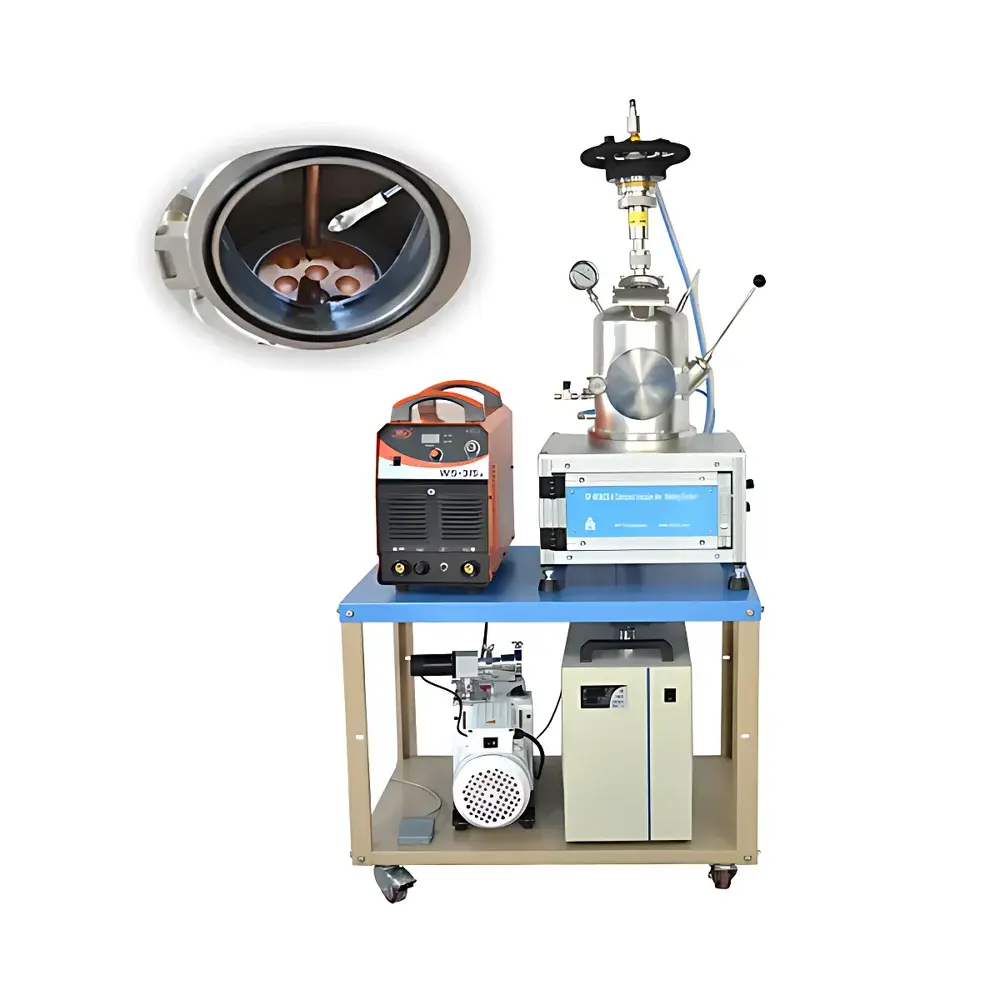
KJ GROUP MSM20-7 Non-Consumable Miniature Metal Arc Melting Furnace
| Brand | KJ GROUP |
|---|---|
| Origin | Liaoning, China |
| Manufacturer Type | Authorized Distributor |
| Country of Origin | China |
| Model | MSM20-7 |
| Dimensions (L×W×D) | 1500 mm × 600 mm × 700 mm |
| Temperature Control Accuracy | ±5 °C (inferred from industrial arc furnace standards |
| Maximum Operating Temperature | 3500 °C |
| Sample Capacity | 7 parallel crucibles (Ø25 mm × 8 mm depth) |
| Vacuum Chamber | Ø200 mm × 300 mm |
| Base Vacuum (with VRD rotary vane pump) | 1 × 10⁻³ mbar |
| High-Vacuum Option (with GZK-103D molecular pump) | 1 × 10⁻⁵ mbar |
| Arc Current Range | 20–315 A |
| Cooling | Integrated KJ-5000 closed-loop deionized water chiller |
| Protective Atmosphere | High-purity argon (≥99.99%) |
| Power Supply | AC 380 V, 50 Hz, ≤12 kW |
| Net Weight | 50 kg |
Overview
The KJ GROUP MSM20-7 Non-Consumable Miniature Metal Arc Melting Furnace is a compact, high-vacuum, direct-current (DC) arc melting system engineered for precise synthesis and purification of refractory and reactive metals and alloys under inert or reduced-pressure atmospheres. Unlike consumable electrode furnaces, the MSM20-7 employs a non-consumable tungsten (W) cathode—selected for its exceptional melting point (3422 °C) and thermal stability—which generates a localized plasma arc exceeding 3500 °C upon ignition. This enables homogeneous melting of high-melting-point elements including Mo, Nb, Ta, Ti, Zr, and their intermetallic compounds without electrode contamination. The furnace operates within a sealed stainless-steel vacuum chamber (Ø200 mm × 300 mm), capable of base pressures down to 1 × 10⁻³ mbar using the included VRD rotary vane pump, or as low as 1 × 10⁻⁵ mbar when upgraded with the optional GZK-103D turbomolecular pumping station. All critical thermal components—including the copper crucible array, tungsten electrode assembly, and vacuum flange interfaces—are actively cooled via a dedicated closed-loop deionized water chiller (KJ-5000), ensuring long-term thermal stability and structural integrity during repeated high-current melting cycles.
Key Features
- Seven independent Ø25 mm × 8 mm deep copper crucibles mounted on a rotating carousel—enabling simultaneous preparation of up to seven alloy samples with zero cross-contamination.
- Non-consumable tungsten electrode with precision manual height adjustment via ergonomic steering-wheel mechanism; arc initiation and current regulation are fully decoupled for reproducible plasma ignition and stable melt pool control.
- Dual quartz observation windows (front and rear) with integrated LED illumination ports allow real-time visual monitoring of arc formation, melt homogeneity, and solidification behavior without vacuum break.
- Mechanized sample flipping arm—actuated remotely—permits in-situ re-melting of ingots under continuous argon protection, essential for compositional homogenization of multi-pass alloys such as high-entropy alloys (HEAs) and Ni-based superalloys.
- Integrated vacuum gauging: standard analog Pirani gauge for rough vacuum; optional EQ-PCG-554 digital capacitance manometer (range: 3.8 × 10⁻⁵ Torr to 1125 Torr) supports GLP-compliant pressure logging and audit trails.
- Modular design accommodates optional accessories including metal sealing tube kits (for air-sensitive quenching) and the MSM20-8 suction-casting module for rapid solidification studies.
Sample Compatibility & Compliance
The MSM20-7 is validated for use with metals and alloys whose melting points fall below tungsten’s—covering >98% of commercially relevant elemental metals (Fe, Co, Ni, Al, Cu, Mg, Ti, Zr, Nb, Mo, Ta, W, Cr, V, Mn, Si, B) and complex multi-principal-element systems. It complies with ISO 27327:2012 (vacuum equipment safety), ASTM F2657-20 (arc melting practice for refractory metals), and supports Good Laboratory Practice (GLP) workflows through traceable vacuum logging, calibrated current feedback, and documented atmosphere integrity checks. Argon gas purity ≥99.99% is required to prevent oxide inclusion formation; inlet fittings conform to ISO 8573-1 Class 2 compressed gas quality standards. The system meets IEC 61000-6-3 (EMC emission) and IEC 61000-6-2 (immunity) requirements for laboratory environments.
Software & Data Management
While the base MSM20-7 operates via analog front-panel controls (arc current potentiometer, vacuum valve actuators, cooling flow indicator), optional digital integration packages enable RS-485/Modbus RTU communication with third-party SCADA or LIMS platforms. When equipped with the EQ-PCG-554 vacuum sensor and external data acquisition hardware, users may generate time-stamped CSV logs compliant with FDA 21 CFR Part 11 Annex 11 requirements—including electronic signatures, audit trails, and user-access-level permissions. All cooling parameters (inlet/outlet temperature differential, flow rate ≥3.5 L/min) are monitored continuously to prevent thermal runaway; alarm thresholds trigger automatic arc shutdown and audible alerts per IEC 61508 SIL-2 functional safety guidelines.
Applications
- Synthesis and compositional refinement of high-entropy alloys (HEAs), bulk metallic glasses (BMGs), and refractory metal intermetallics (e.g., Nb–Si, Mo–Si–B).
- Preparation of master alloys for subsequent casting, powder metallurgy, or additive manufacturing feedstock qualification.
- Controlled stoichiometric blending of rare-earth-containing alloys (e.g., Nd–Fe–B, Sm–Co) under oxygen-free conditions.
- Rapid prototyping of composition-gradient libraries for combinatorial materials discovery.
- Purification of scrap or recycled metal feedstocks via volatile impurity volatilization under dynamic vacuum sweeps.
- Thermophysical property calibration—e.g., solidus/liquidus determination via high-speed pyrometry coupled with synchronized current ramping.
FAQ
What vacuum level is required before initiating arc melting?
A base pressure ≤5 × 10⁻³ mbar is recommended prior to backfilling with argon; this minimizes residual O₂ and H₂O partial pressures to <1 ppm, preventing oxidation and hydrogen embrittlement.
Can the crucible geometry be customized beyond the standard Ø25 mm size?
Yes—KJ GROUP offers OEM crucible machining services for custom diameters (Ø15–Ø40 mm), depths (5–15 mm), and material variants (oxygen-free copper, graphite, or water-cooled molybdenum) upon request with NDA compliance.
Is the system compatible with automated process scripting?
The furnace supports external TTL-triggered arc ignition and programmable current ramping via optional PLC interface modules (e.g., Siemens S7-1200); full recipe automation requires integration with KJ’s EQ-MELT control software suite (sold separately).
What maintenance intervals are recommended for the tungsten electrode?
Visual inspection after every 20 melting cycles; tip resharpening or replacement is advised when crater depth exceeds 0.8 mm or arcing becomes unstable at nominal current settings.
Does the system include validation documentation for ISO/IEC 17025 accreditation?
Factory-assembled IQ/OQ protocols and as-tested calibration certificates (current output, vacuum gauge linearity, cooling flow verification) are provided; PQ execution requires site-specific installation under certified metrology supervision.



