
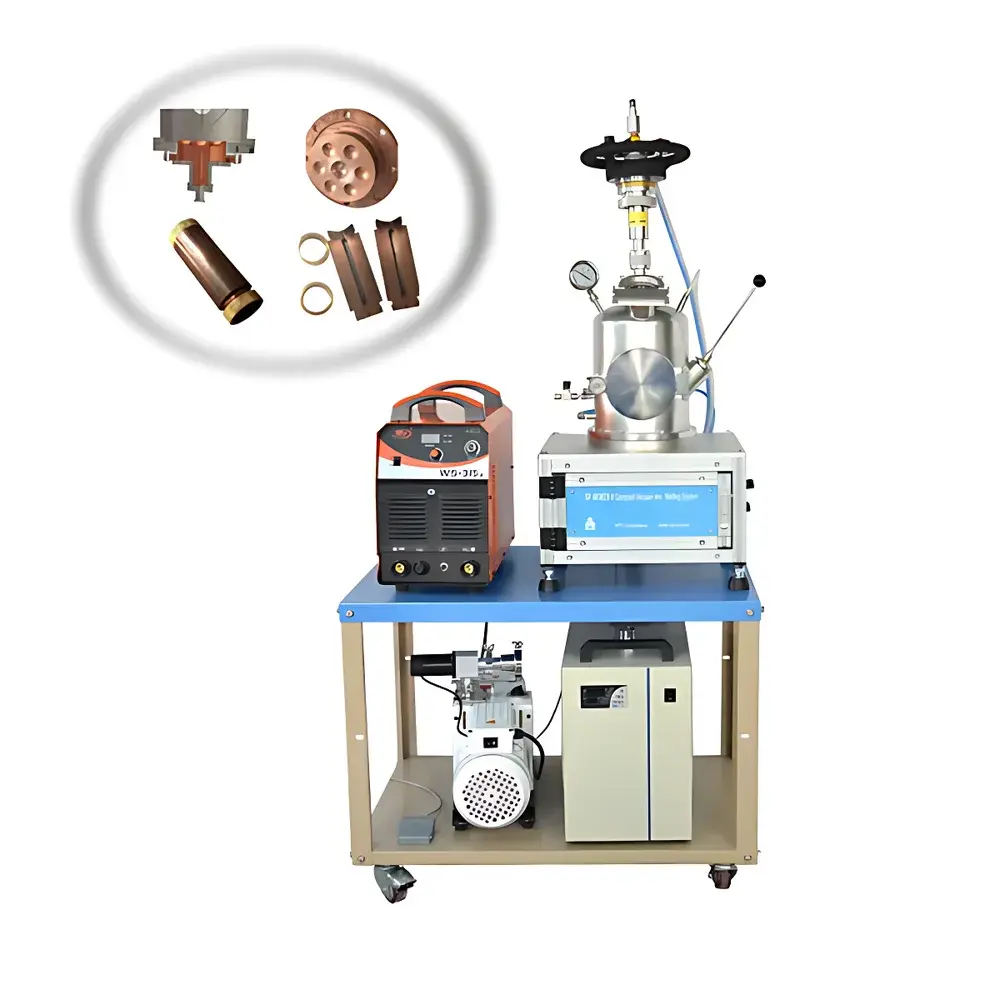
KJ GROUP MSM20-8 Non-Consumable Miniature Arc Melting & Suction Casting Furnace
| Brand | KJ GROUP |
|---|---|
| Origin | Liaoning, China |
| Manufacturer Type | Authorized Distributor |
| Origin Category | Domestic |
| Model | MSM20-8 |
| Quotation | Upon Request |
| Power Supply | AC 380 V, 50 Hz |
| Total Power | <12 kW |
| Vacuum Chamber | Ø200 mm × 300 mm |
| Standard Crucible Configuration | 7-position copper crucible tray (6 × Ø20 mm × 8 mm + 1 suction-casting position Ø6 mm) |
| Crucible Capacity | 8 g (stainless steel, per Ø20×8 mm crucible) |
| suction-cast sample | Ø6 mm × ≤75 mm (15 g stainless steel) |
| Optional Crucibles | 1 × Ø40 mm × 8 mm (50 g), 4 × Ø25 mm × 12.5 mm (20 g each), suction-cast Ø10 mm × 75 mm (15 g) |
| Base Vacuum | ≤1 × 10⁻³ mbar (with rotary vane pump) |
| High Vacuum Option | ≤1 × 10⁻⁵ mbar (with turbomolecular pump system) |
| Non-Consumable Electrode | Ø4 mm tungsten rod (W) |
| Max Operating Temperature | >3500 °C |
| Arc Current Range | 20–315 A |
| Cooling | Integrated closed-loop deionized water chiller (included) |
| Gas Atmosphere | High-purity argon (≥99.99%) |
| Dimensions (L×W×H) | 900 mm × 600 mm × 1800 mm (including frame) |
| Net Weight | 50 kg |
| Ambient Requirements | Altitude ≤1000 m |
Overview
The KJ GROUP MSM20-8 Non-Consumable Miniature Arc Melting & Suction Casting Furnace is a compact, high-precision laboratory-scale arc melting system engineered for controlled metallurgical synthesis under inert atmosphere. It operates on the principle of direct-current (DC) arc discharge between a non-consumable tungsten electrode and a conductive metal charge within a water-cooled copper crucible, generating localized temperatures exceeding 3500 °C—sufficient to melt refractory metals including titanium, nickel-based superalloys, zirconium, molybdenum, and rare-earth intermetallics. Unlike consumable-electrode furnaces, the MSM20-8 employs a fixed tungsten cathode, eliminating electrode contamination and enabling reproducible stoichiometry in multi-pass remelting protocols. Its integrated mechanical flipping mechanism allows sequential re-melting of solidified ingots without breaking vacuum or inert gas integrity—critical for oxygen- and nitrogen-sensitive alloy systems. Designed for academic and R&D environments, the furnace supports both static button casting and suction-casting into graphite or copper molds, facilitating rapid prototyping of compositionally graded samples, master alloys, and small-batch reference standards.
Key Features
- Non-consumable tungsten electrode (Ø4 mm) ensures long-term arc stability and eliminates elemental contamination from electrode erosion.
- 7-position rotating crucible tray with six Ø20 mm × 8 mm melting stations and one dedicated Ø6 mm suction-casting port—enabling parallel synthesis of up to six independent alloy compositions per cycle.
- Integrated mechanical flipping arm permits precise 180° inversion of solidified ingots inside the sealed chamber, supporting ≥3 consecutive remelting cycles without gas exchange or vacuum venting.
- Water-cooled vacuum chamber (Ø200 mm × 300 mm), copper crucibles, and electrode assembly maintain thermal stability and structural integrity during repeated high-current arcing.
- Front and rear quartz viewports (tempered, AR-coated) allow real-time visual monitoring of arc ignition, melt pool dynamics, and surface homogeneity.
- Large Ø120 mm front access door with double O-ring seal enables rapid sample loading/unloading while preserving chamber integrity.
- Manual height adjustment via ergonomic steering-wheel handle provides fine vertical positioning of the electrode relative to the crucible base.
- Self-contained closed-loop deionized water chiller (included) maintains coolant temperature at ≤25 °C with flow rate ≥12 L/min—meeting ASTM E1227 thermal management requirements for arc melting systems.
Sample Compatibility & Compliance
The MSM20-8 accommodates metallic feedstock in button, chip, or granular form—including pure elements (Fe, Ni, Co, Al, Ti, Cu, Zr), master alloys, and pre-alloyed powders—with melting point limits governed only by tungsten’s thermionic emission threshold (~3680 °C). It is routinely used for preparing ASTM E8/E21-compliant tensile test coupons, ISO 11577 reference specimens, and USP metal particulate standards. The system complies with IEC 61000-6-2 (immunity) and IEC 61000-6-4 (emission) for laboratory electromagnetic compatibility. All vacuum components conform to ISO 15732:2016 dimensional standards for UHV flanges. When operated with optional turbomolecular pumping and residual gas analyzers, the furnace supports GLP-compliant documentation of chamber base pressure, gas purity logs, and arc current profiles—aligning with FDA 21 CFR Part 11 data integrity expectations for regulated materials development.
Software & Data Management
While the MSM20-8 operates via analog/manual control architecture—prioritizing operational transparency and failure-mode resilience—it integrates seamlessly with third-party data acquisition systems via 0–10 V analog outputs for arc current, chamber pressure, and coolant temperature. Optional RS485 Modbus RTU interface (available upon request) enables programmable sequencing of current ramping, dwell times, and gas purge cycles through LabVIEW™ or Python-based control scripts. All configuration settings, operator ID, and session timestamps can be logged externally to meet ISO/IEC 17025 audit traceability requirements. Vacuum gauge readings (with optional Pirani/cold cathode or capacitance manometer) are compatible with common SCADA platforms for centralized facility monitoring.
Applications
- Rapid screening of multi-component alloy systems (e.g., high-entropy alloys, bulk metallic glasses) requiring compositional iteration across ≤7 variants per run.
- Refining reactive metals (e.g., Ti, Zr, Mg) under ultra-high-purity argon to minimize interstitial pickup (O, N, C) below ASTM F2885 limits.
- Preparation of calibration standards for XRF, SEM-EDS, and spark-OES analysis—leveraging high homogeneity achieved through repeated flipping and stirring convection.
- Synthesis of intermetallic compounds (e.g., NiAl, FeAl, MoSi₂) where phase segregation must be minimized via controlled cooling rates post-suction casting.
- Teaching laboratories: Demonstrating arc plasma physics, metallurgical phase transformations, and inert-atmosphere handling protocols per ASM International curriculum guidelines.
FAQ
What vacuum level is required before initiating arc melting?
A base pressure ≤5 × 10⁻³ mbar is recommended prior to backfilling with argon to ensure minimal residual oxygen and hydrocarbon partial pressures—critical for preventing oxide inclusion formation.
Can the furnace be upgraded to UHV conditions?
Yes. The standard chamber features CF-63 and CF-100 flanges compatible with turbomolecular pumps, cryopanels, and bake-out heaters. With optional molecular pump + ion getter assembly, ultimate pressure ≤2 × 10⁻⁸ mbar is achievable.
Is remote operation or automation supported?
The base unit is manually operated; however, all analog I/O signals are exposed at terminal blocks, allowing integration with PLCs or custom controllers for automated current ramping, timed flipping, and safety interlocks.
What maintenance intervals are recommended for the tungsten electrode?
Electrode tip geometry should be inspected after every 20–30 melts. Minor pitting or blunting can be restored using diamond lapping film (600–1200 grit); full replacement is advised after ≥100 high-current (>250 A) cycles.
Does the system comply with CE or UL safety directives?
The MSM20-8 meets CE marking requirements under the Machinery Directive 2006/42/EC and Low Voltage Directive 2014/35/EU when installed per KJ GROUP’s site preparation specifications—including mandatory grounding, argon leak testing, and chiller flow verification.



