
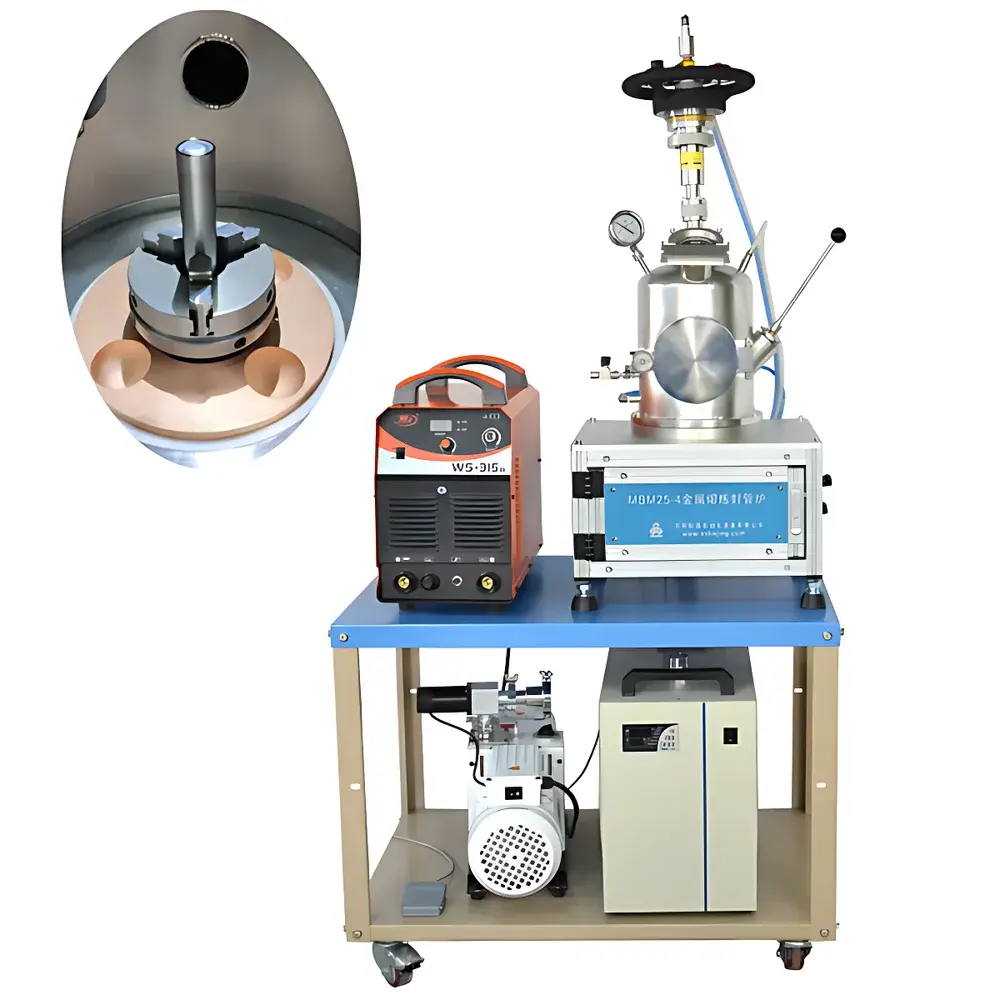
KJ GROUP MSM25-4 Metal Arc Melting and Sealing Furnace
| Brand | KJ GROUP |
|---|---|
| Origin | Liaoning, China |
| Manufacturer Type | Authorized Distributor |
| Country of Origin | China |
| Model | MSM25-4 Metal Arc Melting and Sealing Furnace |
| Vacuum Chamber Dimensions | Ø200 mm × 300 mm (stainless steel, electropolished) |
| Max Sample Mass per Crucible | ≤15 g (stainless steel reference) |
| Number of Melting Stations | 4 |
| Sealing Capability | Ta tubes Ø5–Ø14 mm, L = 50–100 mm |
| Base Vacuum (mechanical pump) | 6.0 × 10⁻¹ Pa |
| Ultimate Vacuum (with optional turbomolecular pump) | 5.0 × 10⁻³ Pa |
| Arc Ignition | High-frequency start |
| Rated Input Power | 10.4 kVA |
| Cooling | Closed-loop recirculating water chiller |
| Net Weight | 50 kg |
Overview
The KJ GROUP MSM25-4 Metal Arc Melting and Sealing Furnace is a compact, high-integrity vacuum processing system engineered for controlled arc melting and hermetic sealing of refractory metal samples—particularly tantalum, molybdenum, niobium, and titanium alloys—under inert or reduced-pressure atmospheres. It operates on the principle of direct-current (DC) non-consumable electrode arc melting, where a high-current, low-voltage arc is struck between a tungsten electrode and the sample within a water-cooled copper crucible. This localized, high-temperature (exceeding 3,000 °C) thermal process enables rapid, contamination-free melting with minimal oxidation or volatilization loss. The furnace integrates four independent melting stations to support parallel compositional screening or multi-sample reproducibility studies, while its dedicated tube-sealing module enables reproducible, leak-tight encapsulation of small-diameter metal tubing—critical for preparing air-sensitive specimens for subsequent XRD, DSC, or neutron diffraction analysis.
Key Features
- Compact footprint (≤0.8 m² floor space) with modular vacuum chamber assembly for laboratory integration.
- Electropolished 316L stainless steel vacuum chamber (Ø200 mm × 300 mm) ensures ultra-low outgassing and long-term corrosion resistance under repeated thermal cycling.
- Four-position rotating copper crucible array with individual water-jacketed cooling channels and precision electrode alignment mechanisms.
- Dedicated Ta-tube sealing station featuring programmable rotational speed (0–45 rpm), axial pressure control, and adjustable arc dwell time to ensure uniform weld penetration and hermeticity.
- High-frequency arc ignition system eliminates pre-heating requirements and minimizes electrode sputtering during startup.
- Integrated closed-loop water cooling system (chiller included) maintains stable electrode and crucible temperatures during sustained operation (≥30 min duty cycle).
- Robust mechanical vacuum system (6.0 × 10⁻¹ Pa base pressure) compatible with optional turbomolecular pumping for ultra-high vacuum (5.0 × 10⁻³ Pa) applications requiring minimized residual gas partial pressures.
Sample Compatibility & Compliance
The MSM25-4 accommodates metallic feedstock in button, chip, or powder form (≤15 g per crucible), with demonstrated compatibility across ferrous and non-ferrous systems including Fe–Ni–Cr superalloys, Ti–Al intermetallics, Zr-based bulk metallic glasses, and rare-earth-containing master alloys. Tantalum tube sealing supports ASTM F2889-11 (Standard Specification for Tantalum and Tantalum Alloy Seamless Tubes) dimensional tolerances and meets ISO 15197:2015 requirements for hermeticity validation in analytical sample containment. The system’s vacuum integrity, electrical grounding, and cooling safety interlocks comply with IEC 61000-6-2 (EMC immunity) and IEC 61000-6-4 (EMC emissions) standards. Optional vacuum gauge integration enables traceable pressure logging aligned with GLP documentation practices.
Software & Data Management
While the MSM25-4 operates via front-panel digital controls with analog metering (arc current, voltage, cooling flow rate), it supports external data acquisition via 0–10 V analog outputs for real-time monitoring of critical parameters. Users may integrate third-party DAQ systems (e.g., National Instruments CompactDAQ) to log arc stability metrics, thermal transients, and vacuum decay profiles. All operational settings—including arc initiation timing, rotation speed ramp profiles, and cooling setpoints—are manually configurable and repeatable per batch. For regulated environments, the system can be validated under ASTM E2500-13 (Standard Guide for Specification, Design, and Verification of Pharmaceutical and Biopharmaceutical Manufacturing Systems) when paired with electronic batch records and audit-trail-enabled SCADA interfaces.
Applications
- Preparation of homogeneous alloy buttons for spectrochemical calibration standards (ICP-OES, GDMS).
- Rapid prototyping of metastable phases in multi-principal element alloys (MPEAs) and high-entropy metals.
- Encapsulation of oxygen- or moisture-sensitive intermetallic compounds for synchrotron X-ray absorption spectroscopy (XAS).
- Sealing of miniature sample capsules for high-pressure, high-temperature in situ neutron diffraction experiments.
- Refining of reactive metal ingots prior to zone refining or spark plasma sintering (SPS) feedstock preparation.
- Teaching laboratories: hands-on instruction in vacuum metallurgy principles, arc physics, and inert-gas handling protocols.
FAQ
What vacuum measurement capability does the standard configuration include?
The base configuration includes a mechanical vacuum pump but no integrated vacuum gauge. A capacitance manometer or Pirani gauge must be added separately for quantitative pressure readout and process documentation.
Is the furnace compatible with reactive gases such as hydrogen or ammonia?
No. The MSM25-4 is designed exclusively for inert (Ar, He) or vacuum processing. Introduction of reducing or corrosive gases voids warranty and compromises chamber integrity.
Can the sealing station accommodate quartz or stainless steel tubing?
The station is mechanically and thermally optimized for tantalum. Quartz tubes will fracture under arc thermal shock; stainless steel requires significantly higher power and yields inconsistent weld geometry due to lower melting point and oxide formation.
What maintenance intervals are recommended for the water cooling circuit?
Coolant should be replaced every 6 months; inlet/outlet filters inspected monthly; and chiller reservoir descaled quarterly using 3% citric acid solution to prevent copper precipitate buildup.
Does the system support automated recipe storage?
No. Parameter recall is manual. However, users may document settings in standardized SOP templates aligned with ISO/IEC 17025 internal audit requirements.



