
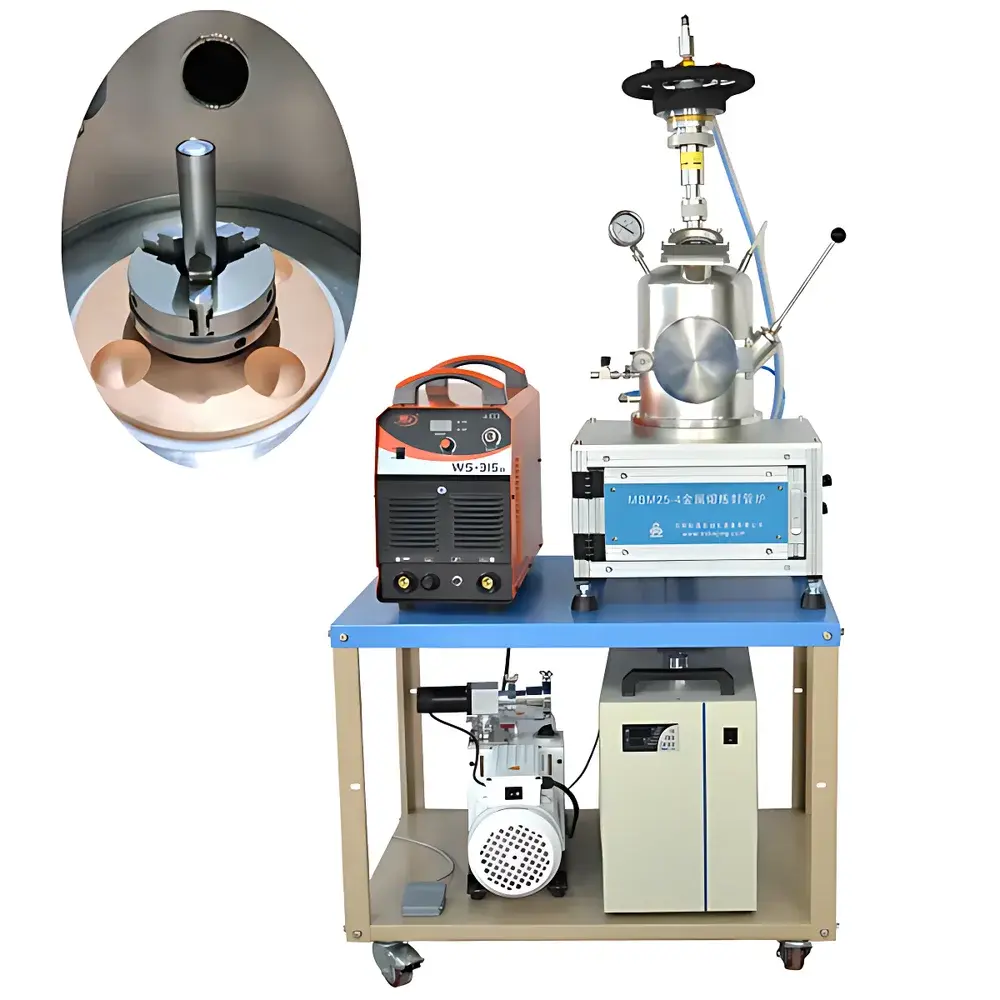
KJ GROUP MSM25-4 Metal Arc Melting and Sealing Furnace
| Brand | KJ GROUP |
|---|---|
| Origin | Liaoning, China |
| Manufacturer Type | Authorized Distributor |
| Country of Origin | China |
| Model | MSM25-4 |
| Quotation | Available upon Request |
| Arc Melting Chamber | Ø200 mm × 300 mm (electropolished stainless steel) |
| Max Sample Mass per Crucible | ≤15 g (calibrated with stainless steel) |
| Number of Melting Positions | 4 |
| Sealing Capability | Ta tubes Ø5–Ø14 mm, L = 50–100 mm |
| Sealing Rotation Speed | 0–45 rpm (motorized, adjustable) |
| Base Vacuum | 6.0×10⁻¹ Pa (with standard mechanical pump) |
| Ultimate Vacuum | 5.0×10⁻³ Pa (with optional turbomolecular pump) |
| Arc Ignition | High-frequency start |
| Rated Input Power | 10.4 kVA |
| Cooling Method | Recirculating water cooling |
| Net Weight | 50 kg |
Overview
The KJ GROUP MSM25-4 Metal Arc Melting and Sealing Furnace is a compact, high-integrity vacuum processing system engineered for controlled arc melting, homogenization, and hermetic sealing of refractory metal samples—particularly tantalum, molybdenum, niobium, and titanium alloys—under inert or reduced-pressure atmospheres. It operates on the principle of direct-current (DC) non-consumable tungsten electrode arc melting, where a high-frequency initiated plasma arc generates localized temperatures exceeding 3,500 °C, enabling rapid, localized melting without crucible contamination. Unlike induction or resistance furnaces, this design eliminates graphite or ceramic crucible interaction, preserving elemental purity—critical for trace-level alloy development, nuclear-grade material synthesis, and isotopic standard preparation. The integrated four-position rotating electrode configuration allows sequential or parallel sample processing, while the dedicated Ta-tube sealing station supports reproducible, leak-tight encapsulation for subsequent heat treatment, diffusion studies, or radioactive sample containment.
Key Features
- Four independent DC arc melting positions with water-cooled copper crucibles, each rated for ≤15 g stainless steel-equivalent mass—optimized for small-batch metallurgical research and prototype alloy screening.
- Dedicated motorized tube-sealing station with precision rotational control (0–45 rpm), enabling uniform arc distribution along the circumference of tantalum tubing (Ø5–Ø14 mm, 50–100 mm length) to achieve hermetic welds with minimal thermal distortion.
- Vacuum chamber constructed from electropolished 304 stainless steel (Ø200 mm × 300 mm), providing corrosion resistance, low outgassing, and compatibility with aggressive cleaning protocols required in ultra-high-purity labs.
- High-frequency arc ignition system ensures reliable, repeatable arc initiation without electrode touching—reducing tungsten contamination and extending electrode service life.
- Integrated recirculating water cooling circuit with pressure and flow monitoring safeguards critical components including electrodes, crucibles, and vacuum feedthroughs during extended operation.
- Modular vacuum architecture: standard two-stage rotary vane pump achieves base pressure of 6.0×10⁻¹ Pa; optional turbomolecular pumping system extends performance to 5.0×10⁻³ Pa—suitable for oxygen-sensitive melts and low-vapor-pressure element retention.
Sample Compatibility & Compliance
The MSM25-4 accommodates metallic feedstocks in button, chip, or pre-alloyed pellet form—including Fe-, Ni-, Co-, Ti-, and Zr-based systems—as well as high-melting-point refractories such as Ta, Mo, W, and Nb. Tantalum tube sealing is validated per ASTM F2629 (Standard Practice for Hermetic Seal Integrity Testing of Metal Packages) when paired with helium leak detection. While not certified to ISO 17025 or FDA 21 CFR Part 11 out-of-the-box, the furnace’s operational repeatability, documented vacuum history (when retrofitted with calibrated Pirani/cold cathode gauges), and closed-loop cooling parameters support GLP-compliant recordkeeping. Users are advised to implement external data logging for audit trails in regulated environments.
Software & Data Management
The MSM25-4 operates via analog/manual controls with discrete instrumentation (no embedded microprocessor or digital HMI). All process parameters—including arc current, chamber pressure (when equipped with optional vacuum gauge), rotation speed, and coolant flow—are monitored through front-panel analog meters or external handheld sensors. For regulatory compliance, users integrate third-party data acquisition systems (e.g., National Instruments DAQ or LabVIEW) to log time-stamped values aligned with SOP-defined checkpoints. Optional RS-485 or 0–10 V analog outputs can be added for remote monitoring—enabling alignment with laboratory-wide SCADA frameworks and electronic lab notebook (ELN) integration.
Applications
- Preparation of master alloy buttons for subsequent casting or powder metallurgy feedstock.
- Homogenization of multi-component intermetallics and high-entropy alloys under argon or vacuum.
- Hermetic encapsulation of air-sensitive or radioactive samples in tantalum capsules for neutron irradiation or long-term storage.
- Rapid prototyping of composition gradients via sequential melting across four crucibles with compositional variation.
- Crucible-free purification of reactive metals by volatile impurity evaporation under controlled vacuum ramps.
- Teaching and methodology development in metallurgical thermodynamics and phase diagram validation.
FAQ
Is the MSM25-4 suitable for oxygen-sensitive melts such as titanium or zirconium?
Yes—when operated under high-purity argon (99.999%) and evacuated to ≤10⁻² Pa (with optional turbomolecular pump), it minimizes oxide formation during melting.
Can the furnace be upgraded with real-time vacuum pressure logging?
Yes—vacuum gauge ports conform to CF16 or KF16 standards; users may install calibrated capacitance manometers or cold cathode gauges with analog output for external data recording.
What maintenance intervals are recommended for the water cooling system?
Coolant flow paths should be inspected quarterly; deionized water with 10% ethylene glycol is recommended, and system descaling is required every 6 months in hard-water regions.
Does the sealing station support automated seam tracking or weld parameter profiling?
No—the rotation stage is manually programmable but lacks CNC motion control or arc voltage feedback; welding parameters must be optimized empirically per tube geometry and wall thickness.
Are replacement tungsten electrodes and copper crucibles available as consumables?
Yes—KJ GROUP supplies OEM-specified electrodes (2.4 mm Ø pure W), water-cooled Cu crucibles (Type 110), and Ta tube holders as catalog items with lead times under 4 weeks.



