
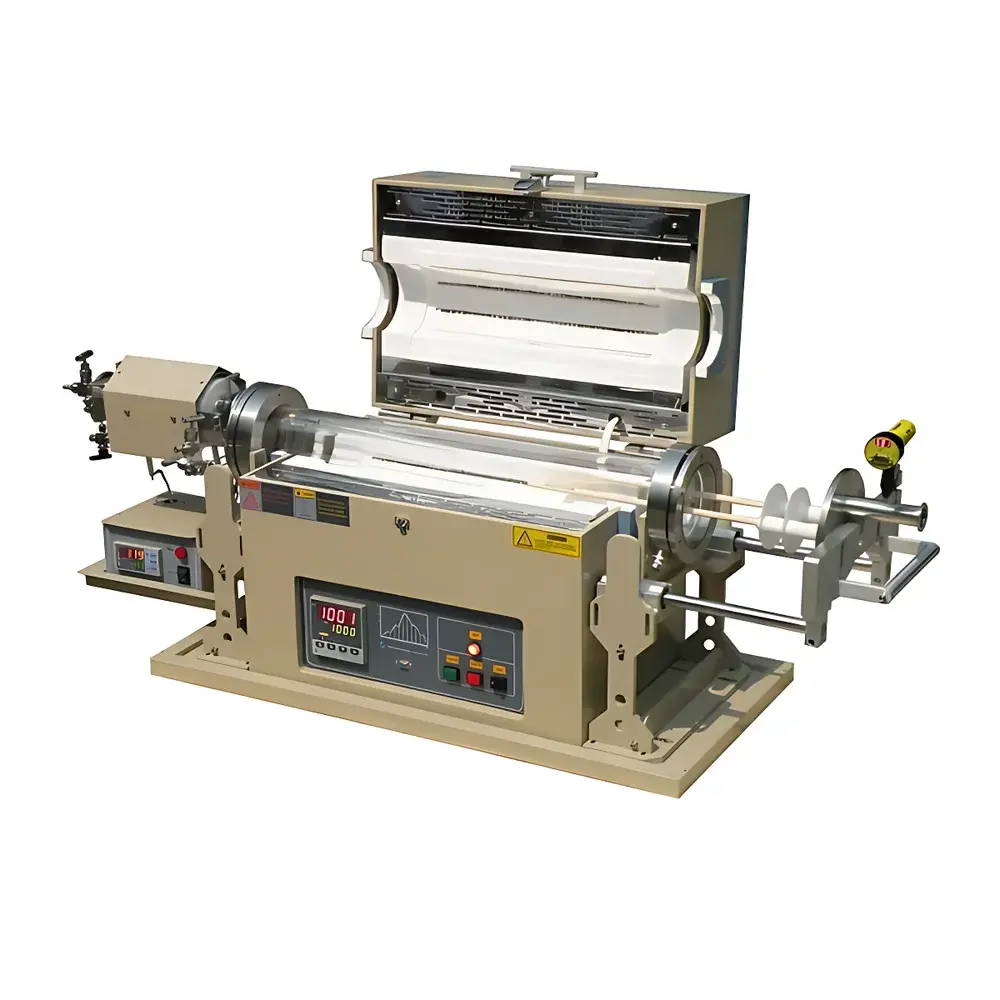
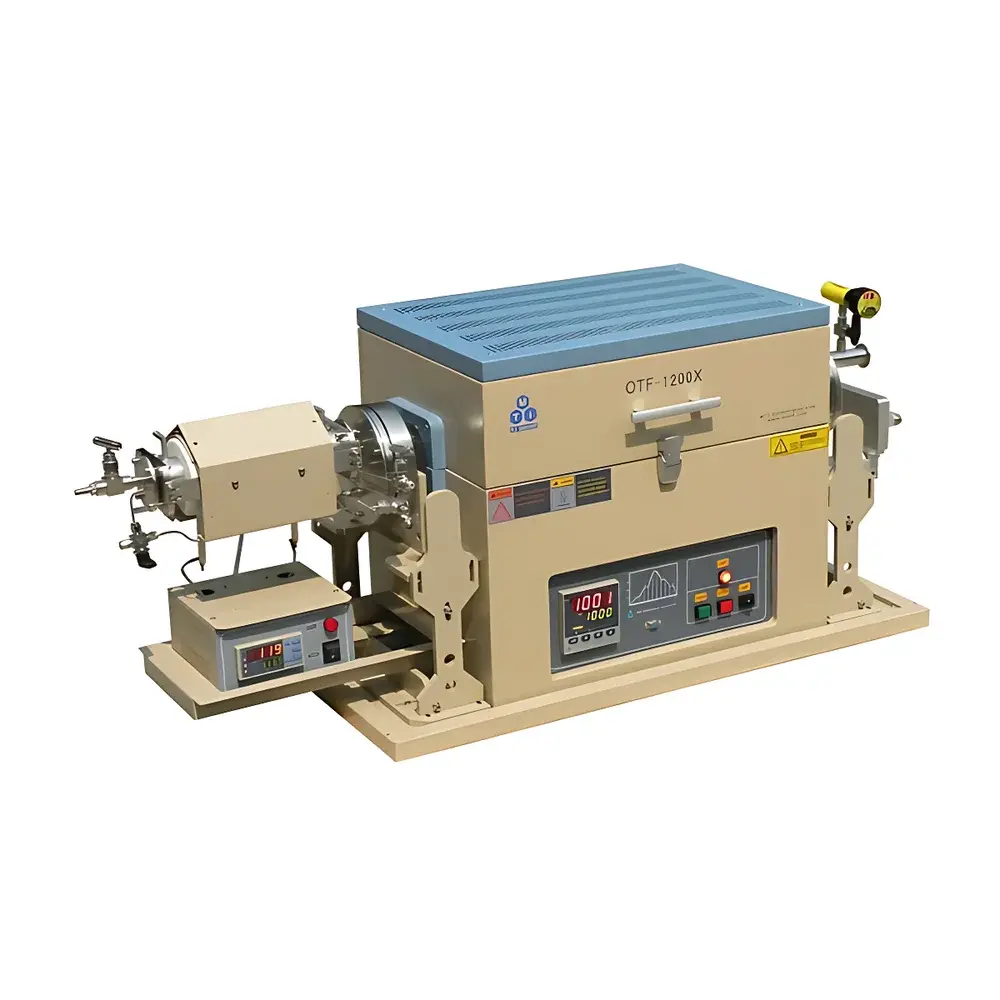
KJ GROUP OTF-1200X-4-NW Compact CVD Furnace for Nanowire Synthesis
| Brand | KJ GROUP |
|---|---|
| Origin | Liaoning, China |
| Manufacturer Type | Authorized Distributor |
| Country of Origin | China |
| Model | OTF-1200X-4-NW |
| Voltage | AC 220 V, 50/60 Hz |
| Power Rating | 3 kW |
| Maximum Operating Temperature (Furnace) | 1100 °C (<2 h), Continuous: 200–1000 °C |
| Maximum Operating Temperature (Preheater) | 500 °C (continuous), 600 °C (intermittent) |
| Heating Zone Length | 400 mm (furnace), 150 mm (preheater) |
| Quartz Tube Dimensions | OD 110 mm, ID 102 mm, L 381 mm |
| Sample Capacity | Up to 3-inch substrates |
| Temperature Control Accuracy | ±1 °C |
| Programmable Ramp Rate | Up to 10 °C/min |
| Controller | PID with 30-segment ramp-soak profile |
| Preheater Chamber | Stainless steel, Ø30 mm × 150 mm |
| Gas Inlets | Four 1/4″ VCR fittings on left flange |
| Vacuum Interface | KF25 quick-connect on right flange |
| Cooling | Optional recirculating chiller with water-cooled flange |
| Compliance | CE-certified |
| Dimensions (W×D×H) | 1200 mm × 450 mm × 510 mm |
| Weight | 100 kg |
Overview
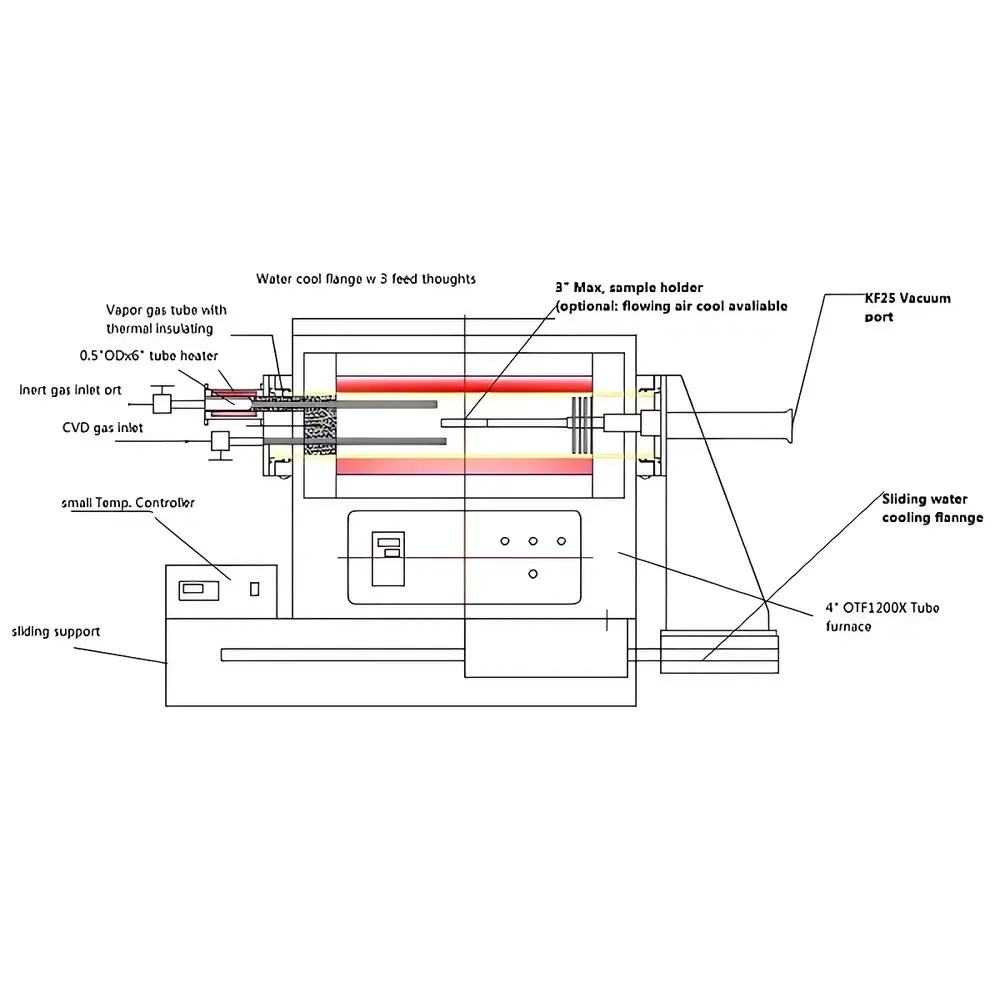
The KJ GROUP OTF-1200X-4-NW is a purpose-engineered compact horizontal tube furnace system designed specifically for controlled vapor-phase synthesis of one-dimensional nanomaterials—including semiconductor nanowires (e.g., Si, Ge, ZnO, GaN), metal oxide nanowires, and core–shell heterostructures—via chemical vapor deposition (CVD) and related techniques such as vapor–liquid–solid (VLS) growth. Its architecture integrates a primary high-temperature reaction zone (up to 1100 °C) with an independently controlled preheating module (up to 600 °C), enabling precise thermal management of precursors in gaseous, liquid, or solid states prior to introduction into the main reaction chamber. The system employs a dual-zone thermal strategy: the main furnace provides uniform axial heating across a 400 mm zone within a high-purity fused quartz tube (OD 110 mm, ID 102 mm), while the auxiliary preheater—housed in a stainless-steel cartridge (Ø30 mm × 150 mm)—ensures consistent precursor volatilization, decomposition, or carrier gas conditioning before entry. This configuration supports reproducible nucleation kinetics, diameter control, and axial crystallographic orientation—critical parameters in nanowire fabrication for optoelectronics, sensing, and energy conversion applications.
Key Features
- Optimized dual-temperature architecture: Main furnace (200–1000 °C continuous, ≤1100 °C short-term) and independent preheater (0–500 °C continuous, ≤600 °C intermittent), both with ±1 °C temperature stability and programmable ramp rates up to 10 °C/min.
- High-efficiency thermal design: Internal furnace chamber lined with imported high-emissivity alumina coating to enhance radiant heat transfer and extend refractory life.
- Modular gas delivery interface: Left flange integrates four 1/4″ VCR ports—two dedicated to independent gas streams (one preheated, one ambient), plus two auxiliary lines for purge or dopant injection—with integrated T-junction mixing inside the quartz tube.
- Operator-centric mechanical design: Sliding right-flange assembly with integrated 3-inch quartz sample holder, KF25 vacuum quick-connect, and optional water-cooled seal interface to maintain elastomer integrity during extended high-temperature operation.
- Advanced process control: Digital PID controller supporting 30-segment temperature programming; optional RS485/USB interface for PC-based monitoring and logging compliant with GLP audit trail requirements.
- CE-certified safety architecture: Includes over-temperature protection, grounded chassis, thermal cutoffs, and interlocked access points aligned with IEC 61010-1 standards for laboratory equipment.
Sample Compatibility & Compliance
The OTF-1200X-4-NW accommodates standard 3-inch wafers, silicon/sapphire substrates, or custom planar templates mounted on a fused quartz support rod. Substrate compatibility extends to catalytic nanoparticles (e.g., Au, Ni colloids), thin-film seed layers, and patterned oxide masks used in site-selective nanowire growth. The system operates under inert (Ar, N₂) or reducing (H₂/Ar mixtures) atmospheres at pressures ranging from high vacuum (≤10⁻³ mbar, when paired with external pumping) to atmospheric pressure. All wetted components—including quartz tube, VCR fittings, and stainless-steel preheater housing—are compatible with common CVD precursors (e.g., SiH₄, GeH₄, TMGa, DEZn, H₂S) and do not introduce metallic contamination. The furnace meets CE marking requirements per Directive 2014/30/EU (EMC) and 2014/35/EU (LVD); optional software packages support 21 CFR Part 11-compliant electronic signatures and data integrity protocols when deployed in regulated R&D or pilot-scale manufacturing environments.
Software & Data Management
An optional Windows-compatible control software package enables remote temperature profiling, real-time data acquisition (sampled at 1 Hz), and automated report generation in CSV or PDF format. The software logs timestamped thermocouple readings (K-type), setpoint history, ramp/soak events, and alarm triggers—retaining full traceability for method validation and quality documentation. Audit trail functionality records user login sessions, parameter modifications, and export actions, satisfying GLP and ISO/IEC 17025 documentation expectations. Data export supports integration with LabArchives, Benchling, or internal LIMS platforms via standardized file formats. Firmware updates are delivered via secure HTTPS channel with SHA-256 signature verification.
Applications
- Vapor–liquid–solid (VLS) growth of single-crystal Si, Ge, and III–V nanowires for CMOS-compatible nanoelectronics.
- Metal oxide nanowire synthesis (e.g., SnO₂, In₂O₃, WO₃) for chemiresistive gas sensors and transparent conductive electrodes.
- Core–shell heterostructure fabrication (e.g., Si@SiO₂, ZnO@TiO₂) via sequential precursor switching and temperature zoning.
- Low-temperature sulfurization/selenization of metal precursors to produce MoS₂, WS₂, or CuInSe₂ nanowires for photovoltaic absorbers.
- Controlled doping studies using secondary gas lines for in situ n-type (PH₃, AsH₃) or p-type (B₂H₆) incorporation.
- Process development for scalable nanowire array integration on flexible or textured substrates.
FAQ
What substrate sizes does the OTF-1200X-4-NW support?
The system is configured for 3-inch (76 mm) circular substrates mounted on a fused quartz sample boat; custom holders for smaller wafers or irregular geometries can be fabricated upon request.
Is vacuum capability built-in?
No—vacuum pumping must be provided externally; the KF25 port on the right flange is compatible with standard turbomolecular or scroll pumps (recommended base pressure <10⁻³ mbar).
Can the preheater accommodate liquid precursors?
Yes—the stainless-steel preheater chamber supports bubblers or micro-droplet injectors; precise temperature control ensures consistent vapor pressure generation without thermal shock to downstream components.
What cooling options are available for extended high-temperature operation?
A recirculating chiller (optional) connects to the water-cooled right flange to maintain O-ring integrity at >200 °C; coolant inlet/outlet ports accept standard 6 mm compression fittings.
Does the system comply with FDA or ISO regulatory requirements for materials research?
While not a GMP production tool, its CE certification, audit-trail-capable software, and documented calibration traceability align with ISO 9001 and ASTM E2911–22 guidelines for laboratory instrument qualification in preclinical development workflows.



