
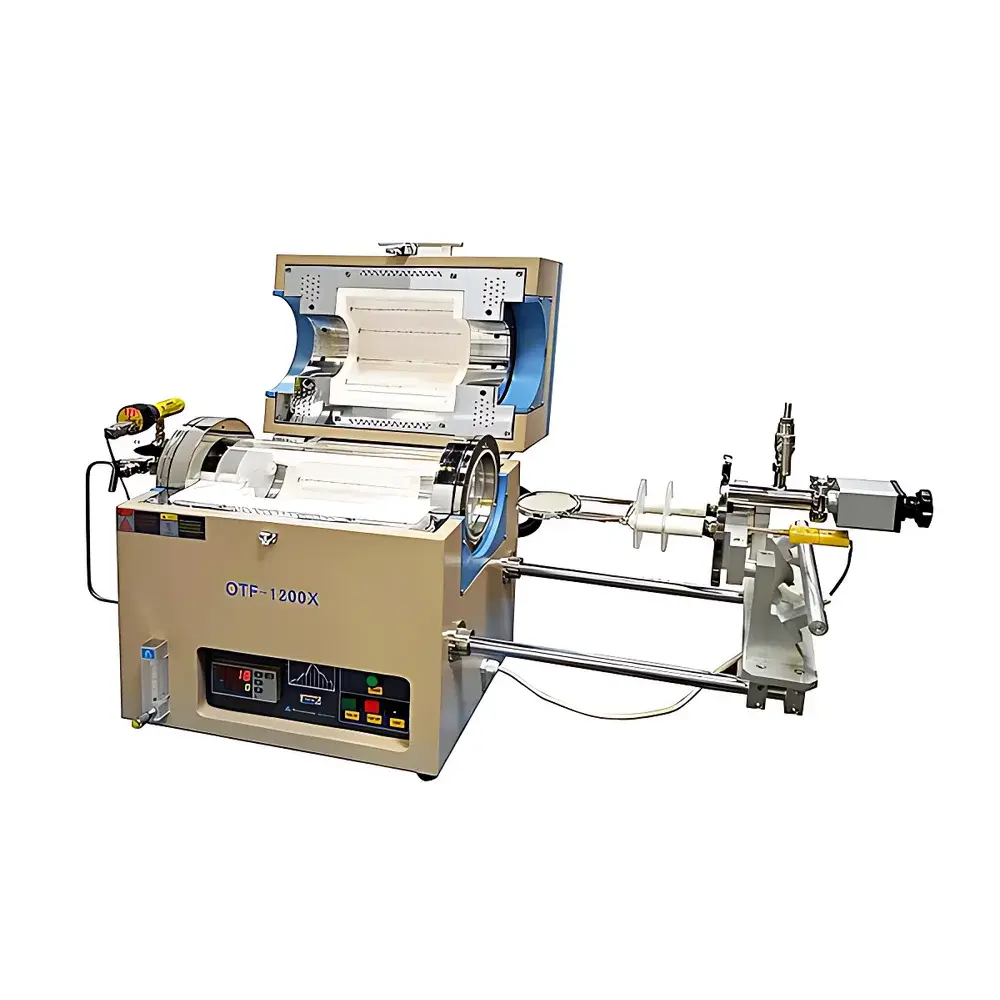
KJ GROUP OTF-1200X-4-RTP Compact Rapid Thermal Processing Furnace
| Brand | KJ GROUP |
|---|---|
| Origin | Anhui, China |
| Manufacturer Type | Authorized Distributor |
| Product Origin | Domestic (China) |
| Model | OTF-1200X-4-RTP |
| Pricing | Upon Request |
| Max Operating Temperature | 1100 °C (Rated at 1000 °C) |
| Heating Rate | 50 °C/s (RT–800 °C), 10 °C/s (800–1000 °C) |
| Cooling Rate | 60 °C/min (200 mtorr), 117 °C/min (1 atm) |
| Uniformity | ±5 °C over 102 mm × 305 mm hot zone |
| Vacuum Capability | 50 mtorr (mechanical pump), 10⁻⁴ torr (turbo-molecular pump) |
| Quartz Tube | Ø110 mm OD / Ø103 mm ID × 380 mm L |
| Sample Capacity | Up to 76 mm (3″) wafers on AlN carrier |
| Control System | 30-segment PID with RS485 interface and PC software |
| Certification | CE, UL/MET/CAS compliant (>24 V components), TUV/CAS certification available upon request |
Overview
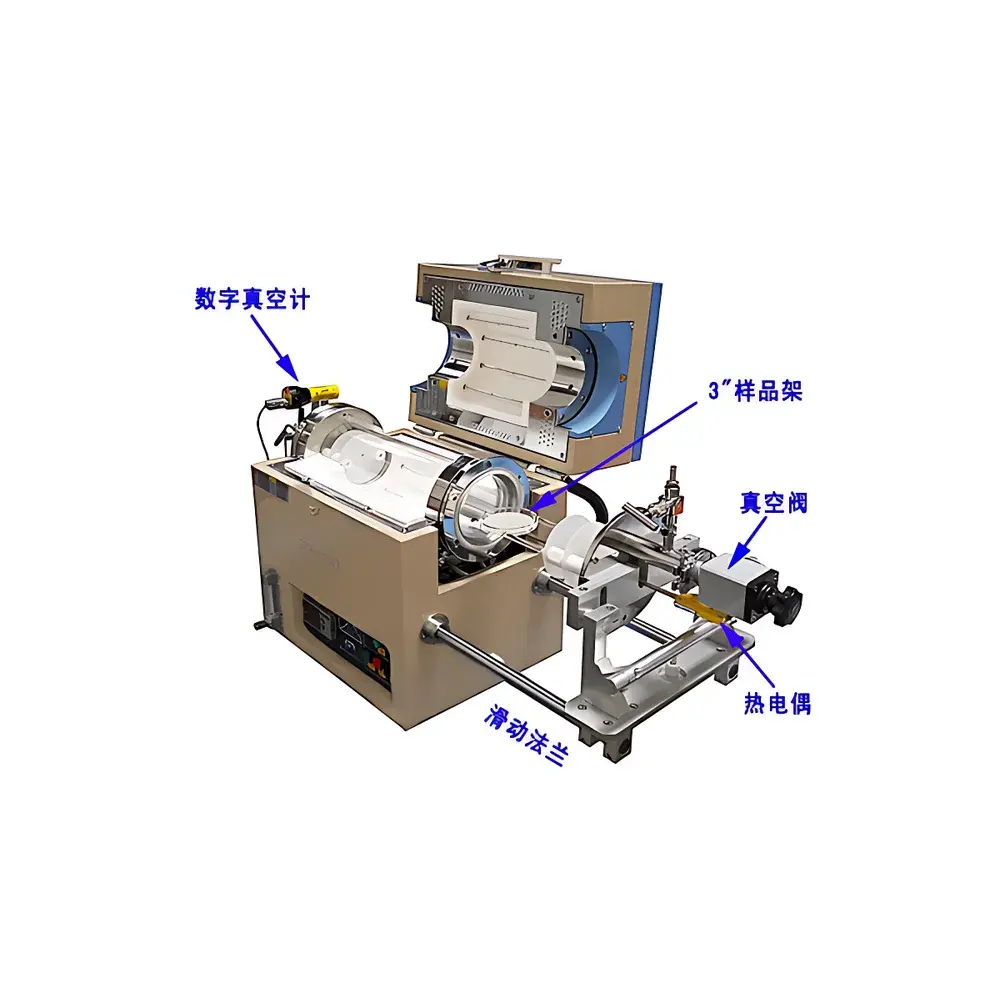
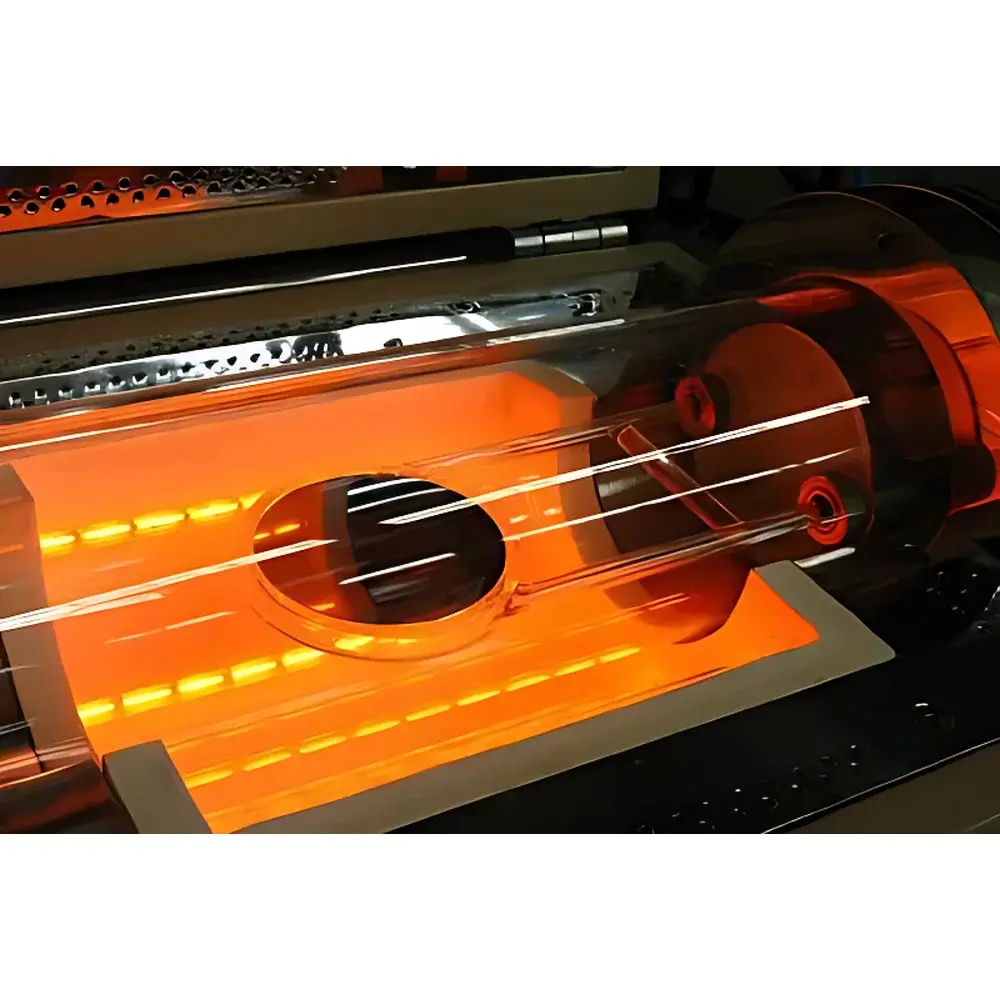
The KJ GROUP OTF-1200X-4-RTP is a compact, high-performance rapid thermal processing (RTP) furnace engineered for precise, repeatable annealing of semiconductor wafers, photovoltaic substrates, and thin-film devices. Utilizing eight high-intensity infrared (IR) lamp arrays as the primary heating source, the system achieves ultra-fast thermal ramping—up to 50 °C/s from ambient to 800 °C—enabling process times measured in seconds rather than minutes. This dynamic thermal response is critical for minimizing dopant diffusion, preserving interfacial integrity, and supporting advanced fabrication protocols such as spike annealing, flash annealing, and rapid oxidation/nitridation. The furnace operates within a fused quartz reaction tube (Ø103 mm ID × 380 mm L), sealed via dual high-temperature Viton® O-rings on a KF-D25 stainless steel vacuum flange, allowing operation under controlled inert (Ar ≥99.99%), reducing, or low-pressure atmospheres. Its rated temperature is 1000 °C, with a maximum limit of 1100 °C (restricted to ≤600 s dwell time per cycle to prevent O-ring degradation). Temperature uniformity across the 102 mm × 305 mm effective hot zone is maintained at ±5 °C, verified using embedded K-type thermocouples and calibrated digital vacuum gauging.
Key Features
- High-efficiency IR heating architecture: Eight 200 mm filament-length, 10 mm coil-diameter infrared lamps deliver localized, non-contact energy transfer—eliminating thermal lag associated with resistive coil furnaces.
- Advanced thermal management: Internal alumina-coated mullite chamber enhances radiant reflectivity and extends structural longevity; integrated water-cooling interface supports optional recirculating chiller (3 L/min flow, 20 °C inlet, 25 PSI pressure).
- Wafer-centric sample handling: Sliding KF-D25 flange mounts a precision-machined quartz sample holder accommodating 76 mm (3″) AlN substrates—selected for its high thermal conductivity (≈180 W/m·K) to ensure lateral temperature homogeneity.
- Robust process control: 30-segment programmable PID controller with auto-tuning, over-temperature cutoff, and thermocouple break detection; RS485 communication enables real-time monitoring, curve logging, and remote setpoint adjustment via Windows-compatible software.
- Compliance-ready construction: All electrical components rated >24 V meet UL, MET, and CSA safety standards; CE marking confirms conformity with EU Machinery Directive 2006/42/EC and EMC Directive 2014/30/EU.
Sample Compatibility & Compliance
The OTF-1200X-4-RTP is optimized for planar substrates up to 76 mm in diameter—including silicon, GaAs, SiC, glass, and flexible metal foils—used in microelectronics, MEMS, perovskite solar cell fabrication, and ALD/CVD pre/post-treatment. It supports processes requiring strict atmospheric control: inert gas purging (Ar, N₂), low-pressure annealing (down to 10⁻⁴ torr with optional turbo pump), and partial pressure modulation via calibrated mass flow controller (16–160 mL/min range). The system complies with ISO 9001 quality management requirements for manufacturing traceability and is compatible with GLP/GMP documentation workflows when paired with audit-trail-enabled software extensions. For regulated environments, optional TÜV Rheinland certification (per EN 61000-6-2/6-4 and IEC 61000-4-3) and CSA C22.2 No. 61010-1 certification can be pursued on a per-unit basis.
Software & Data Management
The included PC-based control suite provides deterministic thermal profiling with millisecond-level timestamp resolution, enabling full reconstruction of ramp-hold-cool cycles. Users define multi-step programs with independent rate, target, and dwell parameters; logged data exports to CSV or Excel formats for statistical process control (SPC) analysis. The software supports FDA 21 CFR Part 11-compliant configurations—including electronic signatures, user role permissions, and immutable audit trails—when deployed on validated Windows OS platforms. Integration with LabVIEW™, MATLAB®, or Python (via Modbus RTU over RS485) allows for automated recipe sequencing in cluster tools or inline metrology lines. All firmware updates are delivered through signed binary packages with SHA-256 verification.
Applications
- Semiconductor manufacturing: Activation annealing of ion-implanted dopants (e.g., B, P, As in Si), silicide formation (NiSi, CoSi₂), and gate oxide densification.
- Photovoltaics: Crystallization of amorphous silicon, passivation layer annealing (SiNₓ:H, Al₂O₃), and contact firing optimization for screen-printed Ag electrodes.
- 2D materials & heterostructures: Defect healing in graphene, MoS₂, and h-BN; interfacial reaction control during van der Waals stacking.
- Thin-film functional oxides: Phase stabilization of ferroelectric (PZT, BTO) and multiferroic (BiFeO₃) layers without interdiffusion.
- Rapid thermal evaporation (RTE): Optional SiC-coated graphite crucible enables sub-second metal evaporation (Al, Cr, Ti) for shadow-mask lithography.
FAQ
What is the maximum safe operating pressure inside the quartz tube?
The internal pressure must not exceed 0.02 MPa (≈0.2 bar gauge). A pressure relief valve is recommended for any process involving reactive or expanding gases.
Can the furnace operate under high vacuum continuously at 1000 °C?
No. At temperatures above 1000 °C, the quartz tube must be held at near-atmospheric pressure to prevent thermal stress fracture and O-ring failure. Vacuum operation is restricted to ≤1000 °C.
Is the digital vacuum gauge calibrated for gases other than nitrogen or air?
The standard gauge is factory-calibrated for N₂ and air only. For Ar, H₂, or other process gases, correction factors from the provided relative sensitivity table must be applied manually.
What cooling infrastructure is required for continuous high-rate cycling?
A closed-loop recirculating chiller maintaining 20 °C inlet water at ≥3 L/min flow and ≥25 PSI is mandatory for >50 cycles/day at peak power to sustain lamp and flange thermal stability.
Does the system support integration into a Class 100 cleanroom environment?
Yes—provided all external utilities (gas lines, coolant, exhaust) are routed through ISO Class 5-rated HEPA-filtered ducting and the unit is installed on vibration-isolated optical tables per SEMI F47-0205 guidelines.



