
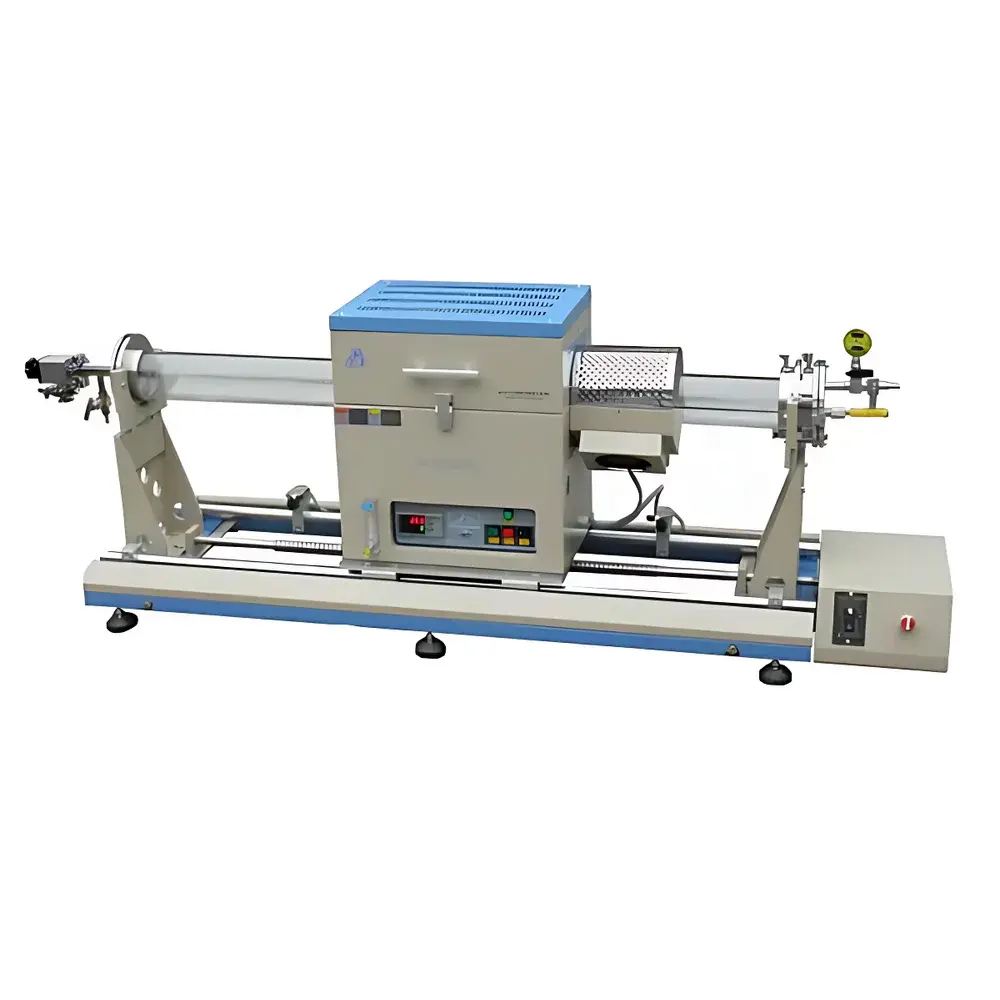
KJ GROUP OTF-1200X-4-RTP-SL Sliding Rapid Thermal Processing Furnace
| Brand | KJ GROUP |
|---|---|
| Origin | Anhui, China |
| Manufacturer Type | Authorized Distributor |
| Country of Origin | China |
| Model | OTF-1200X-4-RTP-SL |
| Power Supply | 208–240 V AC, 50/60 Hz, 9 kW |
| Maximum Operating Temperature | 1000 °C (≤1 h), Continuous: 950 °C |
| Heating Rate | Up to 100 °C/s |
| Cooling Rate | 8.3 °C/s (900–600 °C) |
| Quartz Tube Dimensions | Ø100 mm × 1400 mm |
| Chamber Dimensions | Ø100 mm × 1400 mm |
| Temperature Control Accuracy | ±0.5 °C |
| Thermocouple | K-type, Ø6.35 mm × 610 mm |
| Sliding Rail Stroke | 340 mm, Speed: 0–70 mm/s, Length: 1200 mm |
| Vacuum Performance | 10⁻³ Torr (mechanical pump), 10⁻⁵ Torr (turbo-molecular pump) |
| Water Cooling Requirement | 4 L/min for water-cooled flanges (>900 °C) |
| Gas Inlet | 6 mm double-ferrule fitting for high-purity Ar (≥99.99%) |
| Net Weight | 80 kg |
| Overall Footprint (with rail) | 1800 mm × 450 mm × 680 mm |
Overview
The KJ GROUP OTF-1200X-4-RTP-SL is a precision-engineered sliding rapid thermal processing (RTP) furnace designed for semiconductor process development, thin-film annealing, dopant activation, and nanomaterial synthesis under controlled inert or reducing atmospheres. Unlike conventional tube furnaces, this system employs high-intensity infrared (IR) lamp arrays as the primary heating source, enabling ultra-fast thermal transients—up to 100 °C/s ramp rates—critical for minimizing thermal budget and suppressing undesired interdiffusion in multilayer structures. Its defining mechanical feature is a motorized, temperature-triggered sliding rail mechanism that physically displaces the entire hot zone away from the sample position upon program completion, facilitating rapid quenching via forced convection and ambient conduction. This architecture decouples heating kinetics from cooling dynamics, offering independent control over both thermal profiles—a capability essential for reproducible RTP protocols in R&D and pilot-scale fabrication.
Key Features
- Sliding rail assembly with programmable displacement (0–70 mm/s, 340 mm stroke) synchronized to temperature controller output, ensuring repeatable thermal quenching without manual intervention.
- Double-walled stainless-steel chamber with dual axial cooling fans and high-emissivity imported alumina coating on inner furnace walls—enhancing radiant efficiency and thermal uniformity across the 1400 mm heated length.
- Integrated PID-based 30-segment programmable controller with over-temperature cutoff (hardware-limited at 1050 °C), real-time curve logging, and RS485 communication for external SCADA integration.
- Water-cooled stainless-steel vacuum flanges rated for continuous operation above 900 °C, compliant with ISO-KF and CF standards; requires minimum coolant flow of 4 L/min to maintain seal integrity and prevent thermal deformation.
- Quartz reaction tube (Ø100 mm × 1400 mm) with low OH-content specification—minimizing infrared absorption losses and ensuring spectral transmission stability across 0.8–2.5 µm wavelength range typical of tungsten-halogen IR emitters.
Sample Compatibility & Compliance
The OTF-1200X-4-RTP-SL accommodates wafers up to 6 inches (150 mm) in diameter, substrates up to 10 mm thick, and powder samples in quartz boats or crucibles. It supports atmospheric, low-pressure (10⁻³ Torr), and high-vacuum (10⁻⁵ Torr) processing environments when paired with optional turbo-molecular pumping systems. The furnace meets general safety requirements per IEC 61000-6-2 (EMC immunity) and IEC 61000-6-4 (EMC emissions). While not certified to UL or CE for standalone sale in North America/EU, its design aligns with key elements of SEMI F47 (voltage sag immunity) and ASTM F1529 (thermal processing equipment qualification guidelines) for lab-scale RTP validation. For GLP/GMP-aligned workflows, optional audit-trail-enabled controllers and 21 CFR Part 11-compliant software modules are available through KJ GROUP’s OEM partners.
Software & Data Management
Standard operation utilizes the embedded 7-inch color touchscreen HMI with intuitive graphical programming interface. All temperature setpoints, ramp/soak segments, rail motion triggers, and alarm thresholds are stored in non-volatile memory with timestamped event logging (start/stop, overtemp, door open, vacuum breach). Optional PC-based software (KJ-RTPControl v3.x) provides real-time multi-channel data streaming (Tset, Tactual, rail position, gas flow), CSV export with metadata tagging, and comparative overlay of historical runs—enabling statistical process control (SPC) analysis per ISO 22514-8. Raw thermocouple voltage outputs (mV) are accessible via analog output terminals for third-party DAQ synchronization.
Applications
- Silicon wafer rapid annealing for shallow junction formation and silicide phase stabilization.
- Graphene and transition metal dichalcogenide (TMD) CVD post-growth activation and defect healing.
- Metal oxide thin-film crystallization (e.g., TiO₂, ZnO, NiO) for photovoltaic and memristor applications.
- Pre-sintering of ceramic green bodies prior to HIP or spark plasma sintering (SPS).
- Thermal desorption spectroscopy (TDS) sample preparation under controlled ramp-and-quench cycles.
FAQ
What inert gas purity is required for optimal performance?
High-purity argon (≥99.99% Ar, H₂O < 1 ppm, O₂ < 0.5 ppm) is strongly recommended to prevent oxidation of sensitive substrates and maintain quartz tube longevity. Nitrogen may be used for less demanding applications but exhibits higher thermal conductivity and reduced IR transparency.
Can the furnace operate under vacuum without active cooling?
Mechanical pump vacuum (10⁻³ Torr) is permissible at temperatures ≤800 °C without water cooling. Above 800 °C, water-cooled flanges are mandatory to avoid outgassing-induced pressure instability and gasket degradation.
Is the sliding rail motion programmable independently of temperature?
Yes—the rail movement can be triggered by time, temperature threshold, or process step completion, with adjustable delay and velocity profiles defined within the same 30-segment program.
What maintenance intervals are recommended for IR lamp arrays?
Lamp lifetime averages 2,000–3,000 hours under nominal load (≤950 °C continuous). Visual inspection every 500 hours and radiometric calibration every 1,000 hours ensure consistent irradiance distribution and thermal uniformity.
Does the system support remote monitoring via Ethernet or Wi-Fi?
The base model includes RS485 Modbus RTU; optional Ethernet-to-Modbus gateways (e.g., Moxa EDS-205A) enable integration into factory LANs for centralized monitoring and alarm notification via SNMP or MQTT protocols.
Related Products



