
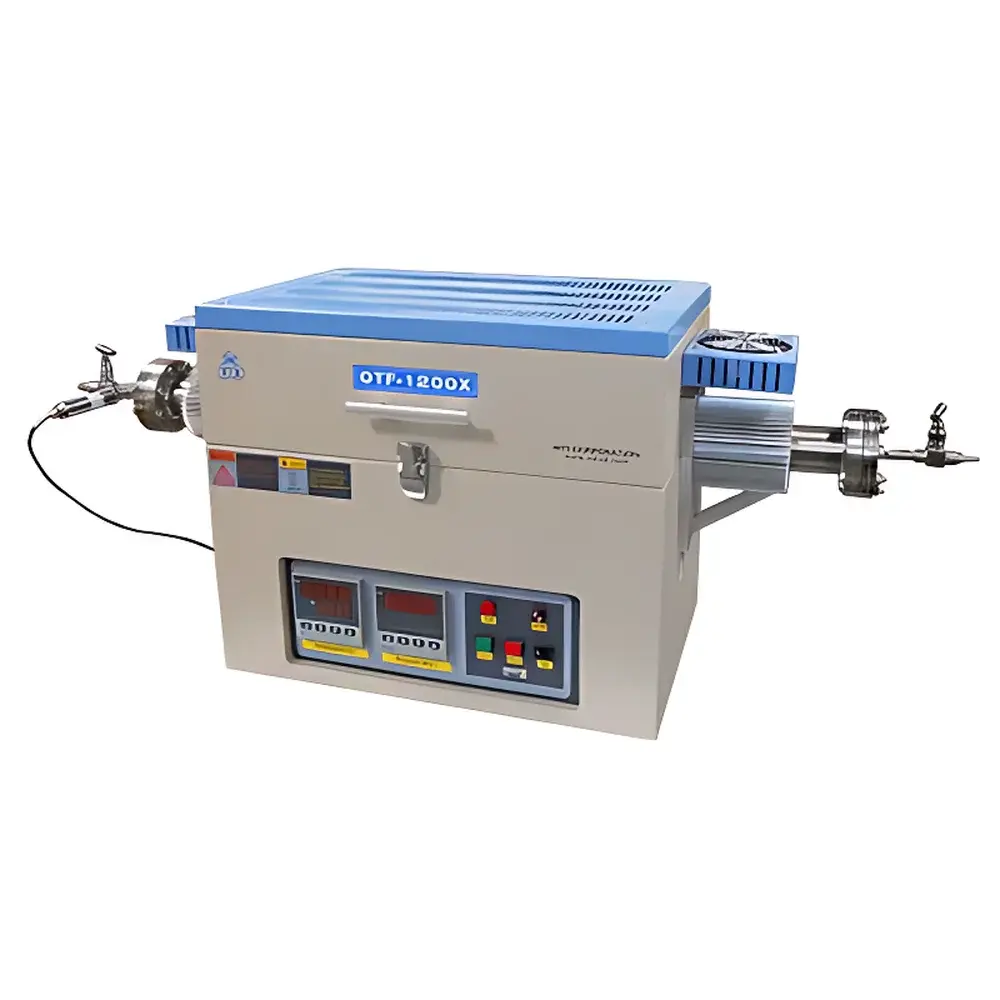
KJ GROUP OTF-1200X-60UV High-Pressure Tube Furnace with UV-Transmissive Quartz Window
| Brand | KJ GROUP |
|---|---|
| Origin | Liaoning, China |
| Manufacturer Type | Authorized Distributor |
| Country of Origin | China |
| Model | OTF-1200X-60UV |
| Power Supply | AC 220 V, 50/60 Hz, 3 kW (20 A circuit breaker required) |
| Tube Material | Nickel-based alloy steel |
| Tube Dimensions | OD 60 mm, ID 52 mm, L 1000 mm |
| Heating Element | Mo-doped Fe–Cr–Al resistance wire with zirconia coating |
| Heating Zone Length | 440 mm |
| Uniform Temperature Zone | 150 mm (extendable to 300 mm with optional triple-zone configuration) |
| Max Operating Temperature | 1100 °C (non-continuous) |
| absolute limit | 1200 °C |
| Pressure Rating | 9 bar @ 1100 °C, 20 bar @ 1000 °C, 50 bar @ 800 °C |
| Vacuum Performance | 10⁻² torr (mechanical pump), 10⁻⁵ torr (turbo-molecular pump) |
| Cooling | Dual-layer chamber with forced-air circulation |
| Temperature Control | 30-segment PID programmable controller with overheat and thermocouple break protection |
| Thermal Insulation | Al₂O₃-coated inner chamber (US-imported coating) |
| Certification | CE compliant |
| Dimensions (W×D×H) | 550 × 380 × 520 mm |
| Net Weight | 50 kg |
| Optional Accessories | Triple-zone heating module, UV-grade fused silica viewport flanges (254 nm–2 µm transmission), PC-based control software with data logging and remote parameter adjustment |
Overview
The KJ GROUP OTF-1200X-60UV is a high-precision horizontal tube furnace engineered for controlled high-temperature, high-pressure, and high-vacuum synthesis and processing environments. Designed around a robust nickel-based alloy steel tube (OD 60 mm, ID 52 mm, L 1000 mm), the system supports inert, oxidizing, and steam-containing atmospheres—including O₂ and H₂O(g)—up to 1100 °C while maintaining pressure integrity up to 9 bar at peak temperature. Its dual-shell architecture integrates an active air-cooling loop to ensure operator safety and thermal stability, limiting external casing temperature to below 60 °C during continuous operation. The internal chamber features a US-sourced alumina ceramic coating that enhances infrared reflectivity, improves thermal uniformity across the 440 mm heating zone, and extends structural longevity under repeated thermal cycling. Temperature regulation is achieved via a 30-segment programmable PID controller with real-time deviation monitoring, overheat cutoff, and thermocouple failure detection—ensuring compliance with fundamental laboratory safety and process repeatability requirements.
Key Features
- Dual-shell construction with integrated forced-air cooling system, enabling safe ambient surface temperatures (<60 °C) even at maximum operating conditions.
- High-purity nickel-based alloy tube rated for oxidative and hydrothermal environments, compatible with O₂, H₂O(g), N₂, Ar, and forming gas up to 1100 °C.
- US-imported α-alumina thermal barrier coating applied to inner furnace walls—increasing radiant efficiency and mitigating thermal degradation over extended service life.
- PID-based temperature controller supporting 30 programmable ramp/soak segments, with ±1 °C steady-state accuracy and configurable alarm thresholds for overtemperature and sensor fault conditions.
- CE-certified design meeting EN 61000-6-2 (immunity) and EN 61000-6-4 (emission) standards for electromagnetic compatibility in laboratory settings.
- Modular vacuum interface accommodating both rotary vane (10⁻² torr base) and turbo-molecular pumping (10⁻⁵ torr base) configurations for controlled low-pressure reaction kinetics studies.
Sample Compatibility & Compliance
The OTF-1200X-60UV accommodates standard cylindrical samples (≤50 mm OD) and crucibles placed centrally within the 150 mm uniform temperature zone—or up to 300 mm when equipped with the optional triple-zone heating module. Its pressure-rated flange system (CF or ISO-K compatible) supports integration with mass flow controllers, pressure transducers, and gas purification units per ASTM E2913 and ISO 8502-7 guidelines for controlled-atmosphere thermal processing. The furnace conforms to general-purpose laboratory equipment safety standards (IEC 61010-1) and is routinely deployed in academic and industrial labs conducting solid-state synthesis, catalyst activation, oxide film growth, and high-temperature material aging per ASTM C1171 and ISO 75-2 protocols. While not inherently GLP/GMP validated, its programmable control architecture and hardware interlocks support audit-ready documentation when paired with validated PC software.
Software & Data Management
An optional Windows-compatible PC control suite enables remote configuration of temperature profiles, real-time acquisition of thermocouple and pressure sensor outputs, and timestamped export of CSV-formatted datasets. The software implements basic audit trail functionality—including user login timestamps, parameter change logs, and session start/stop records—facilitating alignment with FDA 21 CFR Part 11 principles where electronic records are subject to regulatory review. All firmware updates and calibration offsets are stored locally on the controller’s non-volatile memory, preserving traceability independent of host computer availability. Data synchronization is performed via RS485 or USB-to-serial interface, with no cloud dependency or third-party telemetry.
Applications
- High-pressure solid-state reactions involving metal oxides, chalcogenides, and perovskite precursors under controlled pO₂ and pH₂O conditions.
- In situ optical characterization via UV-grade fused silica viewports (optional), enabling Raman, FTIR, or laser-induced fluorescence measurements inside the hot zone at elevated pressures.
- Thermal aging studies of battery electrode materials, thermal barrier coatings, and refractory composites under accelerated stress conditions (e.g., 9 bar / 1100 °C).
- Controlled oxidation kinetics of Ni-, Co-, or Fe-based alloys using calibrated O₂ partial pressure sweeps between 10⁻⁴ and 1 atm.
- Steam-assisted crystallization of zeolites and MOFs under subcritical water vapor conditions (up to 300 °C, 80 bar equivalent).
FAQ
What is the maximum allowable pressure at 1100 °C?
The furnace is rated for 9 bar (130 PSI) at 1100 °C. Exceeding this limit compromises mechanical integrity and voids warranty coverage.
Can the system operate under dynamic gas flow during heating?
Yes—gas inlets and outlets are configured for continuous flow mode, provided mass flow controllers and back-pressure regulators are externally installed and calibrated.
Is the quartz viewport compatible with deep-UV excitation (e.g., 254 nm)?
The optional UV-grade fused silica window transmits >85% from 254 nm to 2 µm; spectral attenuation data sheets are available upon request.
Does the PID controller support external thermocouple input for sample-stage monitoring?
The standard configuration includes one internal K-type thermocouple; auxiliary inputs for secondary sensors require custom wiring and firmware mapping—contact technical support for OEM integration options.
What vacuum pumping configuration is recommended for outgassing sensitive precursors?
A two-stage approach is advised: initial rough pumping with a diaphragm pump to 10⁻² torr, followed by turbo-molecular pumping to achieve ≤10⁻⁵ torr base pressure prior to heating.



