
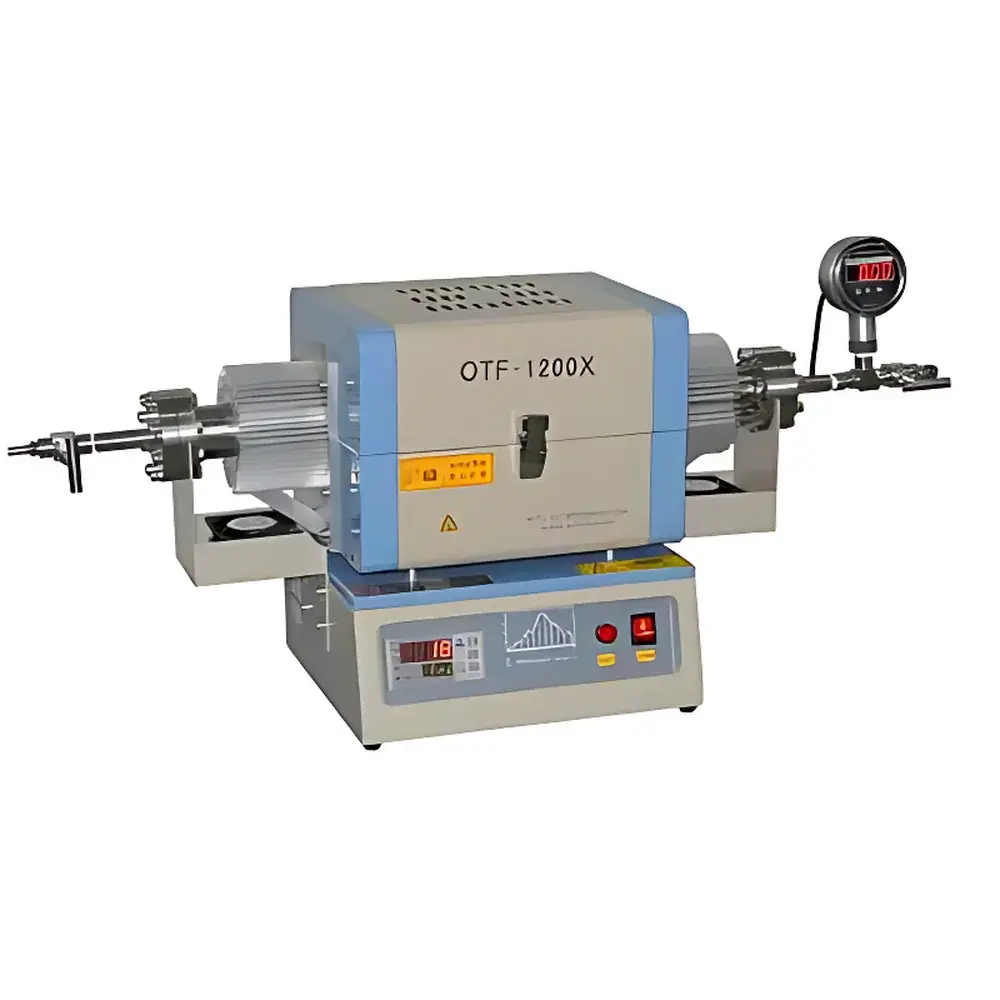
KJ GROUP OTF-1200X-HP-12 High-Temperature & High-Pressure Horizontal Tube Furnace
| Brand | KJ GROUP |
|---|---|
| Origin | Anhui, China |
| Manufacturer Type | Authorized Distributor |
| Model | OTF-1200X-HP-12 |
| Power Supply | AC 220 V, 50/60 Hz, 2.5 kW |
| Maximum Operating Temperature | 1100 °C (short-term up to 1200 °C for <1 h) |
| Maximum Pressure Rating | 4300 psi (20 MPa) at 800 °C |
| Heating Zone Length | 300 mm |
| Tube Dimensions | Ni-based alloy, OD 30 mm, ID 12 mm, L 530 mm |
| Temperature Uniformity | ±1 °C over 50 mm, ±2 °C over 70 mm |
| Max Ramp Rate | ≤20 °C/min |
| Control Accuracy | ±1 °C |
| Safety Features | Overheat protection, thermocouple break detection, pressure interlock shutdown |
| Certification | CE compliant |
| Dimensions (W×D×H) | 340 × 300 × 400 mm |
| Weight | 35 kg |
Overview
The KJ GROUP OTF-1200X-HP-12 is a compact, horizontally oriented high-temperature and high-pressure tube furnace engineered for controlled thermal processing under reactive or inert atmospheres. It employs resistive heating via molybdenum-doped Fe-Cr-Al alloy heating elements with zirconia coating, integrated into a dual-layer stainless steel chamber with aluminum heat-sink flanges to maintain external surface temperatures below 80 °C during operation. The furnace utilizes a high-strength nickel-based alloy tube (OD 30 mm, ID 12 mm, L 530 mm), rated for pressures up to 20 MPa (4300 psi) at 800 °C — with pressure limits decreasing progressively as temperature increases, per ASME B31.3-derived operational envelopes. Its core application domain includes solid-state synthesis, catalytic reaction studies, oxidation/nitridation treatments, and hydrothermal material processing where precise coupling of elevated temperature and pressurized gas environments is required.
Key Features
- Dual-shell construction with integrated aluminum finned heat sinks on both end flanges, ensuring safe external surface temperatures (<80 °C) even during extended high-temperature operation.
- Internally alumina-coated furnace chamber (imported U.S. high-purity Al₂O₃ ceramic coating) enhances infrared emissivity and thermal reflectivity, improving heating efficiency and extending structural integrity under thermal cycling.
- PID-based temperature controller with 30-segment programmable ramp-soak profiles, supporting complex thermal protocols including multi-step sintering, annealing, and thermal decomposition sequences.
- Digital pressure gauge mounted directly on the inlet/outlet flange, configured with user-defined upper pressure limit; automatic heater cutoff is triggered upon exceedance to prevent over-pressurization.
- Comprehensive safety architecture: independent over-temperature cut-off, thermocouple failure detection (open-circuit alarm), and pressure-interlocked thermal shutdown — all compliant with IEC 61000-6-2/6-4 and CE Machinery Directive 2006/42/EC requirements.
Sample Compatibility & Compliance
The OTF-1200X-HP-12 accommodates standard cylindrical samples up to 12 mm in diameter and 500 mm in length, compatible with quartz boats (optional), alumina crucibles (optional), and custom-fabricated metal or ceramic sample holders. It supports continuous gas flow or static pressurized environments using O₂, N₂, Ar, He, H₂, H₂O vapor, or mixed gas blends — with inlet/outlet ports fitted with Swagelok®-compatible VCR fittings. The system meets CE marking requirements for electrical safety, electromagnetic compatibility, and mechanical risk mitigation. While not certified to ISO/IEC 17025 or GLP standards out-of-the-box, its control logging, alarm history, and hardware interlocks provide foundational traceability suitable for method validation under internal QA/QC or pre-GMP research workflows.
Software & Data Management
The furnace operates via an embedded PID controller with local LCD interface; no proprietary PC software is included. All process parameters — setpoints, actual temperatures, pressure readings, elapsed time, and alarm events — are logged internally with timestamping and retained across power cycles. Data export is available via RS485 Modbus RTU protocol (optional interface module required) for integration into LabVIEW™, MATLAB®, or SCADA-based monitoring systems. Audit trail functionality satisfies basic 21 CFR Part 11 readiness when paired with validated third-party data acquisition platforms that enforce electronic signature and change-control protocols.
Applications
- Solid-state synthesis of functional oxides (e.g., LiCoO₂, NMC cathodes) under oxygen partial pressure control.
- High-pressure nitridation of transition metals and ceramics (e.g., TiN, Si₃N₄ formation).
- Thermal stability assessment of battery electrode materials under simulated cell-relevant gas environments.
- Catalyst activation and regeneration studies involving steam reforming or CO₂ hydrogenation under pressurized feed gases.
- Hydrothermal crystallization of zeolites and MOFs using water vapor or supercritical fluid precursors.
- Accelerated aging tests of sealing materials and sensor housings exposed to combined thermal-mechanical stress.
FAQ
What is the maximum allowable pressure at 1000 °C?
At 1000 °C, the furnace tube is rated for a maximum pressure of 10 MPa (1600 psi), as defined by the manufacturer’s validated pressure–temperature derating curve.
Can the furnace be used under reducing atmospheres such as H₂?
Yes — the nickel-based alloy tube exhibits acceptable resistance to hydrogen embrittlement below 900 °C; for prolonged H₂ exposure above this temperature, consult the material datasheet and implement leak-integrity verification prior to pressurization.
Is the temperature uniformity specification verified per ASTM E220?
No — the stated uniformity (±1 °C over 50 mm) is determined per internal calibration procedure using three calibrated Type K thermocouples; formal ASTM E220 qualification requires third-party thermal mapping under load and is available as an optional service.
Are pressure transducers included with the base configuration?
A digital pressure gauge is factory-installed on the main flange; analog 4–20 mA output transducers or redundant pressure sensors are available as configurable options.
Does the system support vacuum operation?
The furnace is not designed for high vacuum; it is optimized for positive-pressure gas environments up to 20 MPa. Vacuum capability (<10⁻² mbar) requires retrofitting with vacuum-rated seals and pumping interfaces, which voids standard warranty coverage.



