
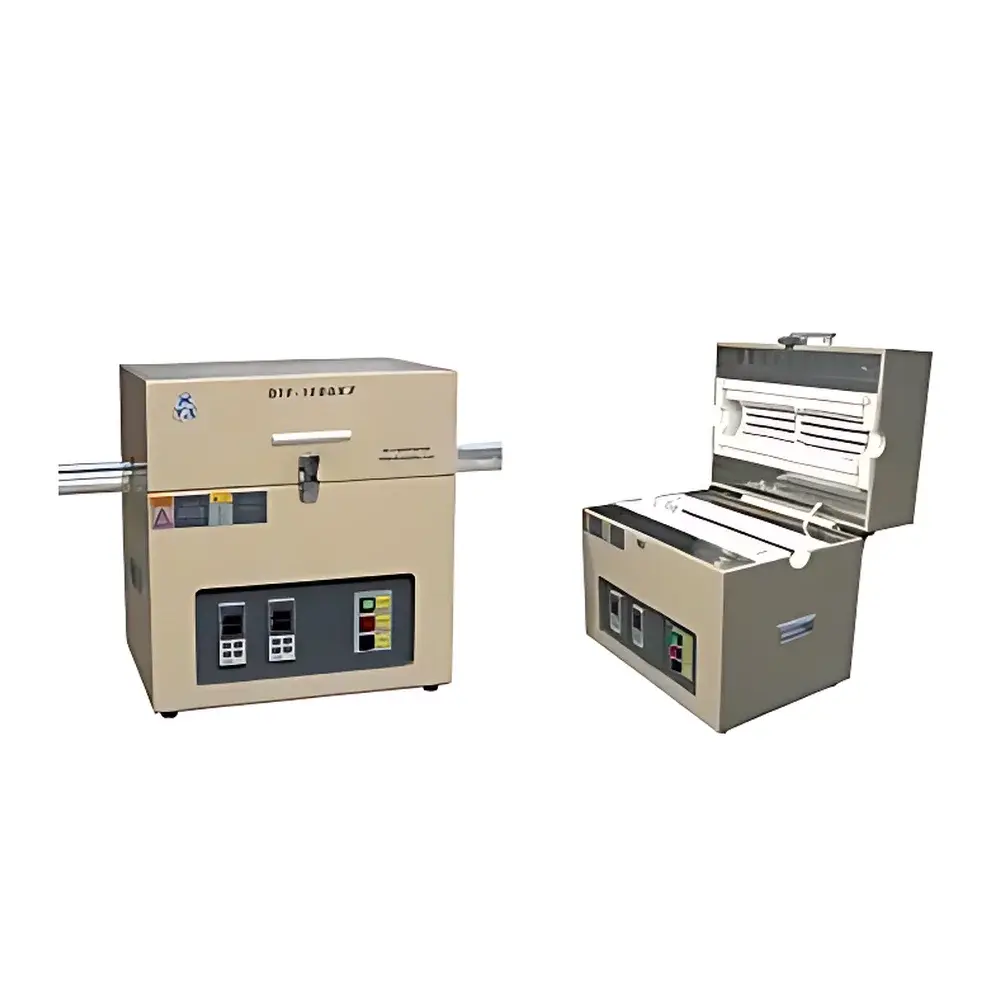
KJ GROUP OTF-1200X-II Dual-Zone Open-Type Tube Furnace with 1200°C Maximum Temperature
| Brand | KJ GROUP |
|---|---|
| Origin | Liaoning, China |
| Manufacturer Type | Authorized Distributor |
| Origin Category | Domestic (China) |
| Model | OTF-1200X-II |
| Pricing | Upon Request |
| Power Supply | AC 220 V, 50/60 Hz, 4 kW |
| Heating Zones | 2 |
| Max Operating Temperature | 1200 °C (continuous at 1100 °C) |
| Heating Length per Zone | 200 mm (total 400 mm) |
| Max Ramp Rate | 20 °C/min |
| Temperature Uniformity | ±1 °C |
| Vacuum Performance | 10⁻² Torr (mechanical pump), 10⁻⁵ Torr (turbo-molecular pump) |
| Quartz Tube Options | OD 50/60/80/100 mm, ID 44/54/74/94 mm, L 1000 mm |
| Heating Element | Mo-doped Fe-Cr-Al alloy wire with ZrO₂ coating |
| Cooling System | Dual-layer shell with forced-air circulation |
| Surface Temp | <60 °C |
| Safety Features | Over-temperature & thermocouple failure alarms |
| Controller | PID-based, 30-segment programmable ramp-soak profile |
| Certifications | CE compliant |
Overview
The KJ GROUP OTF-1200X-II is a precision-engineered dual-zone open-type tube furnace designed for high-temperature thermal processing in materials science research and thin-film fabrication. It operates on resistive heating principles using Mo-doped Fe-Cr-Al alloy elements embedded within a thermally insulated alumina-coated chamber, enabling stable, repeatable temperature control up to 1200 °C. Its defining architectural feature — two independently controllable heating zones — allows users to establish precise axial thermal gradients across the furnace tube, facilitating advanced synthesis protocols such as chemical vapor deposition (CVD), annealing of heterostructured nanomaterials, and controlled phase transformation studies. The open-ended configuration supports rapid sample insertion/removal and integration with auxiliary gas delivery, vacuum, and in-situ monitoring systems. Designed for laboratory-scale R&D environments, the furnace complies with IEC 61000-6-3 (EMC) and IEC 61000-6-2 (immunity) standards, and carries CE marking under the EU Machinery Directive 2006/42/EC.
Key Features
- Dual independent PID-controlled heating zones (each 200 mm long), enabling programmable axial temperature gradients from ambient to 1200 °C
- Dual-shell construction with integrated forced-air cooling system, maintaining external surface temperature below 60 °C during operation at maximum setpoint
- Internal chamber lined with US-sourced alumina ceramic coating for enhanced infrared reflectivity, improved thermal efficiency, and extended refractory life
- 30-segment programmable temperature profile capability with ramp rate control from 0.1 to 20 °C/min and soak stability within ±1 °C
- Comprehensive safety architecture including over-temperature cutoff, thermocouple break detection, and audible/visual alarm activation
- CE-certified design meeting essential health, safety, and environmental protection requirements for deployment in EU-accredited laboratories
Sample Compatibility & Compliance
The OTF-1200X-II accommodates standard high-purity fused quartz tubes (OD 50–100 mm, ID 44–94 mm, L 1000 mm), compatible with common CVD precursors, solid-state reactants, and substrate carriers (e.g., Si wafers, alumina boats, graphite susceptors). It supports inert, reducing, oxidizing, and low-pressure reactive atmospheres when coupled with appropriate gas manifolds and vacuum systems. For regulated environments, the furnace meets baseline requirements for GLP-compliant thermal processing workflows; optional digital vacuum gauges and PC-based data logging modules enable audit-ready record retention aligned with FDA 21 CFR Part 11 principles. All electrical interfaces conform to IEC 60364-4-41 (protection against electric shock) and IEC 60204-1 (safety of machinery – electrical equipment).
Software & Data Management
While the standard unit features an embedded 7-inch color touchscreen controller with local profile storage, optional KJ-LabControl software enables remote supervision via Ethernet or USB. This application provides real-time temperature curve visualization, event-triggered data capture (e.g., vacuum level thresholds, alarm states), and export of time-stamped CSV logs for traceability. When configured with certified digital vacuum instrumentation, the system supports electronic signature-enabled report generation suitable for internal quality audits. Firmware updates are delivered via secure HTTPS portal, ensuring continued compliance with evolving IEC 62443 cybersecurity guidelines for laboratory instrumentation.
Applications
- CVD synthesis of graphene, transition metal dichalcogenides (TMDs), and silicon carbide nanowires
- Thermal annealing of perovskite solar cell precursors under nitrogen or forming gas
- Controlled oxidation of metallic foils to fabricate scalable oxide catalyst layers
- Multi-step heat treatment of battery electrode composites (e.g., LiCoO₂, NMC cathodes)
- Diffusion bonding and intermetallic phase formation studies in refractory alloy systems
- Calibration and validation of thermocouples and pyrometers under gradient thermal fields
FAQ
What vacuum levels can be achieved with this furnace?
With a standard two-stage rotary vane mechanical pump, base pressure reaches ≤10⁻² Torr. Integration with a turbo-molecular pumping station enables ultimate vacuum down to 10⁻⁵ Torr, suitable for ultra-high-purity film growth.
Is the furnace compatible with corrosive precursor gases (e.g., Cl₂, NH₃)?
Yes — when used with quartz tubing and stainless-steel vacuum flanges (standard or optional double ferrule configurations), the system supports chemically aggressive atmospheres; however, prolonged exposure to halogens requires periodic inspection of O-rings and metallic seals.
Can I operate only one zone while keeping the other off?
Yes — each zone has fully independent power regulation and temperature feedback loops, allowing single-zone operation or counter-gradient thermal profiles.
What is the recommended maintenance schedule?
Inspect quartz tube integrity and furnace insulation annually; verify thermocouple calibration semiannually; clean air intake filters monthly under continuous use.
Does the unit support third-party SCADA integration?
Via optional RS485 Modbus RTU or Ethernet/IP interface modules, the controller outputs real-time PV, SP, and status registers for integration into centralized lab automation platforms.
Related Products



