
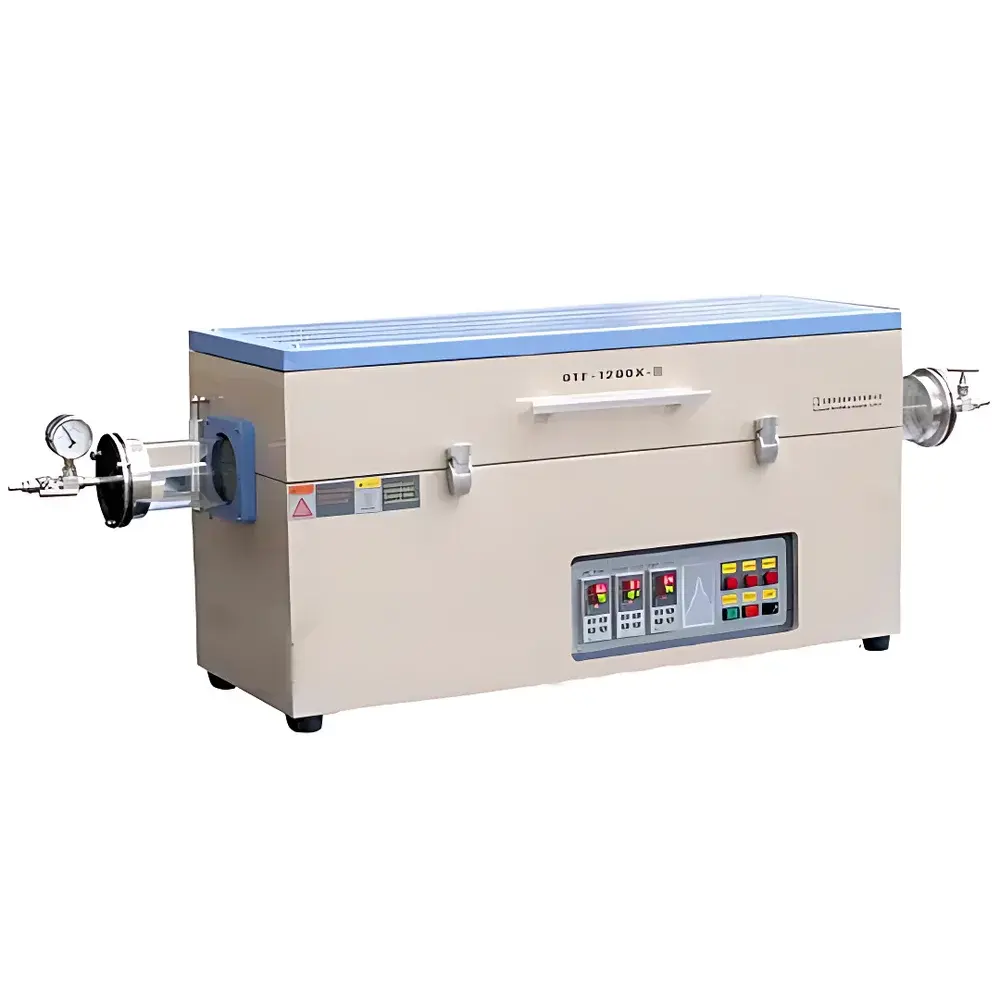
KJ GROUP OTF-1200X-III Triple-Zone Opening Tube Furnace (1200°C)
| Brand | KJ GROUP |
|---|---|
| Origin | Liaoning, China |
| Manufacturer Type | Authorized Distributor |
| Country of Origin | China |
| Model | OTF-1200X-III |
| Price | Upon Request |
| Power Supply | AC 220 V, 50/60 Hz, 7 kW |
| Max Temperature | 1200 °C (continuous at 1100 °C) |
| Heating Zones | 3 independent zones (220 mm + 440 mm + 220 mm) |
| Effective Hot Zone Length | 900 mm |
| Uniform Temperature Zone | 635 mm (when all zones set identically) |
| Max Ramp Rate | 20 °C/min |
| Temperature Control Accuracy | ±1 °C |
| Quartz Tube Dimensions | Ø60 mm OD / Ø55 mm ID × 1400 mm or Ø80 mm OD / Ø72 mm ID × 1400 mm |
| Heating Element | Mo-doped Fe-Cr-Al alloy wire |
| Insulation | High-purity polycrystalline alumina fiber |
| Chamber Coating | Imported US-sourced alumina reflective coating |
| Cooling | Dual-layer shell with forced-air circulation cooling |
| Certifications | CE compliant |
| Footprint | 1030 mm × 430 mm × 580 mm |
| Required Workbench | ≥1600 mm × 600 mm × 700 mm, load capacity ≥200 kg |
| Ambient Operating Conditions | Altitude ≤1000 m, ambient temperature 25 °C ±15 °C, relative humidity 55 %RH ±10 %RH |
| Vacuum & Atmosphere | Compatible with inert/reducing gas flow and vacuum (via optional digital vacuum gauge and modified fittings) |
Overview
The KJ GROUP OTF-1200X-III is a precision-engineered triple-zone opening tube furnace designed for high-temperature thermal processing in materials science, catalysis research, thin-film synthesis, and solid-state chemistry laboratories. Its architecture implements three physically separated heating zones—two 220 mm end zones and one central 440 mm zone—each independently controlled via dedicated PID temperature controllers. This configuration enables precise axial thermal gradient establishment, essential for processes such as controlled crystal growth, multi-step annealing, chemical vapor deposition (CVD), and diffusion studies. The furnace operates up to 1200 °C (with continuous service rated at 1100 °C), leveraging Mo-doped Fe-Cr-Al resistance heating elements embedded within high-purity polycrystalline alumina fiber insulation. A proprietary U.S.-sourced alumina reflective coating applied to the inner chamber surface enhances thermal efficiency, improves temperature uniformity, and resists contamination from volatile reaction byproducts—critical for reproducible sample outcomes in GLP-compliant environments.
Key Features
- Dual-layer stainless steel housing with integrated forced-air circulation cooling system ensures safe surface temperatures (<50 °C at 1100 °C operation) and extends structural integrity over extended duty cycles.
- Three independent 30-segment programmable PID controllers allow fully customizable ramp-hold-cool profiles across each zone—enabling complex thermal protocols such as zone-specific preheating, gradient soaking, and synchronized cooldown.
- High-density polycrystalline alumina fiber insulation provides exceptional thermal retention and low heat loss, contributing to energy efficiency and stable temperature maintenance under dynamic load conditions.
- CE-certified design complies with EN 61000-6-3 (EMC emission) and EN 61000-6-2 (immunity) standards; electrical safety conforms to IEC 61010-1 for laboratory equipment.
- Standard quartz tube (Ø60/Ø55 mm or Ø80/Ø72 mm, 1400 mm length) accommodates diverse sample geometries and process gas flow dynamics; optional double ferrule fittings support high-integrity gas delivery in CVD or annealing applications.
Sample Compatibility & Compliance
The OTF-1200X-III supports a broad range of sample formats—including powders, pellets, wafers, fibers, and coated substrates—within standard quartz tubing. Its open-ended configuration facilitates rapid sample insertion and retrieval, minimizing thermal shock and enabling sequential processing without furnace cooldown. The system is compatible with inert (Ar, N₂), reducing (H₂/N₂ mixtures), and vacuum environments (down to 10⁻² mbar with optional digital vacuum gauge). All materials in contact with the process atmosphere—including quartz tubes, alumina plugs, and internal coatings—meet ASTM C704 and ISO 13707 specifications for high-temperature ceramic purity and dimensional stability. For regulated QC/QA labs, the furnace’s repeatable thermal profiles and traceable controller logs support alignment with ISO/IEC 17025 documentation requirements.
Software & Data Management
While the OTF-1200X-III operates via front-panel PID interfaces, its controllers output analog (4–20 mA) and digital (RS485 Modbus RTU) signals for integration into centralized lab data acquisition systems. Optional PC-based software (sold separately) enables real-time temperature logging, remote parameter adjustment, and export of time-stamped CSV datasets compliant with FDA 21 CFR Part 11 audit trail requirements—including user login tracking, parameter change history, and electronic signature support. All firmware versions are version-controlled and validated per GAMP 5 guidelines for analytical instrument qualification.
Applications
- Controlled-atmosphere sintering of advanced ceramics and battery electrode materials (e.g., LiCoO₂, NMC cathodes).
- Multi-zone thermal treatment for semiconductor precursor decomposition and graphene synthesis via low-pressure CVD.
- Thermal calibration of thermocouples and reference materials per ASTM E230/E230M.
- Decomposition kinetics studies requiring precise axial temperature gradients (e.g., TGA-coupled pyrolysis).
- Post-deposition annealing of metal-organic framework (MOF) thin films under nitrogen or forming gas.
FAQ
What vacuum level can be achieved with this furnace?
With the optional digital vacuum gauge and mechanical pump (not included), base pressures of 10⁻² mbar are routinely attainable using standard quartz tube sealing techniques.
Is the furnace suitable for hydrogen atmosphere operation?
Yes—when equipped with appropriate gas train components (stainless steel lines, leak-tested fittings, and H₂-compatible flow meters), the system supports safe operation under ≤5% H₂/N₂ mixtures at elevated temperatures.
Can I upgrade to automatic gas mixing or mass flow control?
The furnace’s gas inlet ports accept standard 6 mm OD tubing; third-party MFCs and gas mixers (e.g., Brooks, Alicat) integrate seamlessly via NPT or VCR connections.
Does the unit include temperature uniformity mapping data?
A certified temperature uniformity report (±2 °C over 635 mm at 1000 °C) is provided with each shipment, generated per ASTM E220 methodology using calibrated N-type thermocouples.
What maintenance intervals are recommended for long-term reliability?
Quartz tube inspection every 50 operating hours; alumina fiber integrity assessment annually; PID controller calibration verification biannually per ISO/IEC 17025 internal procedure.



