
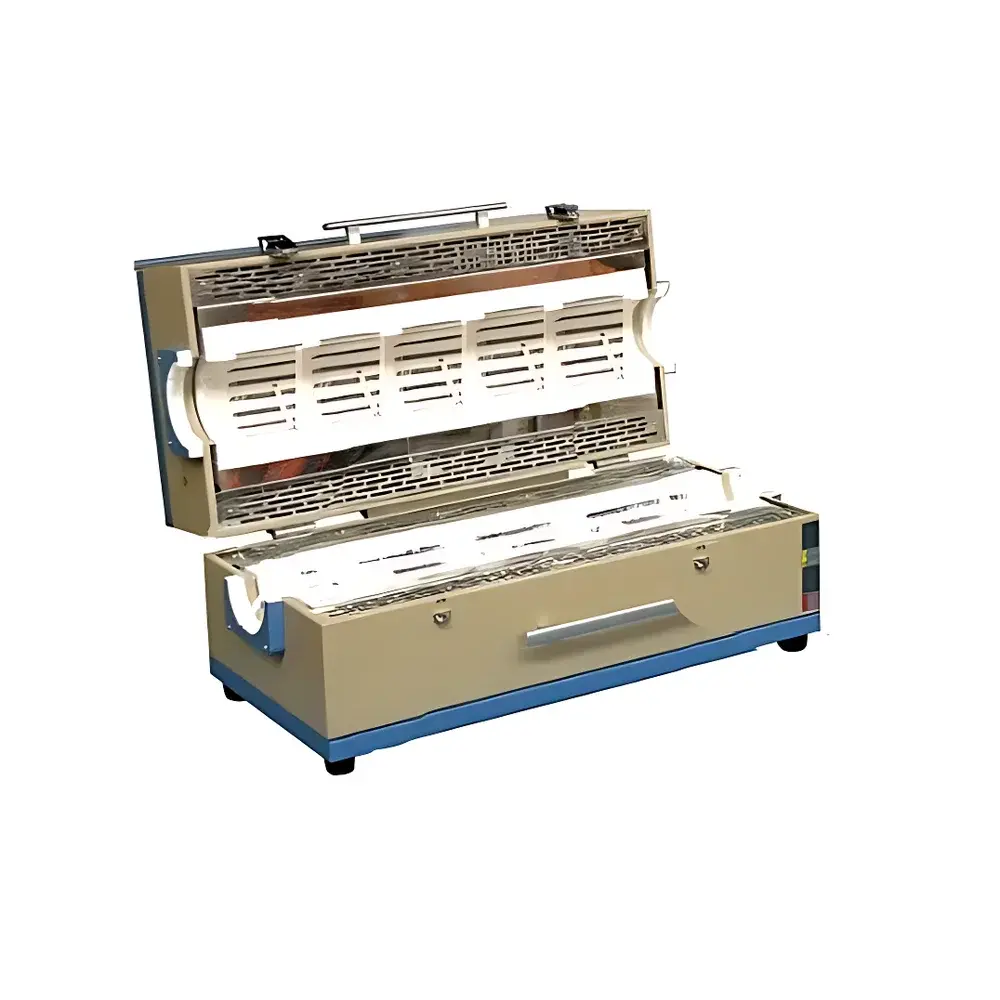
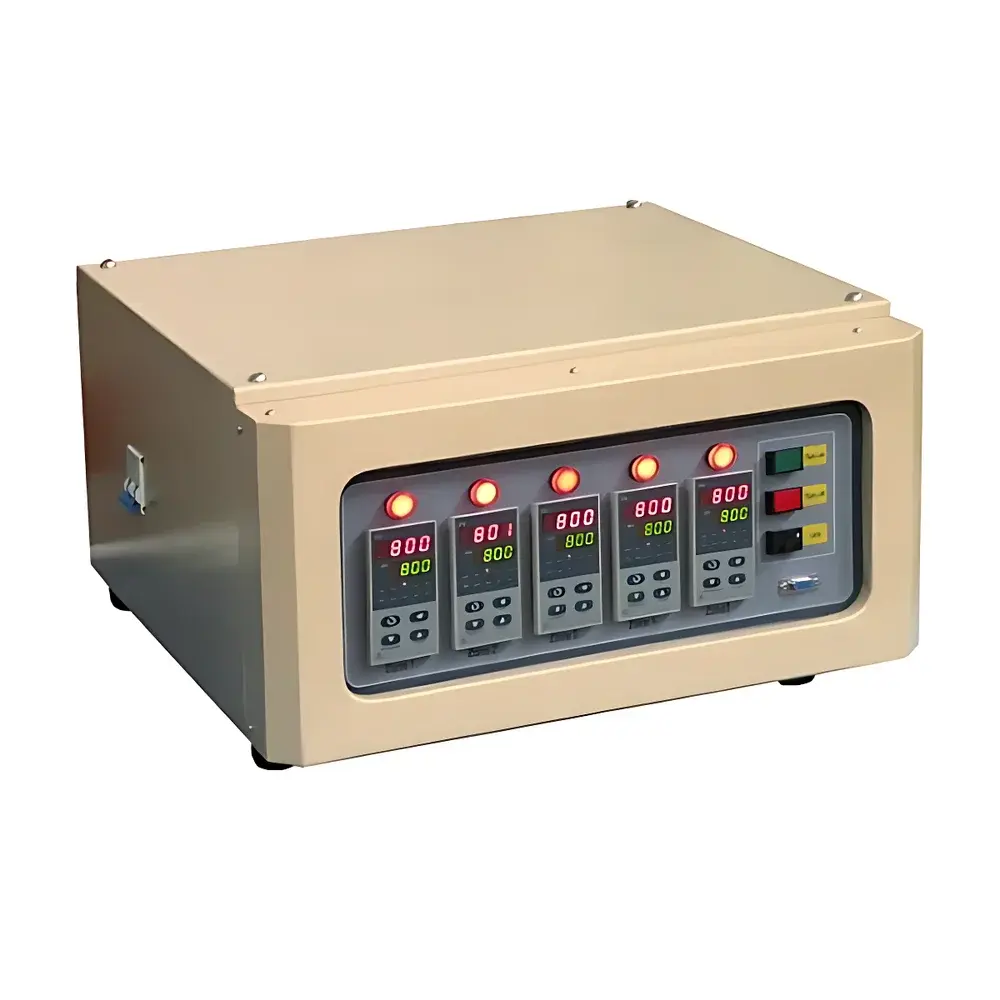
KJ GROUP OTF-1200X-V Five-Zone Independently Controlled Tube Furnace
| Brand | KJ GROUP |
|---|---|
| Origin | Liaoning, China |
| Manufacturer Type | Authorized Distributor |
| Country of Origin | China |
| Model | OTF-1200X-V (Customizable) |
| Power Supply | AC 220 V, 50/60 Hz, 8 kW (40 A circuit breaker required) |
| Max Operating Temperature | 1200 °C (continuous at 1100 °C) |
| Heating Zones | 5 × 152 mm |
| Uniform Temperature Zone | 635 mm (all zones set identically) |
| Temp. Control Accuracy | ±1 °C |
| Max Ramp Rate | 20 °C/min |
| Quartz Tube Options | OD 50/60/80/100 mm, ID 44/54/74/94 mm, L 1400 mm |
| Chamber Insulation | High-purity polycrystalline alumina fiber |
| Internal Coating | Imported US-sourced alumina reflective coating |
| Safety Features | Thermocouple failure protection, over-temperature cutoff |
| Certifications | CE compliant |
| Dimensions (W×D×H) | 1650 × 1150 × 890 mm |
| Net Weight | 113 kg |
Overview
The KJ GROUP OTF-1200X-V is a precision-engineered five-zone horizontal tube furnace designed for advanced thermal processing in materials science, catalysis research, and thin-film synthesis. Built upon a robust dual-layer stainless-steel shell architecture, it integrates independently controllable heating zones—each 152 mm in length—to enable programmable axial temperature gradients or extended uniform-temperature zones up to 635 mm. Its core thermal design leverages high-purity polycrystalline alumina fiber insulation and an internally applied U.S.-sourced alumina reflective coating, significantly reducing radial heat loss and enhancing thermal efficiency and long-term stability. The furnace operates within a validated temperature range of ambient to 1200 °C (with continuous operation rated at 1100 °C), achieving ±1 °C control accuracy via type-K thermocouples and digital PID controllers. Unlike single-zone systems, the OTF-1200X-V supports complex thermal profiles essential for solid-state reactions, controlled atmosphere annealing, and multi-step CVD/PVD precursor decomposition—making it suitable for ISO/IEC 17025-compliant laboratories requiring traceable, repeatable thermal protocols.
Key Features
- Five independent heating zones with isolated PID controllers—enabling precise axial thermal profiling (e.g., preheat → reaction → anneal → cool zones) or synchronized uniform heating across 635 mm.
- Detachable temperature control unit—allows remote operation up to 2 m from the furnace body, improving ergonomic workflow and minimizing operator exposure during high-temperature runs.
- Dual-shell construction with vacuum-rated stainless-steel outer casing and high-density polycrystalline alumina fiber insulation (thermal conductivity < 0.08 W/m·K at 1000 °C), ensuring low surface temperature (< 60 °C at ambient) and minimal energy consumption.
- Internally coated alumina reflective layer enhances infrared emissivity control and mitigates contamination from outgassing—critical for oxide film growth and dopant diffusion studies.
- Integrated safety architecture: real-time thermocouple break detection, hardware-based over-temperature cutoff (settable up to 1250 °C), and automatic power disengagement on fault detection.
- CE-certified design compliant with EN 61000-6-3 (EMC) and EN 61000-6-4 (immunity); meets mechanical safety requirements per EN 61000-1-2.
Sample Compatibility & Compliance
The OTF-1200X-V accommodates standard quartz tubes (OD 50–100 mm, ID 44–94 mm, L 1400 mm) with optional flange configurations—including vacuum-tight CF, KF, or custom double-ferrule gas inlets—for inert, reducing, oxidizing, or reactive atmospheres (e.g., NH₃, H₂, O₂, Ar). It supports vacuum operation down to 10⁻³ mbar when paired with compatible pumps (e.g., two-stage rotary vane or turbomolecular systems). All electrical and thermal subsystems adhere to IEC 61000-4-30 for power quality monitoring and are compatible with GLP/GMP environments when used with audit-trail-capable software (see Software section). The furnace satisfies ASTM E2550 (thermal stability testing) and ISO 8573-1 (compressed air purity) prerequisites for gas-integrated operation.
Software & Data Management
An optional Windows-compatible temperature control software package enables full programmatic control—including ramp/soak sequences, real-time graphing, data logging (≥1 Hz sampling), and export to CSV or Excel. The software supports 21 CFR Part 11 compliance when deployed with user authentication, electronic signatures, and immutable audit trails—essential for regulated QC/QA workflows. Hardware interface modules provide RS485/Modbus RTU or Ethernet/IP connectivity for integration into centralized lab automation systems (e.g., LabVantage, Thermo Fisher SampleManager). All firmware updates are digitally signed and version-logged to ensure traceability during instrument qualification (IQ/OQ/PQ).
Applications
- Controlled-atmosphere synthesis of transition metal oxides (e.g., LiCoO₂, Ni-rich NMC cathodes) under Ar/H₂ mixtures.
- Graphene and 2D material CVD growth using CH₄/H₂ precursors on Cu/Ni foils with gradient-driven domain alignment.
- Thermal annealing of perovskite solar cell precursors (e.g., MAPbI₃) with zone-specific dwell times to suppress halide segregation.
- Pre-sintering and calcination of ceramic powders (Al₂O₃, ZrO₂, SiC) under dynamic gas flow with integrated mass flow controllers.
- High-temperature aging tests per JEDEC JESD22-A108 for electronic packaging reliability assessment.
FAQ
What vacuum level can the furnace achieve with standard configuration?
The base system includes a vacuum-rated flange and O-ring seal; ultimate pressure depends on the connected pump—typically 10⁻³ mbar with a two-stage rotary vane pump and 10⁻⁵ mbar with a turbomolecular system.
Is the furnace compatible with corrosive gases such as Cl₂ or HF?
Quartz tubing provides limited resistance to dry Cl₂ below 500 °C; for HF or wet halogen environments, fused silica or alumina tubes (optional) and Hastelloy C-276 gas lines are strongly recommended.
Can multiple furnaces be synchronized via network control?
Yes—using the optional Ethernet/IP interface module and KJ GROUP’s centralized furnace management software, up to 16 units can be coordinated for batch process replication and cross-unit thermal profiling.
What is the recommended maintenance interval for heating elements?
Under continuous operation at ≤1100 °C, the Mo-doped Fe-Cr-Al alloy elements maintain stable resistance for ≥5,000 hours; visual inspection and resistance measurement are advised every 1,000 operational hours.
Does the CE marking cover EMC and LVD directives comprehensively?
Yes—the CE mark applies to full conformity with Low Voltage Directive 2014/35/EU and Electromagnetic Compatibility Directive 2014/30/EU, verified by TÜV SÜD test reports (available upon request).



