
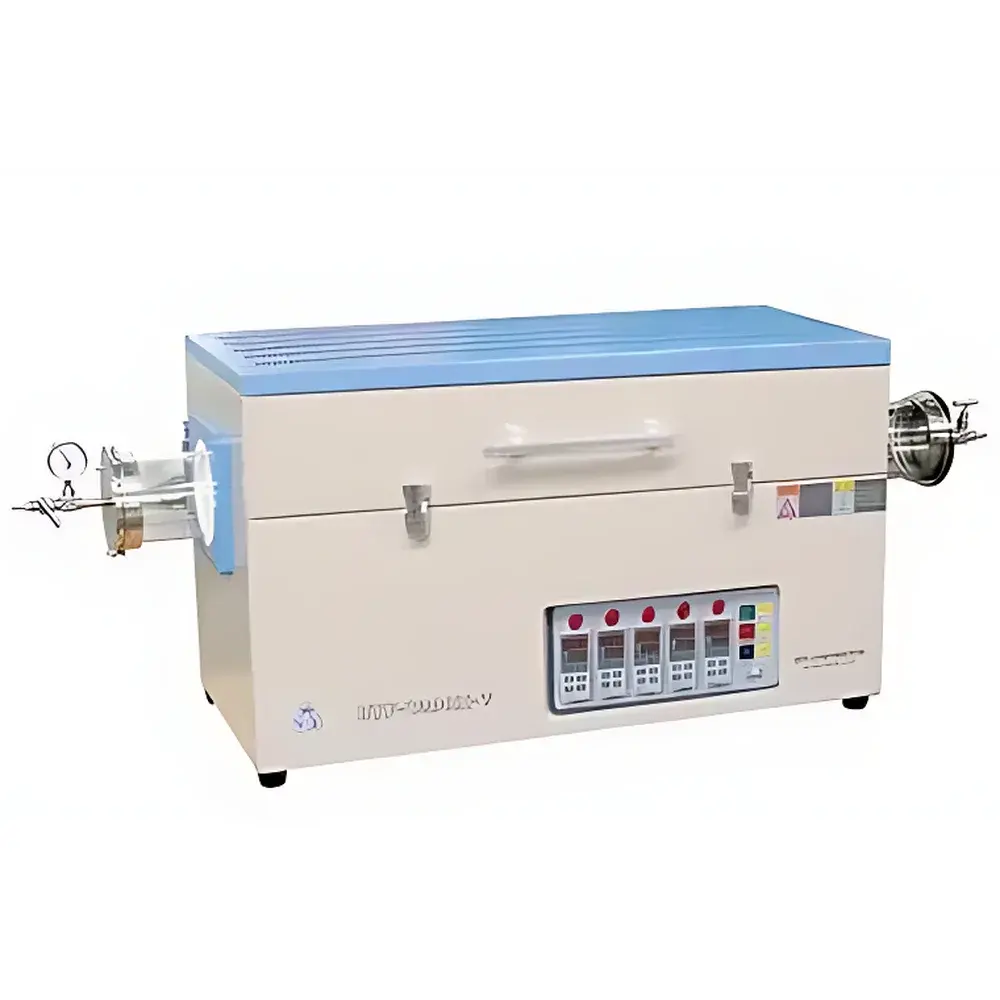
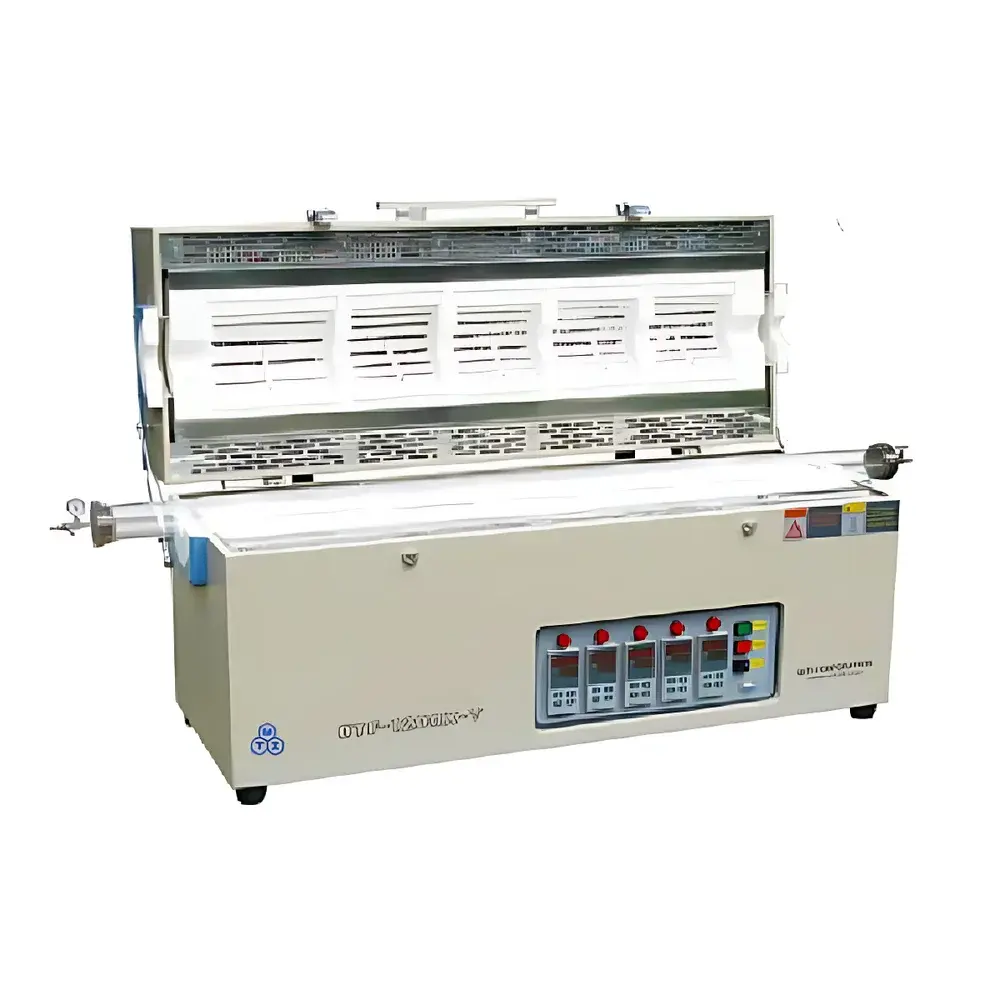
KJ GROUP OTF-1200X-V Five-Zone Split-Type Tube Furnace with Independent PID Control (1200 °C)
| Brand | KJ GROUP |
|---|---|
| Origin | Liaoning, China |
| Manufacturer Type | Authorized Distributor |
| Country of Origin | China |
| Model | OTF-1200X-V |
| Power Supply | AC 220 V, 50/60 Hz, 8 kW (40 A circuit breaker required) |
| Max. Operating Temperature | 1200 °C (continuous at 1100 °C) |
| Heating Zones | 5 independent zones (each 152 mm long) |
| Uniform Temperature Zone | 635 mm (all zones set identically) |
| Max. Ramp Rate | 20 °C/min |
| Temperature Control Accuracy | ±1 °C |
| Chamber Dimensions | Ø50–100 mm ID × 1400 mm L quartz tube options |
| Insulation | High-purity polycrystalline alumina fiber with imported Al₂O₃ surface coating |
| Cooling | Dual-layer shell with forced-air circulation cooling |
| Safety | K-type thermocouples with thermocouple break & overheat protection |
| Compliance | CE certified |
| Software Option | PC-based temperature program logging & curve export (optional interface module) |
| Vacuum & Atmosphere | Standard vacuum flange (KF25 compatible), optional gas mixing/vacuum systems |
Overview
The KJ GROUP OTF-1200X-V is a precision-engineered five-zone split-type tube furnace designed for controlled thermal processing in research and pilot-scale synthesis environments. Its core architecture implements independent PID-controlled heating zones—each 152 mm in length—enabling precise axial temperature profiling across a 1400 mm quartz reaction tube. This modular thermal design supports both gradient-based processes (e.g., zone melting, multi-step CVD precursor decomposition) and extended uniform-temperature zones up to 635 mm when all zones are synchronized. The furnace operates at a maximum temperature of 1200 °C, with continuous stability rated at 1100 °C, making it suitable for ceramic sintering, solid-state reaction studies, thin-film deposition (CVD/PVD pre-treatment), and controlled pyrolysis of precursors. Constructed with dual-layer stainless steel housing and actively cooled via integrated forced-air circulation, the system minimizes external surface temperature rise while maximizing thermal efficiency. Internal insulation utilizes high-purity polycrystalline alumina fiber with a proprietary U.S.-sourced alumina reflective coating, reducing radiant heat loss and extending service life under repeated thermal cycling.
Key Features
- Five independently controllable heating zones, each equipped with a dedicated K-type thermocouple and digital PID controller supporting up to 30-segment ramp-hold programs.
- High-stability heating elements fabricated from Mo-doped Fe-Cr-Al alloy wire, coated with zirconia for enhanced oxidation resistance at elevated temperatures.
- Optimized thermal uniformity: ±1 °C control accuracy across the entire operating range; verified uniformity profile meets ASTM E220-21 requirements for laboratory furnace qualification.
- Dual-shell construction with interstitial air-cooling channels prevents cabinet overheating and ensures safe ambient operation in shared lab spaces.
- CE-certified electrical architecture including over-temperature cutoff, thermocouple failure detection, and grounded 220 V / 8 kW power input (40 A dedicated circuit required).
- Standard vacuum-ready configuration: includes CF/KF25-compatible flanges, vacuum seal gaskets, and pre-installed thermocouple feedthroughs—compatible with turbomolecular or two-stage rotary vane pumping systems.
Sample Compatibility & Compliance
The OTF-1200X-V accommodates standard high-purity quartz tubes (ID 44–94 mm, OD 50–100 mm, L = 1400 mm), enabling compatibility with diverse sample geometries—from powder-packed boats and crucibles to suspended filament substrates. Optional accessories include alumina and fused quartz crucibles, graphite susceptors, and gas distribution manifolds for reactive or inert atmosphere processing (N₂, Ar, O₂, NH₃, forming gas). All materials contacting the hot zone conform to ISO 8502-3 purity specifications for low-metallic leaching. The furnace satisfies structural and operational requirements outlined in ISO/IEC 17025:2017 for accredited testing laboratories and supports GLP-compliant data integrity when paired with the optional PC-based temperature logging software (21 CFR Part 11 audit trail functionality available via third-party validation package).
Software & Data Management
An optional USB-enabled temperature control interface module enables bidirectional communication between the furnace’s embedded controllers and Windows-based host software. Users can upload, edit, and execute multi-zone thermal profiles; log real-time temperature data at configurable intervals (1–60 s); and export time-stamped CSV files containing zone-specific thermocouple readings, power output, and alarm status flags. The software supports overlay plotting of multiple runs for comparative kinetic analysis and integrates with MATLAB and Python via standard serial protocols. For regulated environments, optional IQ/OQ documentation packages and electronic signature modules are available to support FDA 21 CFR Part 11 compliance during equipment qualification.
Applications
This furnace serves as a foundational platform for advanced materials synthesis workflows, including but not limited to: (1) Solid-state synthesis of Li-ion cathode materials (e.g., NMC, LFP) with staged calcination profiles; (2) Low-pressure chemical vapor deposition (LPCVD) of transition metal dichalcogenides (MoS₂, WS₂); (3) Thermal annealing of sol-gel-derived oxide films on silicon wafers; (4) Controlled carbothermal reduction of metal oxides; (5) Graphitization of polymer-derived ceramics; and (6) Inert-atmosphere sintering of piezoelectric PZT and MLCC dielectrics. Its five-zone flexibility allows researchers to decouple nucleation, growth, and coarsening stages within a single run—reducing batch-to-batch variability and accelerating process optimization cycles.
FAQ
What vacuum level can be achieved with the standard configuration?
The base system supports rough vacuum down to 10⁻² mbar using a two-stage rotary vane pump (optional); for high-vacuum applications (<10⁻⁵ mbar), a turbomolecular pump with KF40 interface is recommended.
Can the furnace operate under positive pressure?
Yes—when equipped with pressure-rated quartz tubing and appropriate gas mass flow controllers, it supports up to 2 bar(g) inert gas pressure with proper safety relief provisions.
Is remote monitoring supported?
The optional software interface provides local network access via Ethernet-to-USB bridge; integration with LabVIEW or SCADA systems is possible using Modbus RTU over RS485 (hardware adapter sold separately).
What maintenance is required for long-term reliability?
Annual inspection of heating element continuity, thermocouple calibration verification, and replacement of quartz tube O-rings are recommended; no lubrication or consumable parts are required in the heating assembly.
Does the system comply with electromagnetic compatibility (EMC) standards?
Yes—CE marking confirms compliance with EN 61000-6-3 (emission) and EN 61000-6-2 (immunity) for laboratory environments.
Related Products



