
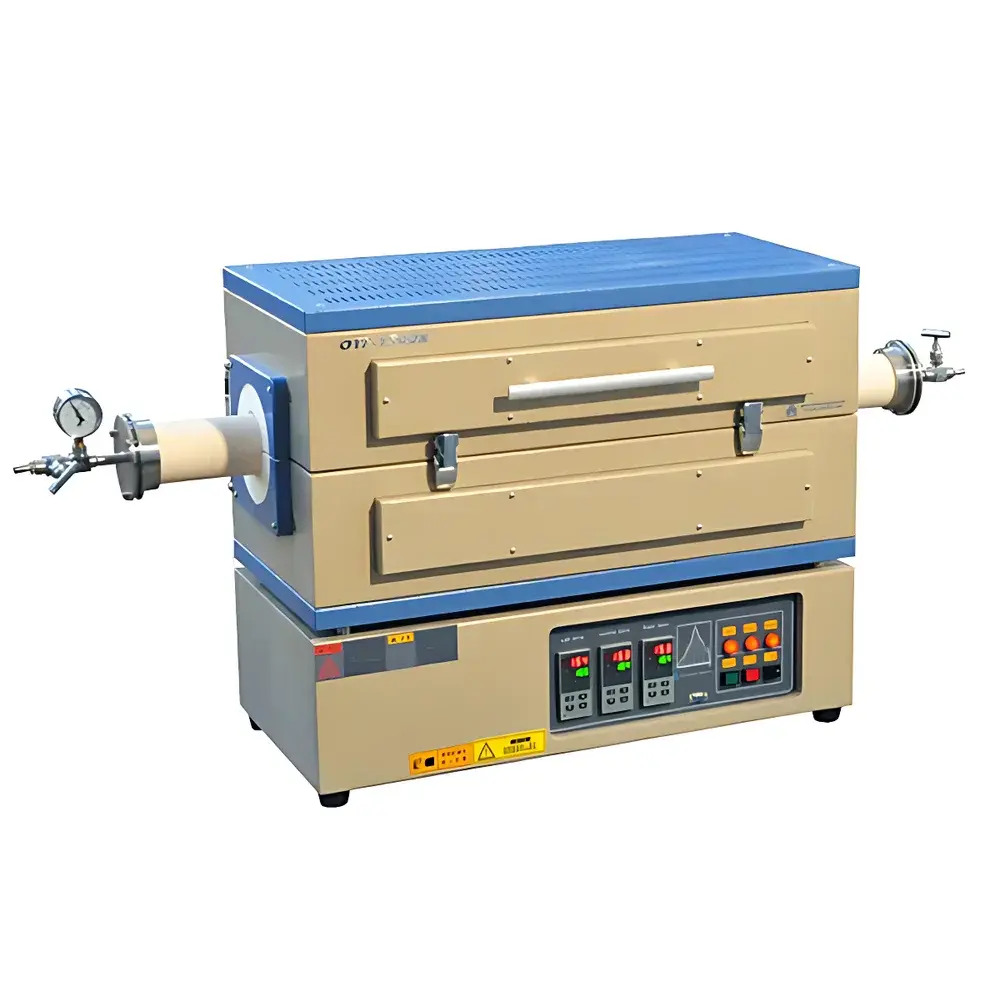
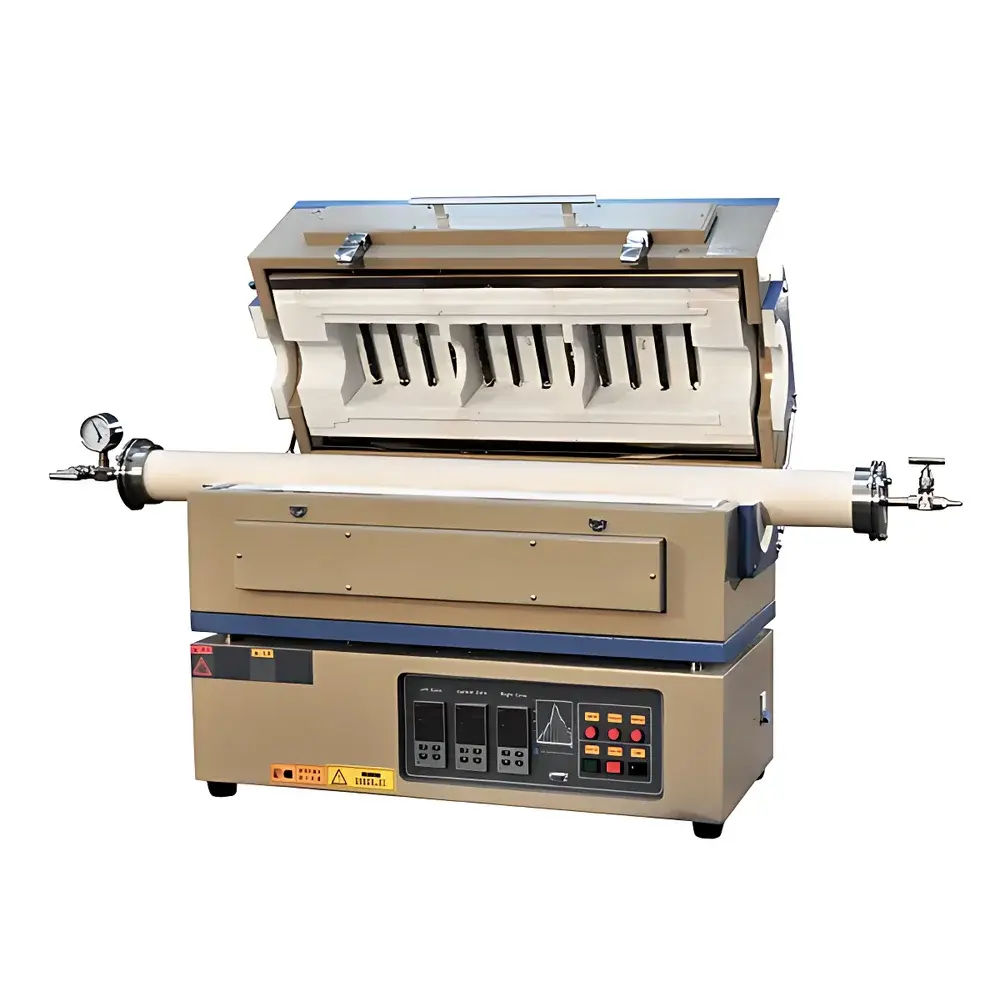
KJ GROUP OTF-1500X-III Triple-Zone Opening Tube Furnace (1500°C)
| Brand | KJ GROUP |
|---|---|
| Origin | Liaoning, China |
| Manufacturer Type | Authorized Distributor |
| Origin Category | Domestic (China) |
| Model | OTF-1500X-III |
| Pricing | Upon Request |
| Power Supply | AC 220 V, 50/60 Hz, 6.6 kW |
| Max Temperature | 1500 °C |
| Continuous Operating Temp | 1400 °C |
| Heating Zones | 3 (200 mm each) |
| Uniform Zone Length | 350 mm |
| Tube Dimensions | Ø80 mm OD × Ø71 mm ID × 1200 mm L |
| Heating Element | Silicon Carbide Rods |
| Insulation | High-Purity Alumina Fiber + Imported Al₂O₃ Reflective Coating |
| Control Precision | ±1 °C |
| Vacuum Level | 10⁻³ torr (mechanical pump), 10⁻⁵ torr (turbo-molecular pump) |
| Cooling | Dual-layer shell with forced-air cooling |
| Surface Temp | <60 °C |
| Certification | CE |
| Weight | 110 kg |
| Footprint | 860 × 280 × 680 mm |
| Recommended Ramp Rate | 5 °C/min |
| Thermocouples | Three S-type |
| Standard Accessories | 1× mullite tube, 3× S-type thermocouples |
| Optional | PC-based control software |
Overview
The KJ GROUP OTF-1500X-III is a precision-engineered triple-zone opening tube furnace designed for high-temperature thermal processing under controlled atmospheres or vacuum conditions. Based on resistive heating via silicon carbide (SiC) elements and insulated with high-purity alumina fiber, the furnace delivers stable, repeatable temperature profiles across three independently controlled axial zones—each spanning 200 mm—with an overall uniform heating zone of 350 mm when operated in synchronized mode. Its maximum operating temperature of 1500 °C (continuous use up to 1400 °C) supports demanding applications including solid-state synthesis, ceramic sintering, thin-film annealing, and precursor decomposition in CVD and ALD precursor studies. The furnace’s modular design enables rapid sample insertion and removal, while its dual-shell construction with integrated forced-air cooling ensures operator safety and long-term thermal stability—surface temperature remains below 60 °C even at full power.
Key Features
- Triple independent PID-controlled heating zones, each supporting 30-segment programmable ramp-soak profiles for precise thermal gradient engineering
- Dual-layer stainless steel housing with active air-cooling system, minimizing external surface temperature to <60 °C during operation
- High-efficiency furnace chamber lined with high-purity alumina fiber insulation and coated with imported Al₂O₃ reflective layer to enhance radiative heat transfer and extend service life
- Vacuum-compatible flanged end caps with standard Swagelok-compatible (Brahma-style) inlet/outlet ports; optional upgrade to double-ferrule VCR fittings available
- Integrated overheat protection and thermocouple break detection for fail-safe operation
- CE-certified design compliant with EN 61000-6-2 (EMC immunity) and EN 61000-6-4 (EMC emissions) standards
Sample Compatibility & Compliance
The OTF-1500X-III accommodates cylindrical samples up to Ø71 mm in diameter within its 1200 mm-long mullite tube (Ø80 mm OD). It supports inert (Ar, N₂), reducing (H₂/N₂), oxidizing (O₂), and vacuum environments—making it suitable for materials processing requiring strict atmospheric control per ASTM E29-23 (standard practice for indicating significant digits), ISO 17025-accredited lab workflows, and GLP-compliant thermal treatment protocols. Vacuum performance—down to 10⁻³ torr with a standard rotary vane pump or 10⁻⁵ torr with an optional turbo-molecular pumping station—meets requirements for low-contamination oxide growth and dopant diffusion studies. All electrical interfaces comply with IEC 61000-3-2 (harmonic current limits) and are grounded per IEC 61000-6-3 for laboratory electromagnetic compatibility.
Software & Data Management
While the furnace ships with a front-panel 7-inch touchscreen controller featuring intuitive menu navigation and real-time graphing of all three zone temperatures, optional PC-based software enables remote monitoring, data logging at user-defined intervals (≥1 Hz), and export to CSV or MATLAB-compatible formats. The software supports alarm event tagging, audit trail generation, and password-protected parameter locking—features aligned with FDA 21 CFR Part 11 requirements for electronic records and signatures when deployed in regulated R&D or pilot-scale manufacturing environments. Data integrity is preserved via non-volatile memory backup and time-stamped thermal profiles traceable to NIST-traceable S-type thermocouples.
Applications
- Controlled-atmosphere annealing of transition metal oxides for battery cathode optimization
- Sintering of YSZ, AlN, and SiC ceramics under nitrogen or argon
- Thermal decomposition of metal-organic frameworks (MOFs) into porous carbons
- Growth of graphene and 2D chalcogenides via ambient-pressure or low-pressure CVD
- Calibration of high-temperature reference materials per ISO/IEC 17025 clause 5.10.4
- Thermogravimetric pre-treatment stages prior to XRD or SEM analysis
FAQ
What vacuum level can be achieved with the standard configuration?
With the included mechanical pump, the system reaches ≤10⁻³ torr. For ultra-high vacuum applications (e.g., oxide epitaxy), a turbo-molecular pump package is available as an add-on option.
Is the furnace compatible with hydrogen gas environments?
Yes—when equipped with appropriate leak-tested flanges and H₂-rated seals, the OTF-1500X-III supports safe operation in forming gas (5% H₂/95% N₂) or pure H₂ up to 1 atm, provided proper ventilation and gas monitoring are implemented per NFPA 55 guidelines.
Can all three zones operate at different setpoints simultaneously?
Yes—each zone has fully independent temperature control, enabling precise axial thermal gradients (e.g., 800–1200–800 °C) for zone melting or directional solidification experiments.
What maintenance is required for long-term reliability?
Annual inspection of SiC rod resistance, thermocouple calibration verification, and cleaning of fiber insulation surfaces with dry nitrogen are recommended. Mullite tubes should be replaced after ~200 cycles above 1300 °C to maintain dimensional stability.
Does the unit support integration into automated process lines?
Yes—the RS485 Modbus RTU interface allows bidirectional communication with PLCs or SCADA systems for centralized thermal process orchestration in pilot-scale production environments.



