
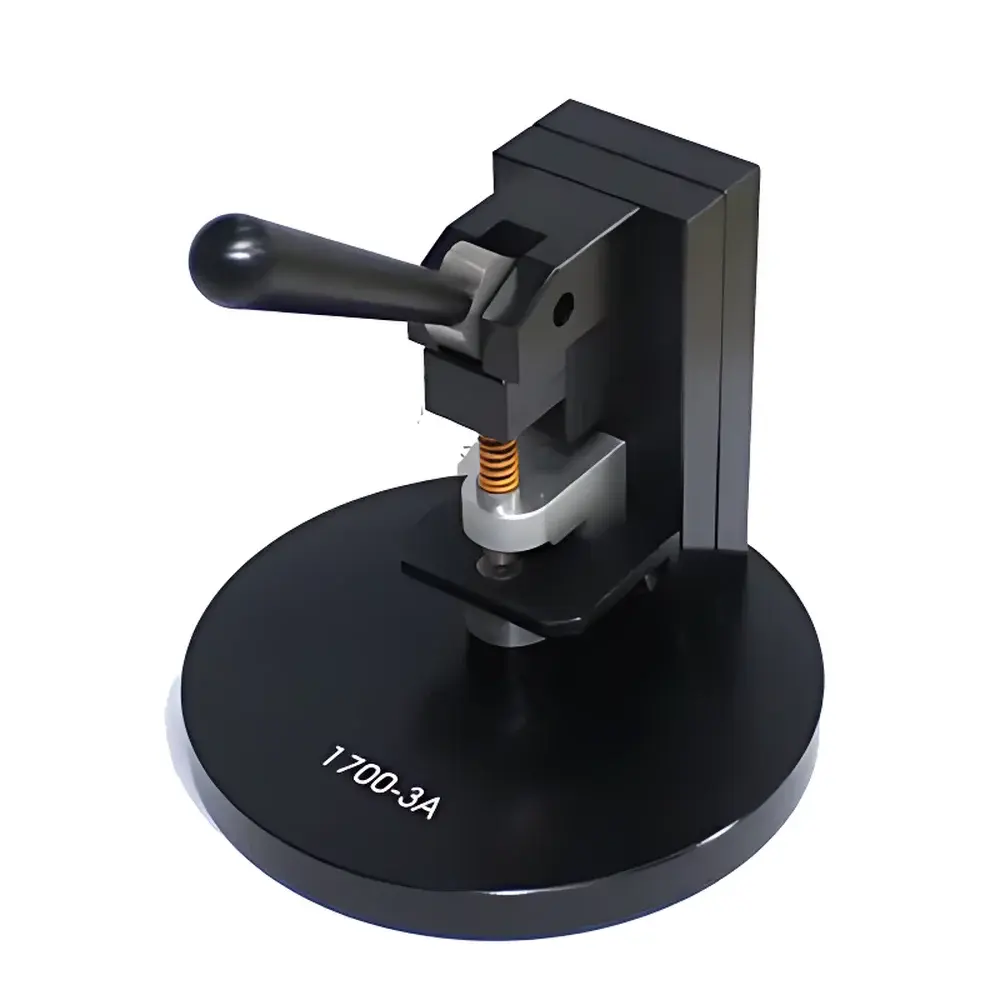
KJ GROUP PM200 TEM Metal Disc Punching Tool
| Brand | KJ GROUP |
|---|---|
| Origin | Liaoning, China |
| Manufacturer Type | Authorized Distributor |
| Origin Category | Domestic (China) |
| Model | PM200 |
| Pricing | Available Upon Request |
| Sample Diameter | φ3 mm |
| Foil Thickness Range | 50–120 µm |
| Rated Punch Cycles | ≥20,000 |
| Punch Clearance | 1.5 mm |
| Dimensions | 100 × 100 × 120 mm |
| Weight | 1 kg |
Overview
The KJ GROUP PM200 TEM Metal Disc Punching Tool is a precision-engineered mechanical specimen preparation instrument designed specifically for the fabrication of electron-transparent thin discs from ductile metallic foils in transmission electron microscopy (TEM) workflows. It operates on a lever-actuated, cold-punching principle—relying on controlled mechanical force to shear circular specimens without thermal degradation, plastic flow distortion, or edge delamination. Unlike manual drilling or chemical thinning methods, the PM200 delivers geometrically accurate, stress-free φ3 mm discs with minimal burr formation and consistent thickness retention across the disc perimeter. Its design eliminates operator-induced variability in sample geometry—a critical requirement for high-resolution TEM imaging, electron diffraction analysis, and subsequent focused ion beam (FIB) lift-out preparation. The tool supports both vertical and horizontal orientations, enabling seamless integration into cleanroom benchtop setups and automated sample handling environments.
Key Features
- Lever-based mechanical actuation reduces required hand force by >60% versus conventional press tools, ensuring ergonomic operation during high-throughput sample preparation sessions.
- High-precision tungsten carbide punch assembly—CNC-machined to ≤±1 µm concentricity tolerance—ensures repeatable disc diameter control and minimizes radial deformation during shearing.
- Heat-treated punch surface hardness exceeds 62 HRC, enabling ≥20,000 burr-free punching cycles on copper, aluminum, nickel, and stainless steel foils (50–120 µm thick).
- Aluminum alloy base structure (6061-T6) with sandblasted anodized finish provides dimensional stability, corrosion resistance, and tactile feedback during alignment and loading.
- Integrated spring-assisted return mechanism ensures consistent stroke recovery and eliminates residual compression in the foil substrate.
- Automatic ejection system: In horizontal configuration, punched discs drop freely into a collection tray; in vertical mode, a spring-loaded ejector pin dislodges the disc post-stroke for rapid manual retrieval.
- Modular die interface allows field replacement of punch/die sets for custom diameters (e.g., φ2 mm, φ4 mm, φ5 mm) without recalibration or structural modification.
Sample Compatibility & Compliance
The PM200 is validated for use with annealed and cold-rolled metallic foils exhibiting yield strengths below 450 MPa and elongation at break ≥15%, including but not limited to Cu, Al, Ti, Ni, Fe–Ni alloys, and austenitic stainless steels (e.g., 304, 316). It is incompatible with brittle intermetallics, heavily work-hardened alloys, or layered composites lacking through-thickness ductility. All components comply with ISO 9001 manufacturing traceability standards. While not certified to GLP or GMP frameworks per se, its deterministic mechanical operation and lack of consumables (e.g., solvents, blades) support audit-ready documentation under ASTM E1122 (Standard Guide for Preparing Metallic Specimens for Microstructural Analysis) and ISO/IEC 17025-compliant laboratory quality systems.
Software & Data Management
The PM200 is a fully mechanical, non-electronic instrument and requires no firmware, drivers, or software. All operational parameters—including punch count, orientation mode, foil batch ID, and operator initials—are recorded manually in lab notebooks or integrated LIMS platforms via standardized metadata templates. For laboratories implementing digital workflow tracking, optional barcode-labeled punch/die sets and serialized tool IDs facilitate traceability in accordance with FDA 21 CFR Part 11 Annex 11 requirements when paired with compliant electronic record systems.
Applications
- Routine preparation of φ3 mm TEM discs from bulk metal foils prior to ion milling or electropolishing.
- Pre-fabrication of site-specific lift-out candidates for dual-beam FIB-SEM cross-sectioning.
- Quality control sampling in metallurgical R&D labs assessing grain structure evolution after thermomechanical processing.
- Standardized specimen generation for inter-laboratory round-robin studies requiring metrologically equivalent starting geometries.
- Teaching laboratories conducting hands-on TEM sample prep training—leveraging its intuitive operation and visual stroke feedback.
FAQ
What is the maximum foil thickness the PM200 can process reliably?
The PM200 is optimized for foils between 50 µm and 120 µm. Thicker foils (>120 µm) may cause premature punch wear or incomplete shearing due to increased shear load.
Can the PM200 be used with non-metallic materials such as polymer films or ceramics?
No. Its punch geometry, clearance, and force profile are calibrated exclusively for ductile metals. Brittle or viscoelastic materials will fracture unpredictably or clog the die cavity.
How is punch life monitored in practice?
Users log cumulative punch counts in a maintenance log. Visual inspection for edge rounding or burr height >5 µm using optical microscopy indicates end-of-life; replacement punch kits are available with calibration certificates.
Is the horizontal auto-feed configuration compatible with vacuum transfer cassettes?
Yes—the ejected discs fall cleanly into standard 3 mm TEM grid storage boxes or custom-designed vacuum-compatible trays, supporting downstream glovebox or load-lock integration.
Does KJ GROUP provide calibration services or traceable certification for the PM200?
While the tool itself does not require periodic calibration, KJ GROUP offers optional NIST-traceable dimensional verification reports for new punch/die sets upon request, aligned with ISO/IEC 17025-accredited metrology partners.



