
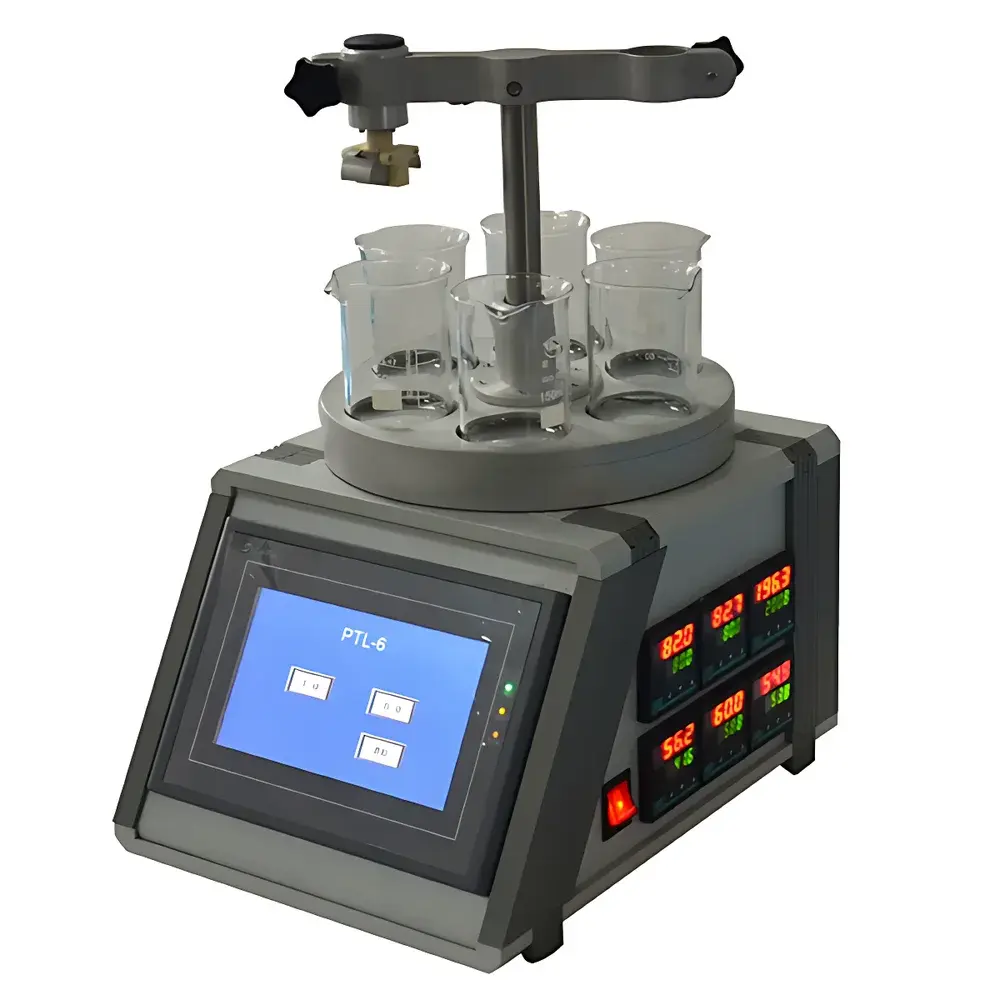
KJ GROUP PTL-6PB Six-Station Dip Coating System
| Brand | KJ GROUP |
|---|---|
| Origin | Liaoning, China |
| Manufacturer Type | Authorized Distributor |
| Country of Origin | China |
| Model | PTL-6PB |
| Certification | CE-compliant |
| Power Supply | AC 220 V, 50 Hz, 1200 W |
| Dimensions (W×D×H) | 260 × 340 × 420 mm |
| Weight | 15 kg |
| Sample Holder Dimensions | 75 × 25 × 2 mm |
| Effective Immersion Length | 60 mm |
| Load Cup Capacity | 150 mL (6 units) |
| Heating Range | RT–100 °C (independently controllable per station) |
| Dip Speed | 1–400 mm/min (auto), 1–150 mm/min (manual) |
| Withdrawal Cycles | 1–45 |
| Immersion/Drying Time | 1–999 s |
| Stroke Adjustment | 1–80 mm |
| Stirring Speed | 1–5 rpm (per station, individually switchable) |
| Ambient Operating Conditions | Altitude ≤1000 m, Temperature 10–40 °C, Humidity 45–65 %RH |
| Footprint Requirement | ≥500 × 800 mm, Load Capacity ≥50 kg |
Overview
The KJ GROUP PTL-6PB Six-Station Dip Coating System is a precision-engineered laboratory instrument designed for controlled, reproducible thin-film deposition via vertical dip coating. It operates on the principle of immersing a substrate into a liquid precursor or molten film-forming material, followed by controlled withdrawal at a defined velocity to govern film thickness through hydrodynamic and evaporation-driven mechanisms—consistent with the Landau–Levich–Derjaguin theoretical framework. The system supports parallel processing across six independent stations, each equipped with programmable thermal control, rotational motion, and synchronized immersion/drying cycles. Its compact footprint (260 × 340 × 420 mm) and modular architecture make it suitable for academic research labs, materials science R&D groups, and QC environments where space efficiency and multi-condition screening are critical.
Key Features
- Six fully independent coating stations with individual PID temperature controllers (RT–100 °C range), enabling simultaneous evaluation of multiple formulations or thermal protocols.
- High-resolution stepper motor drive system ensures precise withdrawal speed control from 1 to 400 mm/min (auto mode) and 1 to 150 mm/min (manual mode), with repeatability better than ±0.5% of setpoint under standard lab conditions.
- Programmable immersion time (1–999 s), drying time (1–999 s), withdrawal cycles (1–45), and stroke length (1–80 mm) via intuitive front-panel interface—no external PC required for basic operation.
- Substrate rotation capability: Each sample holder rotates counterclockwise during immersion to promote uniform meniscus contact and minimize edge effects; rotation is configurable per station.
- Stirring function (1–5 rpm) available per station, independently activatable to maintain homogeneity of viscous or particle-laden solutions during dwell time.
- CE-marked design compliant with EN 61000-6-2 (immunity) and EN 61000-6-4 (emission) standards; includes grounded AC 220 V / 50 Hz input and internal overtemperature protection.
Sample Compatibility & Compliance
The PTL-6PB accommodates rigid planar substrates up to 75 × 25 × 2 mm, with an effective immersion length of 60 mm. It is compatible with solvent-based polymer solutions, colloidal suspensions, sol-gel precursors, and thermoplastic melts that exhibit Newtonian or mildly shear-thinning behavior within the operational viscosity range (typically <10⁴ mPa·s at coating temperature). The 150 mL borosilicate glass load cups resist chemical corrosion from common organic solvents (e.g., chloroform, toluene, DMF) and aqueous media. While not intrinsically certified to ISO/IEC 17025 or GLP, the system’s parameter logging capability (via optional RS232/USB interface) supports traceability requirements for method validation in regulated environments. Users implementing SOPs may reference ASTM D1308 (coating uniformity assessment) or ISO 2137 (dip coating procedure guidelines) when defining test protocols.
Software & Data Management
The PTL-6PB operates natively via its embedded microcontroller-based interface with real-time LED display and tactile keypad navigation. For advanced data handling, an optional communication module enables serial (RS232) or USB connectivity to Windows-based PCs. Compatible KJ GROUP LabControl software provides remote parameter configuration, runtime monitoring, event-triggered data capture (time-stamped speed, temperature, position), and CSV export for post-processing in MATLAB, Python, or Excel. Audit trail functionality—including user login, parameter changes, and cycle completion logs—is configurable to align with FDA 21 CFR Part 11 readiness requirements when deployed in GMP-aligned laboratories.
Applications
- Preparation of metal oxide thin films (e.g., TiO₂, SiO₂, ZnO) via sol-gel dip coating for photovoltaic, photocatalytic, and gas sensing applications.
- Deposition of conductive polymer layers (e.g., PEDOT:PSS, PANI) onto ITO/glass substrates for flexible electronics prototyping.
- Multi-variable optimization studies: Screening solvent composition, concentration, withdrawal speed, and annealing temperature in a single experimental run.
- Teaching laboratories: Demonstrating fundamentals of interfacial rheology, capillary rise, and thickness–velocity relationships without requiring vacuum or cleanroom infrastructure.
- Quality assurance of coating consistency across batch-produced optical filters, anti-reflective layers, or biomedical hydrogel coatings.
FAQ
What substrate geometries can be accommodated beyond the standard 75 × 25 × 2 mm size?
Custom fixtures (e.g., dual-sample holders, extended-length clamps) are available as optional accessories; maximum usable width remains constrained by the 60 mm immersion window and cup diameter.
Is inert atmosphere operation supported?
No built-in gas purging or glovebox integration is provided; however, the unit may be placed inside externally supplied nitrogen- or argon-purged enclosures, subject to clearance verification.
Can the heating function be disabled for ambient-temperature coating?
Yes—each station’s heater can be deactivated independently while retaining full control over immersion, withdrawal, and rotation parameters.
How is calibration verified for withdrawal speed accuracy?
Users may perform traceable verification using a calibrated linear encoder or high-speed video analysis against a ruled scale; KJ GROUP supplies a calibration certificate template upon request.
Are replacement load cups and O-rings available as consumables?
Yes—borosilicate glass cups (P/N: PTL-CUP-150) and silicone sealing kits (P/N: PTL-SEAL-KIT) are stocked and shipped globally within 5 business days.



