
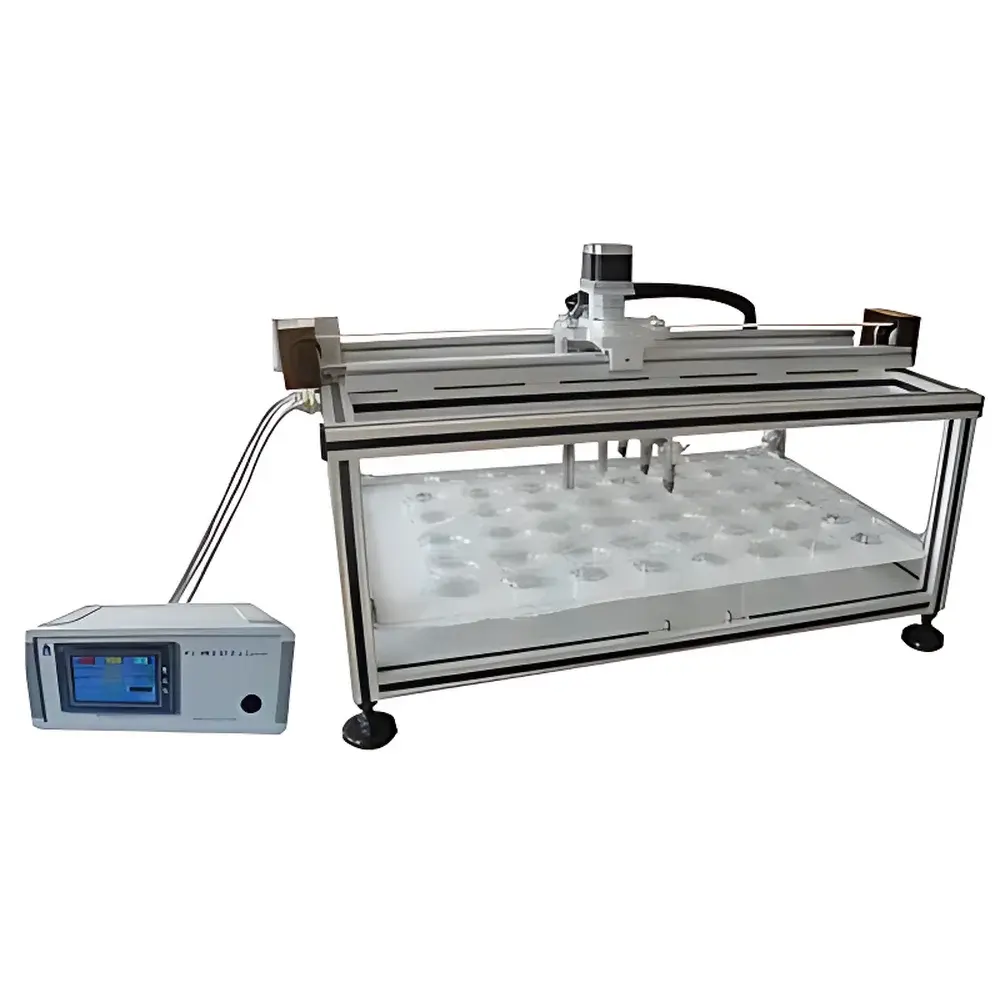
KJ GROUP PTL-MM02-8P Dip Coating System
| Brand | KJ GROUP |
|---|---|
| Origin | Liaoning, China |
| Manufacturer Type | Authorized Distributor |
| Country of Origin | China |
| Model | PTL-MM02-8P |
| Power Supply | AC 220 V, 50 Hz |
| X-axis Speed Range | 500–5000 mm/min |
| Z-axis Speed Range | 1–200 mm/min |
| Effective Immersion Length | 65 mm |
| Sample Dimensions (per substrate) | 75 × 25 × 2.5 mm |
| Max Simultaneous Substrates | 5 |
| Substrate Positions per Batch | 8 |
| Immersion & Drying Time Range | 1–999 s |
| Cycle Count Range | 1–999 |
| Operating Ambient | ≤1000 m altitude, 10–40 °C, 45–65 %RH |
| Footprint | 900 × 520 × 540 mm |
| Weight | 20 kg |
Overview
The KJ GROUP PTL-MM02-8P Dip Coating System is a precision-engineered laboratory instrument designed for controlled thin-film deposition via vertical immersion and withdrawal (dip coating) of substrates into liquid precursor solutions. Based on the classical Landau–Levich–Derjaguin hydrodynamic model, this system enables reproducible fabrication of uniform, thickness-tunable films—including sol-gel oxides, polymers, perovskites, and functional nanocomposites—by precisely regulating withdrawal velocity, immersion dwell time, and cycle repetition. Its modular architecture supports parallel processing of up to five substrates simultaneously, each with eight independently programmable coating positions, making it especially suited for high-throughput screening in materials science research, optical coating development, and functional surface engineering.
Key Features
- Eight independent coating stations per substrate holder—each configurable with unique withdrawal speed (1–200 mm/min), immersion duration (1–999 s), drying interval (1–999 s), and cycle count (1–999)—enabling multi-parameter combinatorial studies within a single run.
- High-resolution stepper motor drive system ensures stable, jitter-free vertical (Z-axis) motion with repeatability better than ±0.5% across the full speed range; X-axis translation (sample loading/unloading) operates at 500–5000 mm/min for efficient batch handling.
- Intuitive 7-inch capacitive touchscreen HMI with embedded control firmware allows direct parameter entry, real-time status monitoring, and recipe storage—no external PC required for basic operation.
- Compact footprint (900 × 520 × 540 mm) and low mass (20 kg) facilitate integration into standard fume hoods or confined lab benches without structural reinforcement.
- CE-marked design complies with EN 61000-6-2 (immunity) and EN 61000-6-4 (emission) standards; safety interlocks include dual-position transparent acrylic shielding and emergency stop circuitry.
Sample Compatibility & Compliance
The PTL-MM02-8P accommodates rigid planar substrates measuring 75 × 25 × 2.5 mm (L × W × T), including glass slides, silicon wafers, ITO-coated PET, stainless steel coupons, and ceramic tiles. Its open-bath configuration permits use with aqueous, alcoholic, and low-viscosity organic solvent-based precursors (e.g., titanium isopropoxide in ethanol, PEDOT:PSS dispersions, or colloidal silica suspensions). All wetted components are chemically resistant (316 stainless steel fasteners, PTFE-coated fixtures, borosilicate glass reservoirs). The system meets general-purpose laboratory safety requirements per ISO/IEC 17025:2017 Annex A.2 for equipment qualification and supports GLP-compliant documentation when paired with optional audit-trail-enabled software modules.
Software & Data Management
While standalone operation requires no computer, optional USB- or Ethernet-connected PC software provides extended functionality: automated calibration logging, G-code-style motion scripting, CSV export of process metadata (timestamp, speed profile, cycle index), and compliance-ready electronic records. When configured with timestamped user authentication and immutable log files, the system satisfies traceability requirements under FDA 21 CFR Part 11 for regulated R&D environments. Firmware updates are delivered via secure HTTPS portal and validated using SHA-256 checksum verification.
Applications
- Sol-gel synthesis of TiO₂, SiO₂, and ZnO antireflective or photocatalytic coatings.
- Deposition of perovskite precursor layers for optoelectronic device prototyping (e.g., solar cells, LEDs).
- Functionalization of biosensor surfaces with chitosan, collagen, or conductive polymer films.
- Preparation of corrosion-inhibiting silane monolayers on metal substrates.
- High-throughput optimization of film thickness vs. withdrawal speed (v2/3 dependence) for fundamental rheological characterization of coating fluids.
FAQ
What is the maximum allowable viscosity of coating solutions compatible with this system?
The PTL-MM02-8P is optimized for Newtonian or weakly shear-thinning liquids with dynamic viscosities below 500 mPa·s at shear rates typical during withdrawal (≈1–100 s⁻¹). Higher viscosities may require reduced Z-axis speed or pre-heating to maintain film continuity.
Can the system be integrated with a temperature-controlled bath?
Yes—optional recirculating chillers or thermostatic water baths (RT to 70 °C, ±1 °C stability, 25 L capacity) mount directly beneath the dip tank and interface via standardized flange ports.
Is remote monitoring or networked operation supported?
Standard configuration includes isolated RS-485 Modbus RTU for PLC integration; Ethernet/IP and OPC UA gateways are available as factory-installed options.
How is positional accuracy verified during routine maintenance?
A two-point laser interferometric validation protocol—using NIST-traceable displacement sensors—is included in the service manual and recommended annually or after mechanical impact.
Are custom substrate holders available for non-standard geometries?
KJ GROUP offers OEM mechanical design services for bespoke fixtures, including multi-angle clamping plates, curved-surface adaptors, and vacuum-assisted wafer chucks—subject to minimum order quantity and lead time confirmation.



