
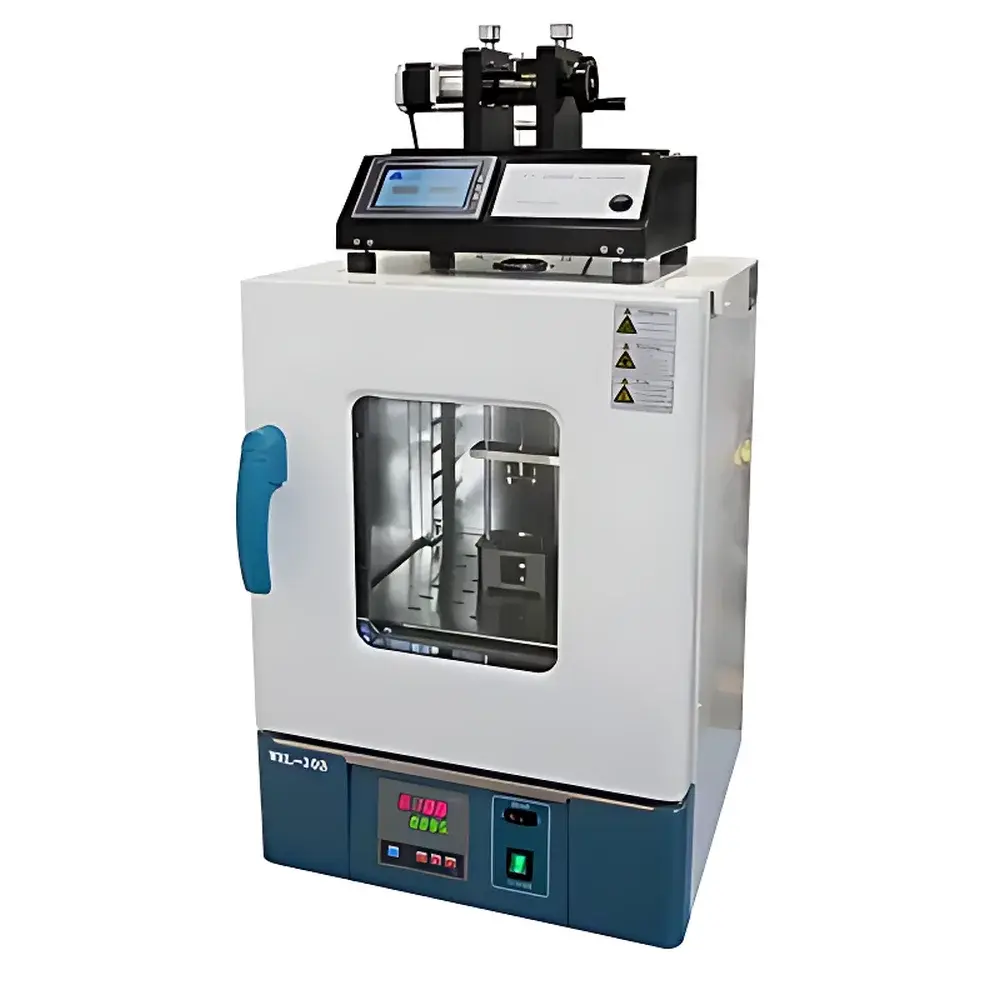
KJ GROUP PTL-UMB Micrometer-Precision Dip-Coating System with Integrated恒温 Chamber
| Brand | KJ GROUP |
|---|---|
| Origin | Liaoning, China |
| Manufacturer Type | Authorized Distributor |
| Country of Origin | China |
| Model | PTL-UMB |
| Price | Upon Request |
| Certifications | CE compliant |
| Power Supply | AC 220 V, 50 Hz, grounded |
| Operating Environment | Altitude < 1000 m |
| Dimensions (W×D×H) | 460 mm × 510 mm × 970 mm |
| Effective Immersion Length | 60 mm |
| Substrate Dimensions Supported | 75 mm × 25 mm × 2.5 mm |
| Withdrawal Speed Range | 1–500 µm/s |
| Temperature Control Range (Chamber) | RT + 5 to 100 °C |
| Temperature Uniformity | ±1.5 °C |
| Immersion/Drying Time Setting | 1–999 s |
| Cycle Count | 1–20 cycles |
| Control Interface | Color TFT touchscreen with PLC-based logic |
| Drive Mechanism | High-resolution stepper motor with suspended motor mount for vibration isolation |
| Standard Accessories | 1× substrate holder set, 1× liquid reservoir cup, 3× withdrawal wires |
Overview
The KJ GROUP PTL-UMB Micrometer-Precision Dip-Coating System is an engineered platform for controlled, reproducible thin-film fabrication via vertical dip-coating—a technique rooted in colloidal and sol-gel science. It operates on the principle of controlled meniscus withdrawal: a substrate is immersed into a precursor solution at a defined depth and dwell time, then withdrawn vertically at a precisely regulated velocity (1–500 µm/s), enabling uniform film thickness governed by the Landau-Levich-Derjaguin (LLD) equation. Unlike conventional dip coaters lacking thermal control, the PTL-UMB integrates a thermostatically regulated chamber (RT + 5 to 100 °C, ±1.5 °C stability) that maintains constant ambient conditions during both immersion and post-withdrawal drying phases—critical for minimizing solvent evaporation gradients, suppressing Marangoni instabilities, and enhancing interfacial homogeneity in oxide, polymer, or hybrid films.
Key Features
- PLC-based motion control architecture ensures deterministic repeatability across sequential coating cycles—essential for multi-layer stack development and statistical process validation.
- High-resolution stepper motor drive system, coupled with suspended motor mounting, eliminates mechanical coupling vibrations that compromise nanoscale thickness uniformity.
- Full-parameter touchscreen interface displays and logs real-time values for withdrawal speed, immersion depth (60 mm effective), dwell time (1–999 s), drying interval (1–999 s), and cycle count (1–20).
- Integrated temperature-controlled chamber enables isothermal processing—supporting thermally sensitive precursors (e.g., perovskite inks, bio-polymer dispersions) and promoting consistent nucleation kinetics.
- Compact footprint (460 × 510 × 970 mm) meets ISO/IEC 17025-compliant laboratory spatial constraints without sacrificing operational rigidity or thermal shielding integrity.
- CE-marked design complies with EN 61000-6-2 (immunity) and EN 61000-6-4 (emission) standards, ensuring electromagnetic compatibility in shared instrumentation environments.
Sample Compatibility & Compliance
The PTL-UMB accommodates standard slide-sized substrates (75 × 25 × 2.5 mm), including silicon wafers, glass slides, ITO-coated substrates, and flexible polymer foils. Its open-access reservoir design allows direct integration with custom solvent systems—including aqueous, alcoholic, and low-boiling-point organic media—without modification. All wetted components are chemically inert (stainless steel cup, PTFE-sealed chamber seals). The system supports GLP-aligned documentation workflows: parameter settings are timestamped and stored locally on the PLC controller; manual logbook entries may be cross-referenced with batch records per ISO 9001:2015 clause 8.5.2. While not FDA 21 CFR Part 11–validated out-of-the-box, audit trails can be exported via USB for inclusion in GMP-compliant coating process validations.
Software & Data Management
The embedded HMI firmware provides local parameter configuration, real-time status monitoring, and cycle history storage (up to 100 runs). No external PC or proprietary software is required for operation. Exportable logs (CSV format via USB port) include: date/time stamp, speed profile, temperature setpoint and actual, immersion duration, number of passes, and operator ID field (manually entered). Data integrity is preserved through non-volatile memory retention—even during power interruption. For laboratories requiring traceability, the system’s deterministic behavior permits correlation of film thickness (measured ex situ via ellipsometry or profilometry) directly to programmed withdrawal parameters—enabling empirical calibration curves compliant with ASTM D823 and ISO 2137 standards.
Applications
This system is routinely deployed in academic and industrial R&D for fabricating functional thin films in photovoltaics (TiO₂, SnO₂ electron transport layers), optical coatings (anti-reflective SiO₂, high-index Ta₂O₅), corrosion-resistant barriers (sol-gel silanes), and biosensor interfaces (chitosan, polyelectrolyte multilayers). Its microscale speed resolution (1 µm/s increments) enables precise tuning of thickness in the 10 nm–5 µm range—particularly valuable for studying shear-thinning precursor rheology and capillary-driven meniscus dynamics. It serves as a primary tool in materials science curricula for teaching interfacial phenomena, colloidal stability, and kinetic vs. diffusion-limited growth regimes.
FAQ
What substrate geometries are supported beyond the standard 75 × 25 mm size?
The mechanical holder accepts substrates up to 80 mm in length and 30 mm in width; custom fixtures can be fabricated upon request for non-standard profiles.
Is remote monitoring or Ethernet connectivity available?
No native network interface is included; however, optional RS-485 Modbus RTU output can be added for integration into centralized lab automation systems.
How is temperature uniformity verified inside the chamber?
Calibration is performed using NIST-traceable PT100 probes placed at three axial positions (top/mid/bottom); deviation remains within ±1.5 °C across the full 60 mm immersion zone.
Can the system operate under inert atmosphere?
The chamber is not gas-tight; for oxygen/moisture-sensitive processes, users integrate it within a glovebox environment using standard viewport-compatible mounting brackets.
What maintenance intervals are recommended for long-term accuracy?
Stepper motor lubrication and guide rail cleaning are advised every 6 months under continuous use; annual verification of speed calibration against optical encoder reference is recommended.



