
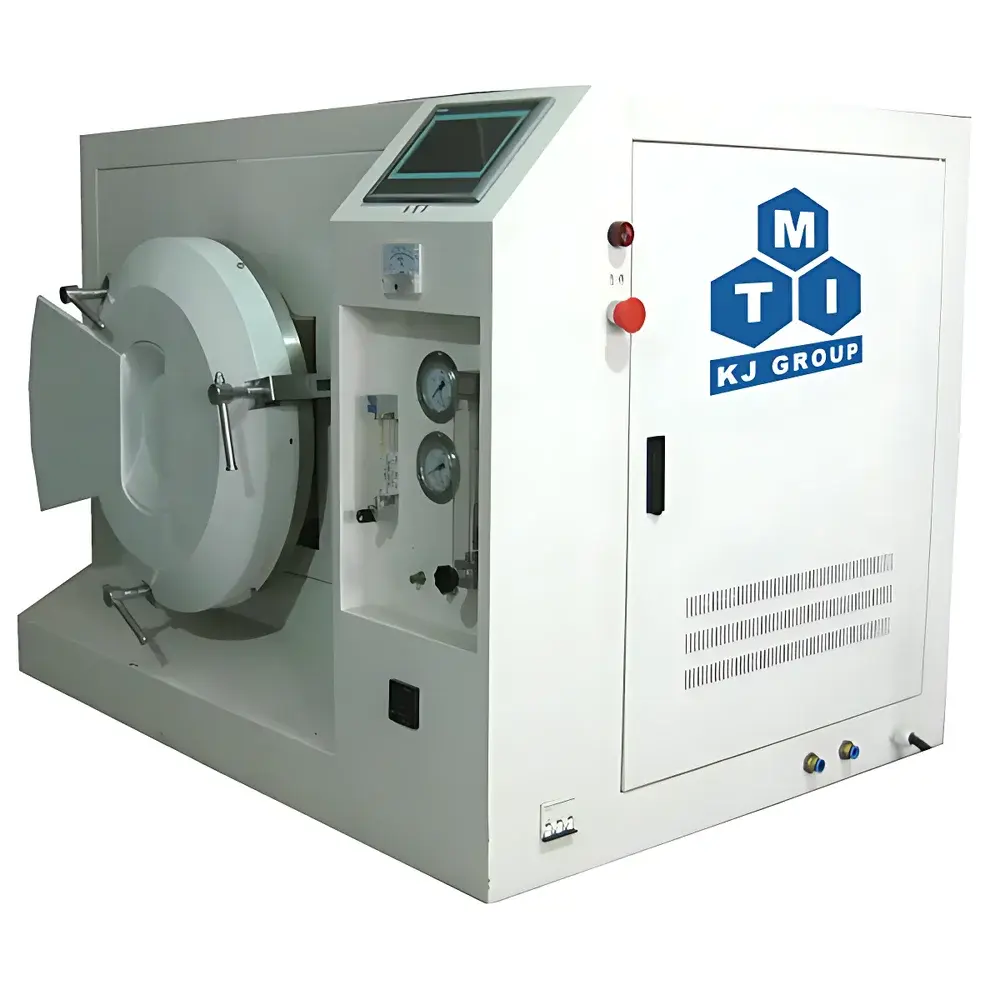
KJ GROUP QS-Series Microwave Atmosphere Experimental Furnace
| Brand | KJ GROUP |
|---|---|
| Origin | Liaoning, China |
| Manufacturer Type | Authorized Distributor |
| Product Origin | Domestic (China) |
| Model | QS-Series Microwave Atmosphere Experimental Furnace |
| Pricing | Upon Request |
| Voltage | 220±10 V, 50 Hz, Three-Phase |
| Rated Power | 4 kW (QS1512) / 6 kW (QS1516) |
| Microwave Output Power | 0.01–1.40 kW (Continuously Adjustable) |
| Microwave Frequency | 2.45 GHz |
| Max Operating Temperature | ≤1200 °C (QS1512) / ≤1600 °C (QS1516) |
| Heating Chamber Dimensions | 140×140×70 mm (QS1512) / 110×110×70 mm (QS1516) |
| Temperature Measurement | Type S or K Thermocouple |
| Temp Range & Accuracy | 0–1300 °C ±0.1% RDG (QS1512) / 0–1600 °C ±0.1% RDG (QS1516) |
| Static Ultimate Vacuum | ≤100 Pa |
| Atmosphere Control | Dual-channel gas inlet with rapid pre-vacuum capability |
| Control System | Mitsubishi PLC + Schneider HMI touchscreen |
| Programmable Stages | 40-segment ramp-soak profiles with data logging, export (CSV), real-time curve display, and dynamic screen-saver mode |
| Microwave Leakage | <0.05 mW/cm² |
| Safety Interlocks | Door-closed sensing switch, overtemperature protection, overcurrent protection, magnetron thermal cutoff |
| Cooling | External recirculating chiller (2 m³/h flow rate, 1.6 kW cooling capacity) |
| Overall Dimensions | 1150×850×800 mm (L×W×H) |
Overview
The KJ GROUP QS-Series Microwave Atmosphere Experimental Furnace is a standardized, multi-functional high-temperature laboratory workstation engineered for precise thermal processing under controlled gaseous environments. Unlike conventional resistance-heated furnaces, this system employs 2.45 GHz industrial-grade microwave energy to induce volumetric, non-contact heating within the sample—enabling rapid, uniform temperature rise with minimal thermal gradients. The integrated vacuum-atmosphere architecture supports dynamic pressure control down to ≤100 Pa and dual-gas-line delivery for oxidation, inert (e.g., Ar, N₂), or mild reduction (e.g., 5% H₂/Ar) conditions. Designed for reproducible R&D-scale synthesis and thermal treatment, it serves as a critical platform for advanced ceramic sintering, catalyst calcination, battery cathode annealing, metallurgical phase transformation studies, and ashing protocols requiring strict atmospheric purity and thermal fidelity.
Key Features
- Monolithic integration of furnace chamber, vacuum manifold, and gas distribution system—eliminating external tubing complexity and enhancing operational safety and leak integrity.
- Industrial magnetron source with continuously adjustable microwave output (0.01–1.40 kW), enabling fine-grained power modulation across low-power drying, mid-range calcination, and high-temperature sintering regimes.
- Non-contact, volumetric microwave coupling minimizes contamination risk and avoids electrode degradation or hot-spot formation common in resistive heating systems.
- Multi-layer composite insulation—including high-purity alumina fiber and reflective metallic shielding—ensures thermal efficiency >65% at 1200 °C and reduces standby heat loss by >40% versus standard refractory linings.
- Real-time thermal profiling via calibrated thermocouple (Type S/K), with 0.1% reading accuracy and active cold-junction compensation, synchronized to PLC-controlled power delivery for closed-loop stability.
- Comprehensive interlock suite: door-position sensor, magnetron overtemperature cutoff, current-limiting circuitry, and chiller flow monitoring—all logged and displayed on the HMI with fault-code diagnostics.
Sample Compatibility & Compliance
The QS-Series accommodates diverse sample geometries—powders, pellets, crucibles (Al₂O₃, SiC, graphite), thin films on substrates, and small-volume molten alloys—within its precisely dimensioned cavity (140×140×70 mm or 110×110×70 mm). Its atmosphere flexibility meets ASTM C1171 (ceramic sintering), ISO 11561 (catalyst thermal stability), and USP <631> (pharmaceutical excipient pyrolysis) requirements. Vacuum integrity (<100 Pa) satisfies preconditioning needs for oxide-free metal processing per MIL-STD-883 Method 1010. The microwave leakage level (<0.05 mW/cm²) complies with ICNIRP occupational exposure limits and IEC 61000-4-3 immunity standards. All control logic adheres to IEC 61131-3 programming conventions and supports audit-ready event logging for GLP/GMP-aligned laboratories.
Software & Data Management
The embedded Mitsubishi FX5U PLC and Schneider HMIG3U touchscreen deliver deterministic process execution with 40 programmable ramp-soak segments. Each segment defines target temperature, dwell time, microwave power setpoint, gas flow rates (via optional mass flow controllers), and vacuum hold parameters. All operational data—including thermocouple readings, power output, chamber pressure, and alarm timestamps—are timestamped and stored locally (SD card) with CSV export capability. The HMI provides real-time multi-curve overlay (temperature vs. time, power vs. time), dynamic screen-saver retention of the last 72 hours’ trends, and password-protected user roles (operator, engineer, administrator). Optional Ethernet/IP or Modbus TCP interface enables integration into centralized LIMS or MES platforms compliant with FDA 21 CFR Part 11 for electronic record integrity.
Applications
- Ceramic engineering: Rapid densification of ZrO₂, AlN, and SiC composites with submicron grain retention and minimized intergranular porosity.
- Battery materials: Lithium transition-metal oxide cathode (e.g., NMC811) annealing under O₂/N₂ mixtures to optimize cation ordering and oxygen stoichiometry.
- Heterogeneous catalysis: Controlled calcination of Pt/Al₂O₃ or Co-Mo-S/Al₂O₃ precursors under graded O₂ concentration to tune metal-support interaction and dispersion.
- Environmental analysis: Quantitative ashing of polymer composites or soil samples under inert atmosphere to preserve inorganic residue integrity for XRF or ICP-MS quantification.
- Metallurgy research: Short-duration melt-spinning trials of Fe-based amorphous ribbons under high-purity Ar, leveraging microwave’s instantaneous thermal response to suppress crystallization during quenching.
FAQ
What vacuum level can the QS-Series achieve, and how is it maintained during heating?
The system achieves a static ultimate vacuum of ≤100 Pa using an integrated oil-free scroll pump. During active heating, vacuum integrity is sustained via continuous pressure feedback to the PLC, which modulates pump speed and seals all flange interfaces with fluorosilicone gaskets rated to 200 °C.
Can the furnace operate under hydrogen-containing atmospheres?
Yes—up to 10% H₂ in inert carrier gas is supported. The dual-channel gas manifold includes stainless-steel solenoid valves rated to IP65, and all internal surfaces are passivated to prevent embrittlement. A dedicated H₂ leak detection port is available as an optional retrofit.
Is temperature uniformity validated across the heating zone?
Uniformity is characterized per ASTM E220 using a 3×3 thermocouple array at maximum operating temperature. Typical deviation is ±8 °C at 1200 °C and ±12 °C at 1600 °C within the central 70% volume of the cavity.
Does the system support remote monitoring or automation integration?
Yes—Modbus TCP and Ethernet/IP protocols are natively supported. OPC UA gateway compatibility is available via third-party middleware, enabling seamless connection to SCADA, LabVIEW, or Python-based control frameworks.
What maintenance intervals are recommended for the magnetron and waveguide components?
Magnetron service life exceeds 5,000 operational hours under nominal load. Waveguide interior inspection and ceramic window cleaning are advised every 500 h; full preventive maintenance—including RF choke calibration and vacuum gauge recalibration—is scheduled annually per KJ GROUP Technical Bulletin TB-QS-2023.



