
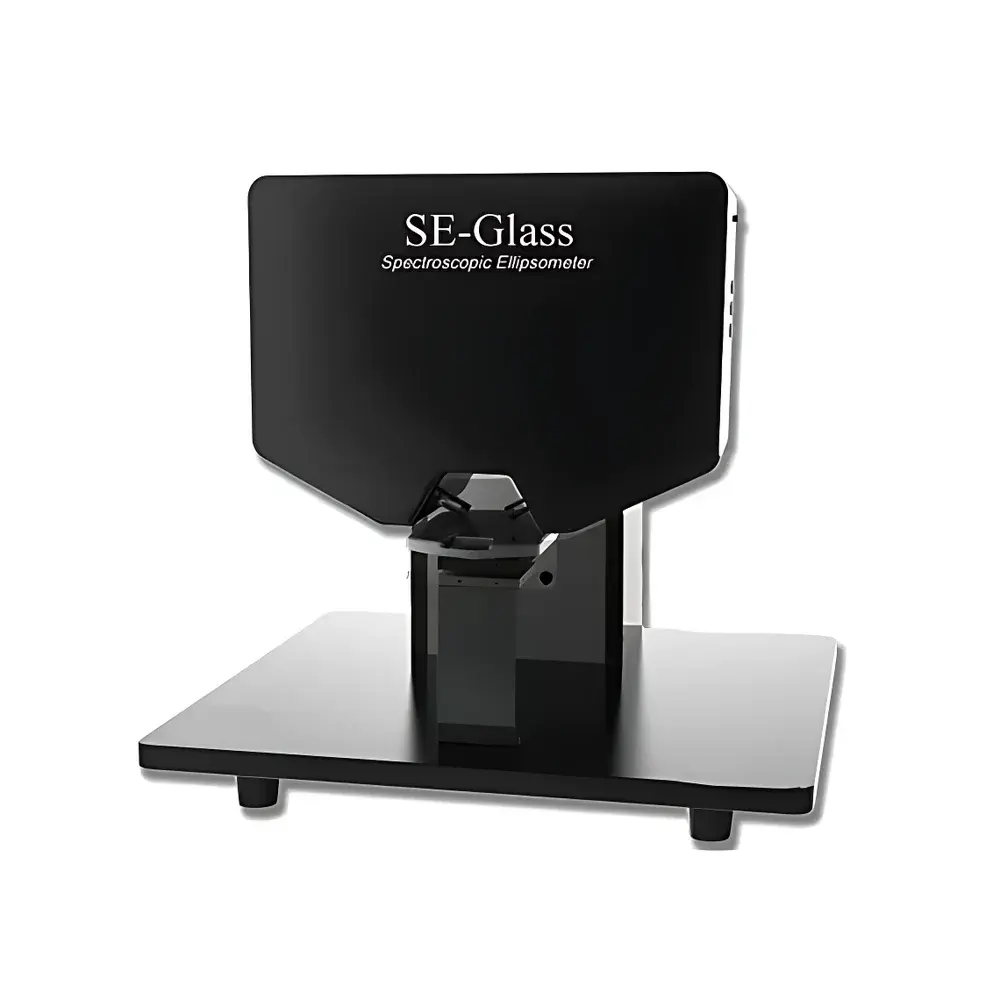
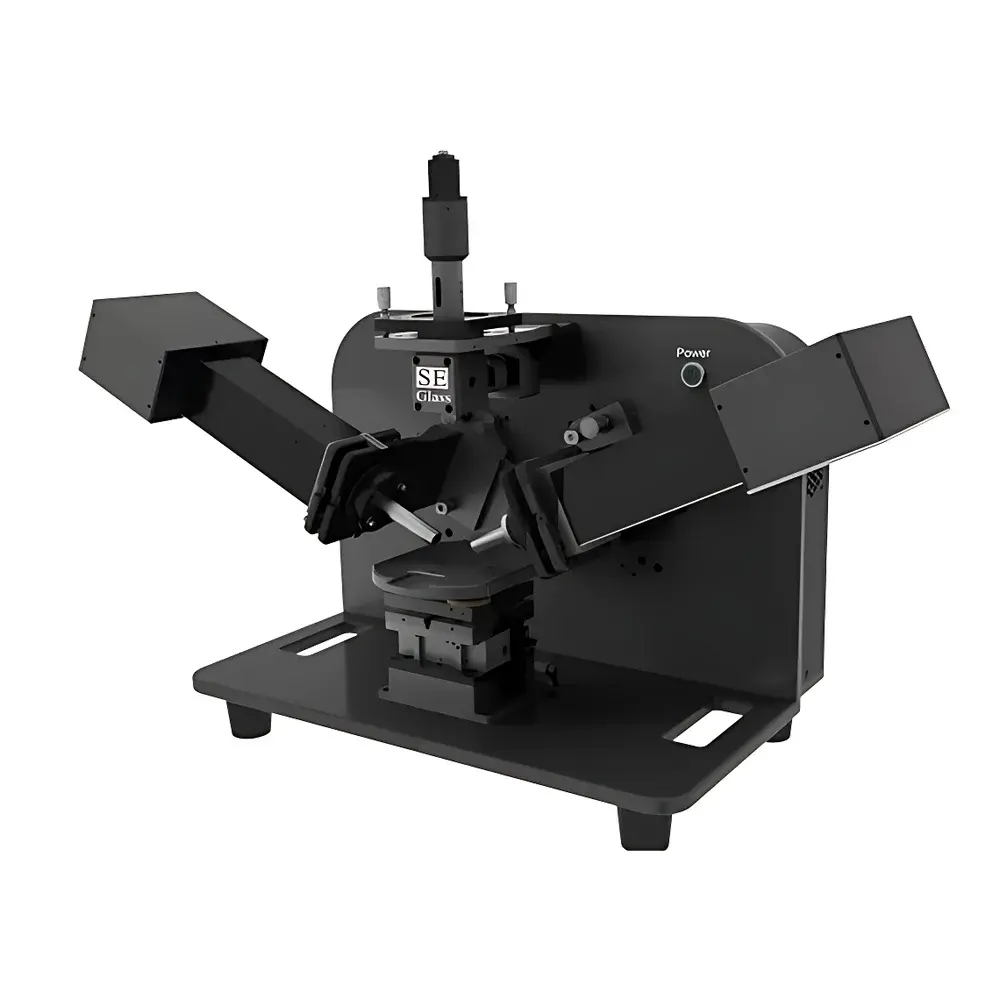
KJ GROUP SE-Glass Spectroscopic Ellipsometer
| Brand | KJ GROUP |
|---|---|
| Origin | Liaoning, China |
| Manufacturer Type | Authorized Distributor |
| Origin Category | Domestic |
| Model | SE-Glass |
| Pricing | Upon Request |
| Measurement Principle | Rotating Compensator Spectroscopic Ellipsometry |
| Spectral Range | 380–1000 nm (customizable) |
| Spot Size | Micro-spot (<50 µm) |
| Measurement Time per Scan | 0.5–5 s |
| Thickness Repeatability | ±0.01 nm |
| Sample Compatibility | Flat & 3D curved glass substrates, PET films, transparent dielectric stacks |
| Key Outputs | Ψ(λ), Δ(λ), n(λ), k(λ), thickness profiles, optical dispersion models |
Overview
The KJ GROUP SE-Glass Spectroscopic Ellipsometer is a purpose-built metrology platform engineered for high-precision, non-contact characterization of thin-film stacks on transparent and semi-transparent substrates—specifically optimized for the mobile display glass cover lens industry. It operates on the physical principle of rotating compensator spectroscopic ellipsometry (RCSE), measuring the change in polarization state (Ψ and Δ) of reflected broadband light across the visible to near-infrared spectrum (380–1000 nm). Unlike conventional ellipsometers, the SE-Glass integrates a micro-spot optical configuration and real-time polarization calibration to suppress parasitic back-reflection from thick glass substrates (e.g., 0.3–2.0 mm Gorilla Glass, aluminosilicate, or soda-lime float glass), enabling robust quantification of sub-nanometer-thick anti-reflective (AR), conductive (ITO, Ag nanowire), smart-tinting (electrochromic, PDLC), and barrier coatings—even on complex 3D-curved surfaces.
Key Features
- Industry-specific RCSE architecture with dual-channel polarization detection and active thermal drift compensation
- Micro-spot optical head (≤50 µm diameter at sample plane) minimizing substrate interference and enabling localized measurement on patterned or edge-sensitive regions
- Motorized, vision-assisted sample stage with real-time tilt feedback and auto-leveling algorithm—critical for reproducible data acquisition on 3D-formed glass substrates (e.g., front cover lenses with R < 2.5 mm curvature)
- Dedicated film-on-PET analysis module incorporating substrate-transmission correction and biaxial stress-induced optical anisotropy modeling
- Modular spectral engine supporting optional extension into UV (250 nm) or SWIR (1700 nm) ranges upon customer specification
- Fully programmable measurement sequences compatible with inline integration via Ethernet/IP or RS-485 industrial protocols
Sample Compatibility & Compliance
The SE-Glass accommodates standard 4″–12″ glass wafers, cut cover lenses (flat and 3D), and flexible polymer films (PET, PI, COP) with thicknesses from 25 µm to 2 mm. Its optical design conforms to ISO 15630-3 (optical thin-film metrology) and supports traceable calibration using NIST-traceable Si/SiO₂ reference standards. Data acquisition and reporting comply with GLP/GMP documentation requirements, including full audit trails, user access control, and electronic signature support per FDA 21 CFR Part 11 when deployed in regulated manufacturing environments (e.g., ITO coating lines certified to ISO 9001:2015 and IATF 16949).
Software & Data Management
Control and analysis are performed via KJ-EllipSoft v4.x—a Windows-based application built on Qt and Python 3.9 with native HDF5 data storage. The software includes multi-layer optical modeling (Cauchy, Tauc-Lorentz, Cody-Lorentz dispersion functions), global fitting with Levenberg-Marquardt optimization, and batch processing for statistical SPC charting (X-bar/R, Cpk). Raw Ψ/Δ spectra, fitted parameters, and confidence intervals are exportable in CSV, XML, and ASTM E2920-compliant formats. Remote diagnostics, firmware updates, and method synchronization are supported over secure TLS 1.3 connections.
Applications
- Thickness and optical constants (n, k) mapping of single- and multi-layer AR coatings (MgF₂/TiO₂/SiO₂ stacks) on smartphone cover glass
- In-line process monitoring of sputtered ITO and AZO layers for sheet resistance correlation (via Drude model extraction)
- Quantification of electrochromic WO₃ layer crystallinity and hydration state through dispersion analysis
- Characterization of low-e coatings (Ag/dielectric multilayers) for automotive HUD combiners
- Quality assurance of hard-coat + oleophobic stack durability after abrasion or solvent exposure
- PET-based flexible touch sensor film development (e.g., metal mesh, graphene, or conductive polymer layers)
FAQ
Does the SE-Glass support automated integration into glass coating production lines?
Yes—via OEM-ready API (RESTful + TCP socket interface), PLC-compatible digital I/O triggers, and SEMI E54-compliant recipe handling.
Can it measure films on deeply curved glass (e.g., >5R curvature)?
Yes—the visual auto-leveling module corrects for local surface normal deviation up to ±6°, and spot size remains stable within ±5% across radii down to 1.8 mm.
Is NIST-traceable calibration included with shipment?
A factory-calibrated Si/SiO₂ reference wafer (certified thickness ±0.005 nm) is provided; annual recalibration services are available under ISO/IEC 17025-accredited procedures.
What level of technical support is offered for optical modeling assistance?
KJ GROUP provides application engineering support—including initial model setup, dispersion function selection, and uncertainty analysis—for all warranty-covered instruments.
Are software updates and security patches provided post-purchase?
Yes—free version upgrades and critical security patches are delivered for five years from date of commissioning, with extended maintenance plans available.



