
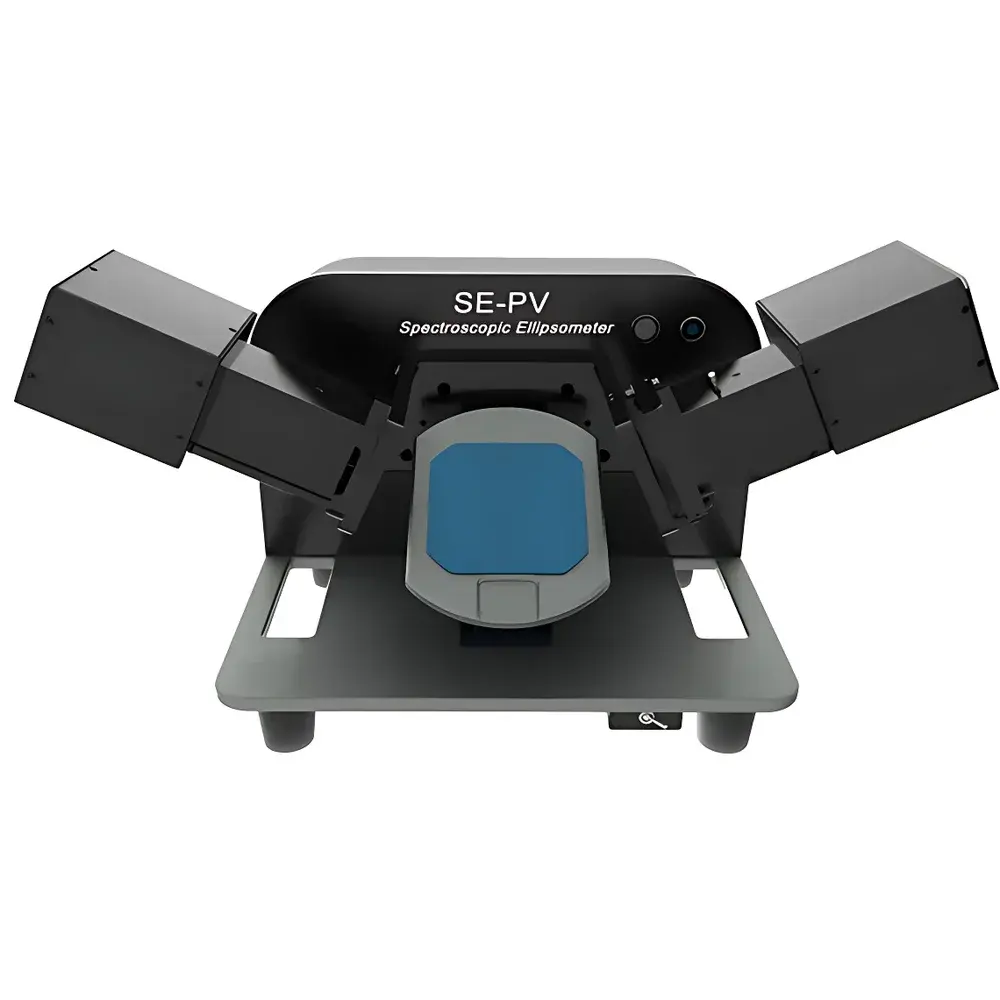
KJ GROUP SE-PV Photovoltaic Spectroscopic Ellipsometer
| Brand | KJ GROUP |
|---|---|
| Origin | Liaoning, China |
| Manufacturer Type | Authorized Distributor |
| Product Origin | Domestic (China) |
| Model | SE-PV |
| Pricing | Available Upon Request |
| Automation | Customizable Automation Options |
| Application | PV-Specific Ellipsometry |
| Core Measurement Functions | Psi/Delta, Refractive Index (n), Extinction Coefficient (k), Surface Roughness (C), Scattering Parameter (S) |
| Spectral Range | 380–1000 nm (customizable) |
| Single-Measurement Duration | 0.5–5 s |
| Repeatability Precision | ±0.01 nm |
| Optical Configuration | Variable-Angle, Tilt-Adjustable Stage |
| Light Source | High-Power, Long-Life Imported Halogen/Xenon Hybrid Lamp |
| Algorithm Engine | PV-Optimized Scattering Matrix Model for Textured Si Surfaces |
| Sample Compatibility | Textured Monocrystalline & Multicrystalline Silicon Wafers with ARC (SiNx, SiO₂, Al₂O₃, TiO₂) |
Overview
The KJ GROUP SE-PV Photovoltaic Spectroscopic Ellipsometer is an application-engineered optical metrology instrument designed specifically for in-line and R&D characterization of anti-reflection coatings (ARCs) on textured silicon photovoltaic substrates. It operates on the fundamental principle of spectroscopic ellipsometry—measuring the change in polarization state (Ψ and Δ) of light reflected from a sample surface across a broad spectral range (380–1000 nm). Unlike conventional ellipsometers optimized for flat, polished wafers, the SE-PV integrates a physics-based scattering matrix formalism to rigorously model light interaction with microscale pyramidal or random-textured surfaces typical of industrial monocrystalline and multicrystalline silicon solar cells. This enables quantitative extraction of film thickness, complex refractive index (n + ik), interfacial roughness, and effective medium composition—critical parameters for process control of plasma-enhanced chemical vapor deposition (PECVD) of silicon nitride (SiNx) and atomic layer deposition (ALD) of aluminum oxide (Al2O3) passivation layers.
Key Features
- PV-optimized optical architecture featuring a motorized, tilt-adjustable sample stage enabling precise angular alignment to maximize signal-to-noise ratio on highly scattering textured surfaces.
- High-stability, broadband halogen/xenon hybrid illumination source delivering enhanced photon flux in the near-UV to NIR range—critical for resolving thin (<10 nm) SiNx films on low-reflectance textured Si.
- Pre-loaded material database with industry-standard optical constants for common PV thin films (SiNx, SiO2, TiO2, Al2O3, a-Si:H, ITO) and textured silicon substrates—reducing model setup time and minimizing user-induced fitting ambiguity.
- Scattering matrix algorithm validated against rigorous coupled-wave analysis (RCWA) simulations for cone- and pyramid-type surface textures—ensuring physically consistent interpretation of depolarization effects without empirical correction factors.
- Modular automation interface supporting integration with wafer handling robots, inline conveyor systems, and MES/SCADA platforms via TCP/IP or RS-232 protocols.
Sample Compatibility & Compliance
The SE-PV accommodates standard photovoltaic substrates including 125 × 125 mm, 156 × 156 mm, and 166 × 166 mm textured mono- and multicrystalline wafers, as well as full-size M10 and G12 format pseudo-square wafers (up to 210 mm diagonal). Its stage design supports both front-side ARC measurement and back-surface field (BSF) layer analysis under controlled ambient conditions. The system complies with ISO/IEC 17025 requirements for calibration traceability and supports audit-ready documentation per GLP and ISO 9001 quality management frameworks. Data integrity safeguards—including electronic signatures, audit trails, and user-access-level controls—are implemented in accordance with FDA 21 CFR Part 11 when paired with optional validated software modules.
Software & Data Management
The proprietary KJ-EllipSoft™ platform provides a deterministic, scriptable workflow environment for ellipsometric modeling, regression analysis, and statistical process monitoring (SPC). It supports multi-layer optical models with graded interfaces, effective medium approximations (EMA) for porous or mixed-phase films, and real-time deviation mapping across wafer grids. All raw Ψ/Δ spectra, fitted parameters, covariance matrices, and goodness-of-fit metrics (χ², RMS error) are stored in vendor-neutral HDF5 format. Export options include CSV, XML, and ASTM E2943-compliant data exchange schemas for interoperability with factory analytics platforms such as JMP, Python-based SciPy pipelines, or Siemens Opcenter Analytics.
Applications
- Real-time PECVD process development and endpoint detection for SiNx:H ARC deposition on textured c-Si.
- Quantitative assessment of Al2O3/SiNx stack optical coupling and interfacial recombination velocity prediction.
- Thickness uniformity mapping of transparent conductive oxides (TCOs) on heterojunction (HJT) solar cells.
- Monitoring oxidation-induced thickness drift in thermal SiO2 passivation layers during firing processes.
- Correlation of ellipsometric n/k dispersion with minority carrier lifetime (τeff) measured by quasi-steady-state photoconductance (QSSPC).
FAQ
Does the SE-PV support measurement on black silicon or nanostructured surfaces?
Yes—the scattering matrix algorithm has been extended to handle sub-wavelength periodic and stochastic nanostructures; validation datasets for black Si and metal-assisted chemical etching (MACE) surfaces are available upon request.
Can the system be calibrated traceably to NIST standards?
Yes—KJ GROUP provides optional factory calibration using NIST-traceable Si/SiO2 reference wafers with certified thickness values (SRM 2822), documented per ISO/IEC 17025.
Is remote diagnostics and software update capability included?
Standard firmware and software updates are delivered via secure HTTPS portal; remote diagnostic access requires signed service agreement and IT-approved firewall configuration.
What level of training is provided for process engineers?
A two-day on-site application workshop covers optical modeling fundamentals, ARC stack fitting strategies, SPC charting, and failure mode analysis—delivered by KJ GROUP’s certified PV metrology specialists.
How is data security handled in shared lab environments?
Role-based access control (RBAC), encrypted local storage (AES-256), and configurable auto-purge policies ensure compliance with internal IT security policies and ISO 27001 guidelines.



