
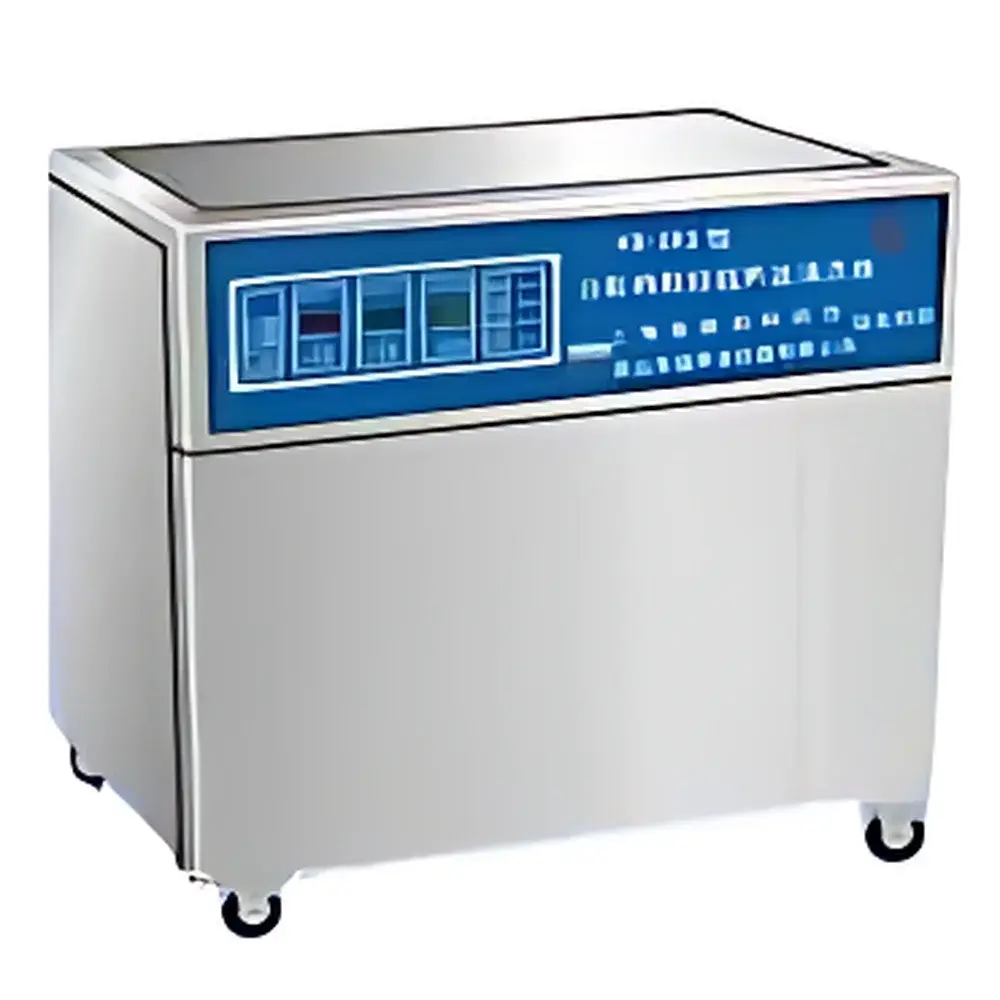
KJ GROUP Series High-Power Digital Ultrasonic Cleaner
| Brand | KJ GROUP |
|---|---|
| Origin | Liaoning, China |
| Manufacturer Type | Authorized Distributor |
| Product Category | Domestic |
| Model | Series High-Power Digital Ultrasonic Cleaner |
| Instrument Type | General-Purpose |
| Ultrasonic Frequency Options | 19 kHz, 25 kHz, 28 kHz, 40 kHz |
| Ultrasonic Power Output | 100 W |
| Adjustable Power | Yes |
| Adjustable Temperature | Yes |
| Adjustable Timer | Yes |
| Sound-Dampening Lid | Included |
| Drain/Inlet Control | Manual |
Overview
The KJ GROUP Series High-Power Digital Ultrasonic Cleaner is an industrial-grade benchtop cleaning system engineered for demanding laboratory and R&D environments where robust cavitation energy, precise process control, and long-term operational reliability are essential. It operates on the principle of high-intensity ultrasonic cavitation—generated by piezoelectric transducers bonded to the tank bottom—to produce microbubble implosion forces capable of dislodging tenacious contaminants, breaking down biofilms, degassing viscous solutions, dispersing nanoparticles, and facilitating cell lysis. Unlike standard low-power cleaners optimized for delicate optics or jewelry, this series delivers sustained 100 W acoustic output across multiple frequency bands (19–40 kHz), enabling users to select the optimal frequency for specific material compatibility and cleaning mechanism: lower frequencies (19–28 kHz) favor macro-scale particle removal and heavy-duty degreasing, while higher frequencies (40 kHz) provide finer resolution for submicron residue removal and sensitive biological sample preparation.
Key Features
- Integrated floor-standing design with reinforced stainless-steel tank (304 grade) and welded stainless-steel mesh basket—engineered for mechanical durability and corrosion resistance in aggressive solvents and aqueous alkaline baths.
- Digital microcontroller-based operation panel with real-time LED display showing set and actual values for ultrasonic power level, elapsed time, heating temperature, and internal tank temperature.
- Four selectable ultrasonic frequencies (19 kHz, 25 kHz, 28 kHz, 40 kHz) via front-panel toggle—enabling method optimization for diverse applications including metal part decontamination, ceramic sintered filter cleaning, and tissue homogenization.
- Programmable timer with 999,999-hour cumulative runtime counter—supporting GLP-compliant recordkeeping and maintenance scheduling.
- Comprehensive safety architecture: digital low-level fluid detection, over-temperature cutoff (±2 °C accuracy), over-voltage and over-current monitoring, and automatic shutdown upon lid opening or thermal runaway.
- Manual fill-and-drain interface with integrated valve assembly—designed for compatibility with lab-grade deionized water, ethanol, isopropanol, and proprietary alkaline or acidic cleaning formulations.
Sample Compatibility & Compliance
This ultrasonic cleaner accommodates a broad range of sample geometries—from large industrial components (up to 300 × 200 × 150 mm) to multi-well plates and glassware stacks—without compromising cavitation uniformity. Its wide-frequency capability ensures compatibility with fragile substrates (e.g., silicon wafers, MEMS devices) when operated at 40 kHz, and with heavily soiled metal tools or ceramic crucibles at 19 kHz. The unit meets general electrical safety requirements per IEC 61010-1 and is constructed to support compliance with ISO 13485 cleanroom auxiliary equipment guidelines when deployed in regulated QC/QA labs. While not certified for sterile processing under ISO 17664 or AAMI ST79, its consistent thermal and acoustic repeatability supports validation protocols aligned with ASTM D2603 (cavitation intensity measurement) and USP (ultrasonic cleaning of pharmaceutical equipment).
Software & Data Management
The device operates via embedded firmware without external PC dependency; however, all operational parameters—including power level, frequency selection, temperature setpoint, and cycle duration—are retained in non-volatile memory after power loss. The digital display logs real-time status flags (e.g., “LOW WATER”, “OVER TEMP”) with timestamped event history accessible via front-panel navigation. For audit-trail requirements in GMP-regulated environments, users may integrate optional RS-232 or USB-to-serial adapters (sold separately) to export parameter logs into LIMS-compatible CSV format. The system supports 21 CFR Part 11–compliant electronic signature workflows when paired with validated third-party data acquisition software and user-access controls.
Applications
- Pre-analytical sample preparation: removal of organic residues from HPLC vials, GC liners, and ICP-MS nebulizers.
- Materials science: deburring of additive-manufactured metal parts, cleaning of sintered powder metallurgy filters, and dispersion of carbon nanotubes in polymer matrices.
- Life sciences: gentle cell disruption for protein extraction (sonication-assisted lysis), cleaning of electrophoresis combs and gel trays, and degassing of agarose and polyacrylamide gels prior to casting.
- Quality control: verification of particulate cleanliness per ISO 14644-1 Class 5–8 cleanroom standards using filtered rinse water analysis.
- R&D scale-up: emulsification of oil-in-water systems, sonochemical synthesis of metal oxide nanoparticles, and accelerated solvent extraction of botanical matrices.
FAQ
What frequency should I select for cleaning precision optical components?
For delicate optics such as coated lenses or laser mirrors, 40 kHz is recommended to minimize surface pitting while maintaining effective contaminant removal.
Can this unit be used for sterilization?
No—this device performs cleaning and degassing only. Sterilization requires validated autoclaving, dry heat, or ethylene oxide exposure per ISO 17664.
Is the tank heater compatible with flammable solvents?
Heating is disabled automatically when flammable solvent mode is selected (via firmware setting); always consult SDS and use only in ventilated fume hoods.
How often should transducer performance be verified?
We recommend quarterly calibration using ASTM E1774 hydrophone-based intensity mapping, especially after extended high-power operation or frequency switching.
Does the unit support continuous operation beyond 30 minutes?
Yes—the 999,999-hour timer and thermal management system enable unattended batch processing up to 24 hours, provided ambient temperature remains below 35 °C and ventilation clearance is maintained.



