
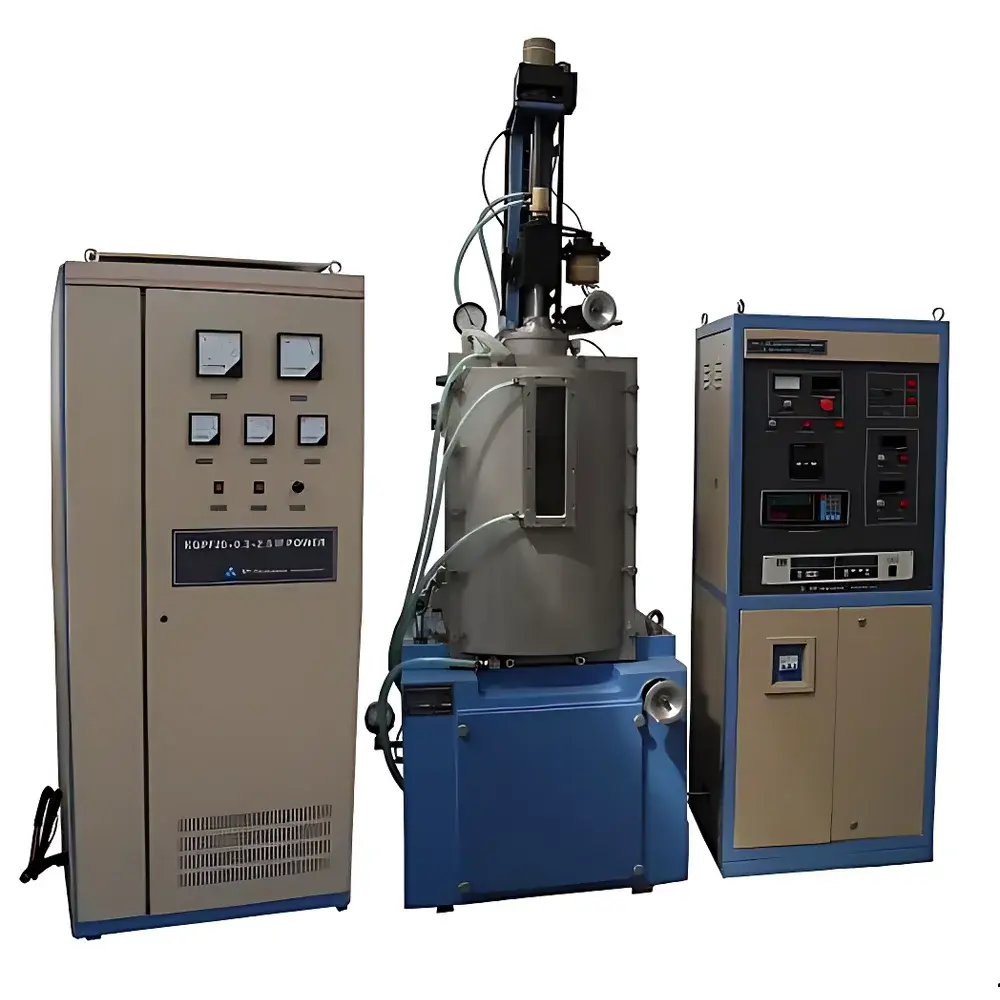
KJ GROUP SKJ-50 Czochralski Crystal Growth Furnace
| Brand | KJ GROUP |
|---|---|
| Origin | Anhui, China |
| Manufacturer Type | Authorized Distributor |
| Origin Category | Domestic (China) |
| Model | SKJ-50 |
| Pricing | Upon Request |
| Power Supply | 3-Phase AC 380 V, 25 kW |
| RF Frequency Range | 0.2–20 kHz |
| RF Power Output | 25 kW |
| Vacuum Chamber Dimensions | Ø500 mm × 700 mm |
| Base Vacuum (Mechanical Pump) | 10⁻³ Torr |
| Ultimate Vacuum (Diffusion Pump) | 10⁻⁵ Torr |
| Maximum Pulling Stroke | 500 mm |
| Pulling Speed Range | 0.1–20 mm/h |
| Seed Rod Rotation Speed | 0–40 rpm |
| Max Melting Temperature | 2100 °C |
| Temperature Control Accuracy | < ±0.2 °C |
| Cooling Water Pressure | 0.13–0.18 MPa |
| Cooling Water Flow Rate | 60 L/min |
| Translation Speed (Fine Adjustment) | 1–10 mm/h |
| Rapid Manual Translation | Yes |
| Crystal Rotation Speed | 1–50 rpm |
| Vacuum System | Dual-stage (Mechanical + Diffusion Pump) |
| Overall Dimensions (Furnace) | 880 mm × 1250 mm × 2850 mm |
| Control Cabinet | 680 mm × 540 mm × 1700 mm |
| RF Generator Cabinet | 1100 mm × 500 mm × 1500 mm |
| Total Weight | 1500 kg |
| Ambient Operating Conditions | Altitude ≤1000 m, Ambient Temp. 25 °C ±15 °C, Relative Humidity 55% RH ±10% RH |
| Required Gas | Argon (≥99.99% purity), supplied via external cylinder with Ø6 mm double-ferrule fitting |
| Cooling Medium | Deionized or purified water (integrated recirculating chiller) |
| Grounding Requirement | Mandatory earth ground per IEC 61000-5-1 |
| Working Table Spec | 1500 mm × 600 mm × 700 mm, load capacity ≥200 kg |
| Ventilation | Local exhaust recommended for argon displacement and thermal management |
Overview
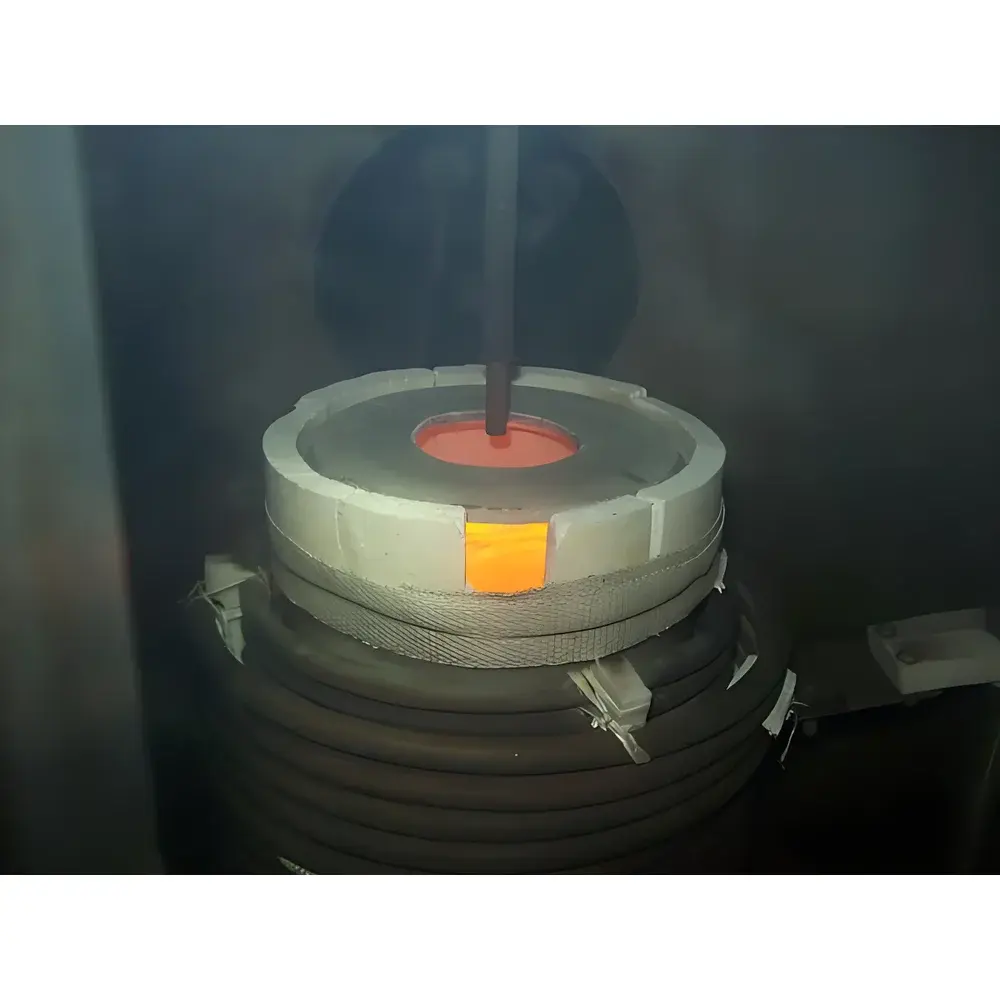
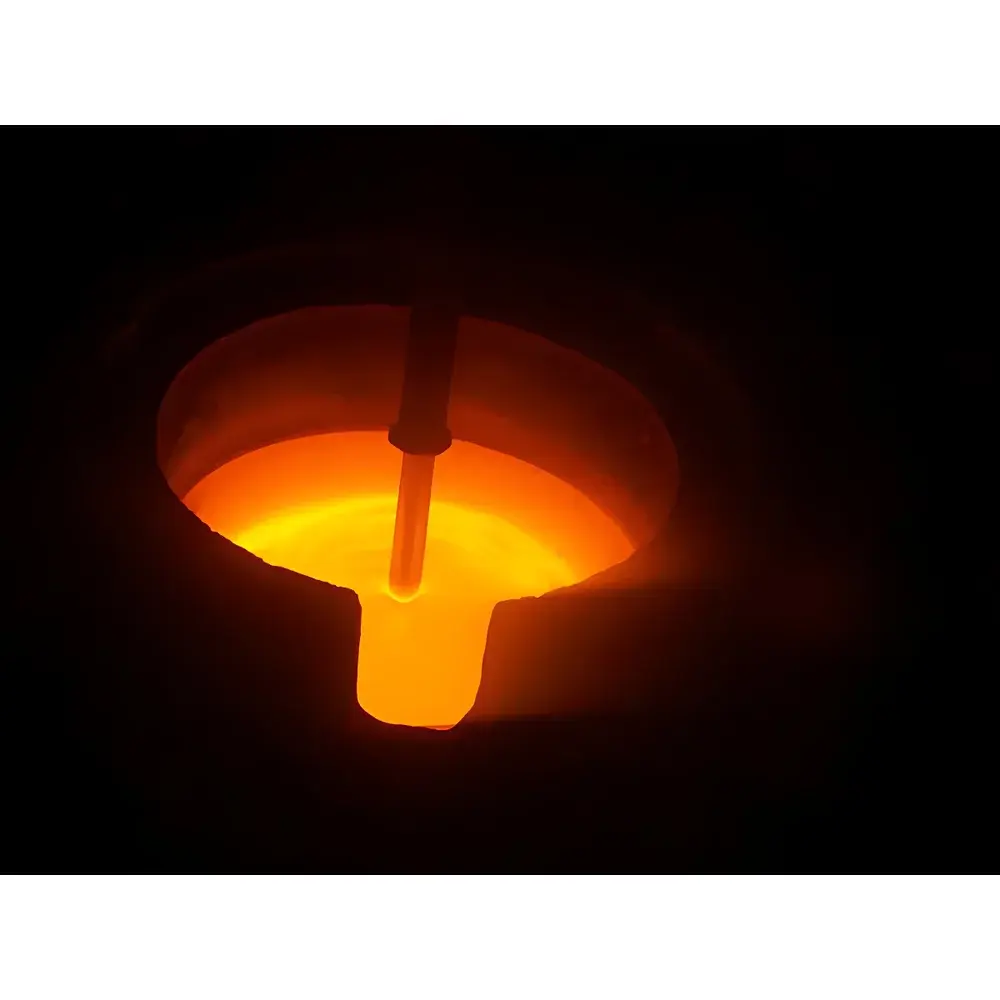
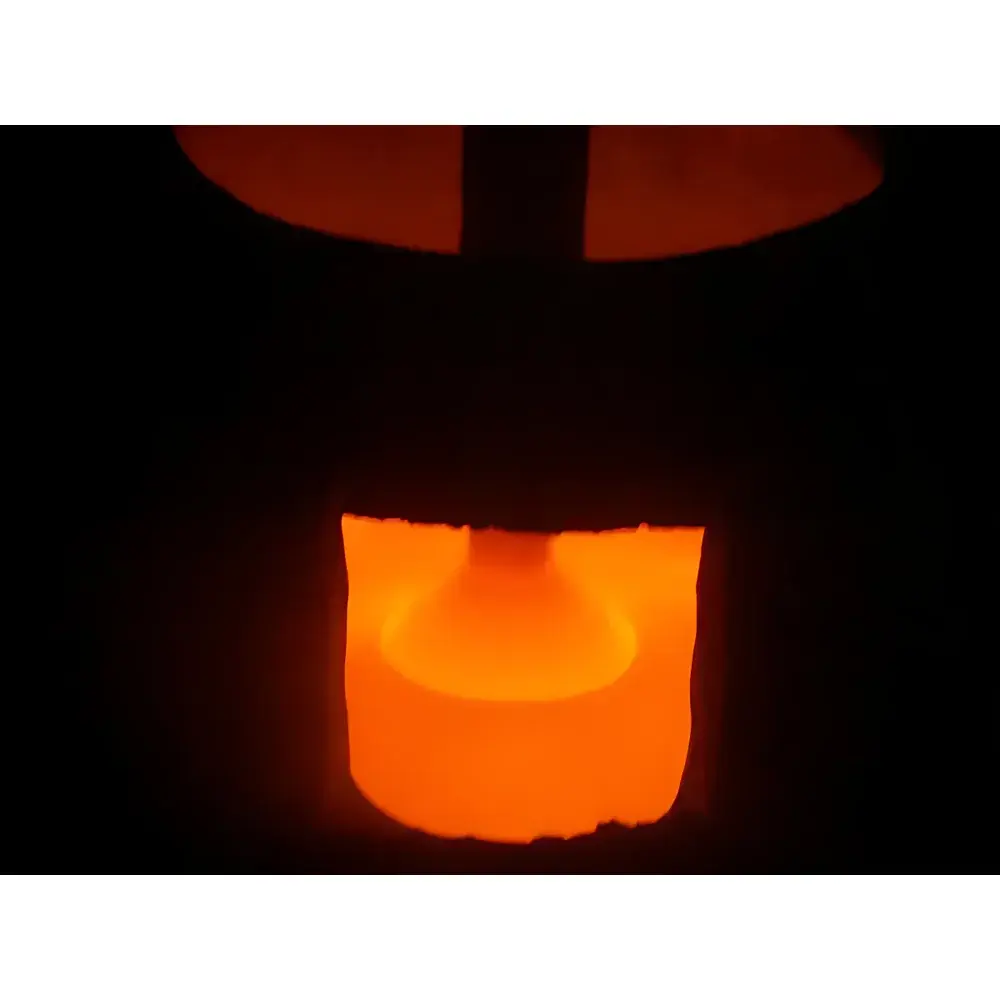
The KJ GROUP SKJ-50 Czochralski (CZ) Crystal Growth Furnace is an engineered system designed for the controlled, high-precision growth of single-crystal materials using the vertical pulling (Czochralski) method. It employs medium-frequency induction heating (0.2–20 kHz) to achieve stable, uniform melt temperatures up to 2100 °C—sufficient for processing refractory oxides (e.g., sapphire, YAG, GGG, LaAlO₃, SrLaAlO₄) and elemental semiconductors (Si, Ge). The furnace integrates a vacuum-compatible quartz or iridium crucible chamber, dual-stage vacuum pumping (mechanical + oil diffusion pump), and real-time diameter feedback control via integrated precision load cell instrumentation. Its compact footprint and modular cabinet architecture make it suitable for academic laboratories, national research institutes, and pilot-scale crystal development facilities where reproducibility, thermal stability, and process traceability are critical.
Key Features
- Medium-frequency induction heating system delivering 25 kW nominal power with frequency tunability (0.2–20 kHz) for optimized coupling efficiency across diverse crucible materials and melt volumes.
- Vacuum-rated stainless-steel chamber (Ø500 mm × 700 mm) compatible with inert gas purging (Ar ≥99.99%) and capable of achieving ≤10⁻⁵ Torr ultimate pressure—ensuring low-oxygen, low-contamination melt environments essential for stoichiometric oxide crystal growth.
- High-resolution axial motion control: motorized pulling mechanism with programmable speed range (0.1–20 mm/h) and fine translation (1–10 mm/h), plus manual rapid positioning for operational flexibility.
- Dual-axis rotational control: independent adjustment of seed rod rotation (0–40 rpm) and crystallization rotation (1–50 rpm), enabling optimization of melt convection, interface shape, and defect distribution.
- Integrated digital load cell system enables closed-loop diameter regulation during growth, minimizing diameter drift and improving crystal homogeneity—particularly valuable for 3-inch (76 mm) diameter boules.
- Temperature uniformity maintained within ±0.2 °C at setpoint via multi-zone thermocouple feedback and PID-controlled RF power modulation.
- Self-contained recirculating chiller system requiring only deionized or purified water; specified flow rate (60 L/min) and pressure (0.13–0.18 MPa) ensure consistent thermal management of RF coil, vacuum feedthroughs, and chamber jacketing.
Sample Compatibility & Compliance
The SKJ-50 supports growth of optically active, laser-grade, and electronic-grade single crystals including but not limited to Al₂O₃ (sapphire), Y₃Al₅O₁₂ (YAG), Gd₃Ga₅O₁₂ (GGG), LaAlO₃, SrLaAlO₄, Si, and Ge. Its maximum usable crucible volume accommodates up to 3-inch-diameter crystal boules. All vacuum components conform to ISO-KF and CF flange standards. The system operates in compliance with IEC 61000-6-2 (immunity) and IEC 61000-6-4 (emission) for industrial electromagnetic environments. While not pre-certified for FDA 21 CFR Part 11, its digital control logs—including temperature profiles, pull/rotation speeds, vacuum traces, and weight feedback—can be exported in CSV or ASCII format for integration into validated GLP/GMP data management workflows. Users are responsible for site-specific validation per ASTM F2656 or ISO/IEC 17025 requirements.
Software & Data Management
The SKJ-50 utilizes a dedicated industrial PLC-based control platform with touchscreen HMI (Human-Machine Interface). All process parameters—including RF power output, thermocouple readings (Type B or S), vacuum gauge outputs (Pirani + cold cathode), pulling position, rotation speeds, and load cell mass data—are sampled at ≥1 Hz and stored locally on an embedded industrial SSD. Data export is supported via USB 2.0 or Ethernet (Modbus TCP/IP), enabling synchronization with third-party SCADA or LIMS systems. Optional software packages provide real-time trend visualization, alarm logging with timestamped event history, and customizable recipe templates for repeatable growth cycles. Audit trails include operator ID (via login), parameter changes, and emergency stop events—supporting basic ALCOA+ principles (Attributable, Legible, Contemporaneous, Original, Accurate, Complete, Consistent, Enduring, Available).
Applications
- Growth of laser host crystals (YAG, GGG) for solid-state laser development and optical parametric oscillation studies.
- Production of sapphire substrates for LED epitaxy and RF device fabrication under controlled oxygen partial pressure.
- Research into segregation behavior and defect formation mechanisms in perovskite-related oxides (e.g., LaAlO₃, SrLaAlO₄) for quantum materials applications.
- Development of high-purity silicon and germanium crystals for detector-grade semiconductor characterization.
- Thermal gradient and interface stability studies under varying Ar backfill pressures (10⁻⁵ Torr to 1 atm).
- Training platforms for graduate-level crystallography, materials science, and solid-state physics curricula.
FAQ
What vacuum level is required for oxide crystal growth, and how is it achieved?
The SKJ-50 achieves base vacuum ≤10⁻³ Torr using a mechanical rotary vane pump and ultimate vacuum ≤10⁻⁵ Torr with an oil diffusion pump—sufficient for reducing transition metal impurity incorporation during YAG or sapphire growth.
Is the system compatible with reactive atmospheres such as O₂ or N₂?
The standard configuration is optimized for inert gas (Ar) operation. For oxidizing or nitriding atmospheres, optional quartz-lined hot zones, corrosion-resistant feedthroughs, and gas mass flow controllers must be specified at order stage.
Can the furnace be integrated into an existing cleanroom HVAC or exhaust system?
Yes—the unit includes standardized ventilation ports (DN100) and meets local mechanical code requirements for heat dissipation and argon displacement. Integration requires coordination with facility engineers for static pressure balancing and duct velocity specifications.
What calibration documentation is provided with delivery?
Each system ships with factory calibration certificates for thermocouples (NIST-traceable), vacuum gauges, and load cells. On-site IQ/OQ support is available upon request for GxP-aligned installations.
Does the SKJ-50 support automated recipe execution with conditional logic (e.g., ramp-hold-cool based on real-time diameter deviation)?
Basic sequential recipe execution is supported. Advanced conditional logic requires optional upgrade to the KJ-SCADA Pro module, which adds Python-scriptable control loops and external sensor input triggering.
Related Products



