
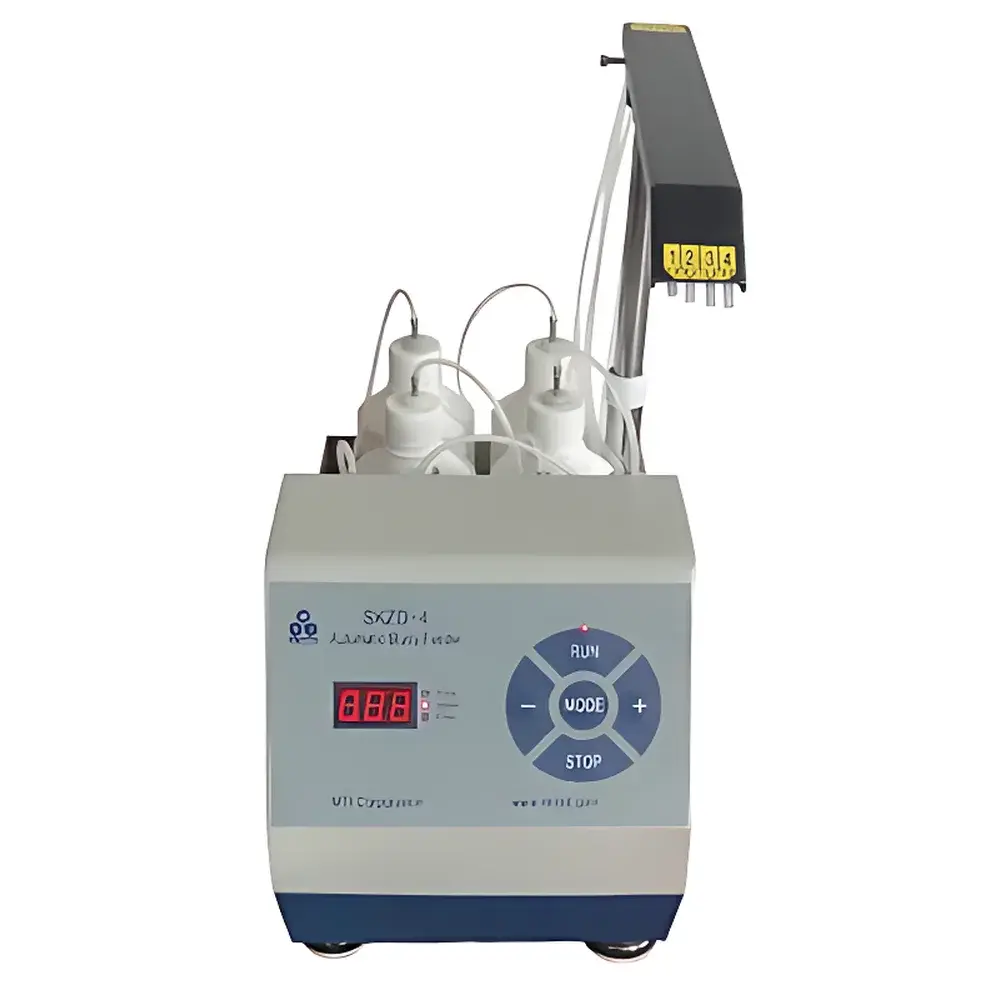
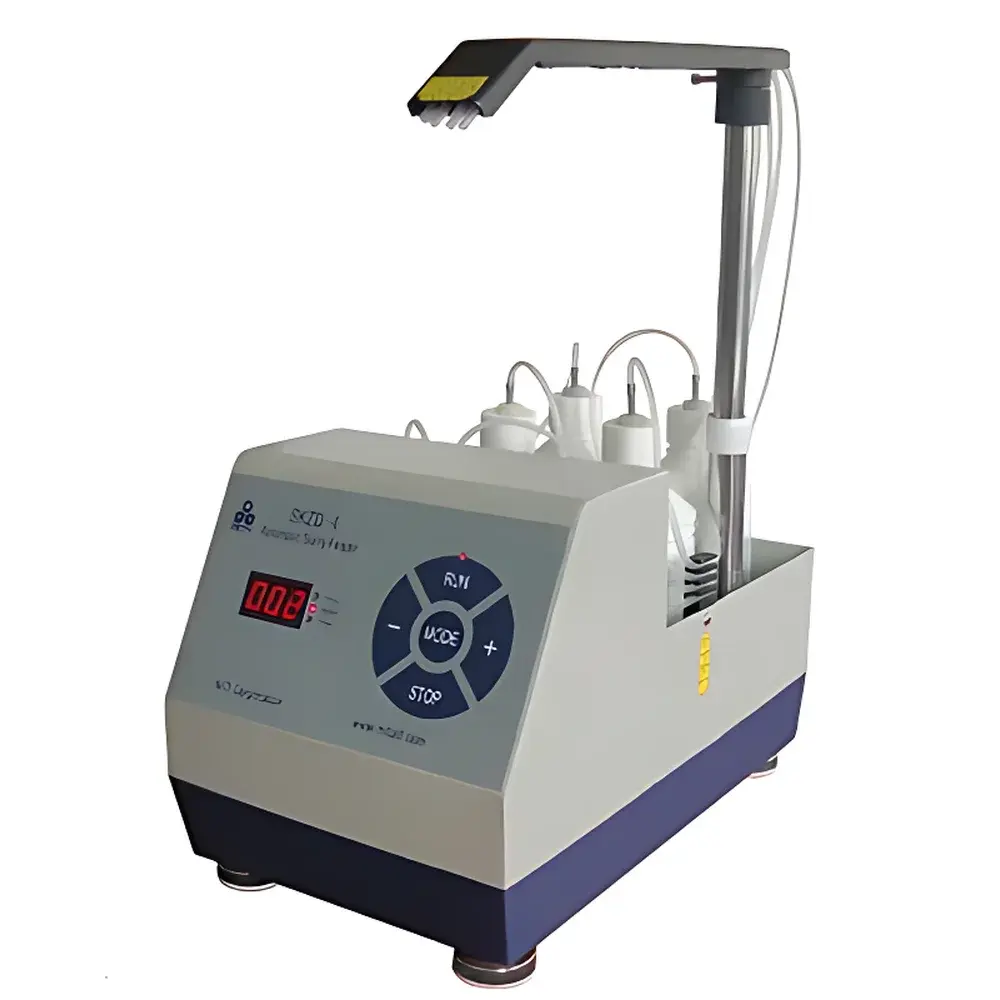
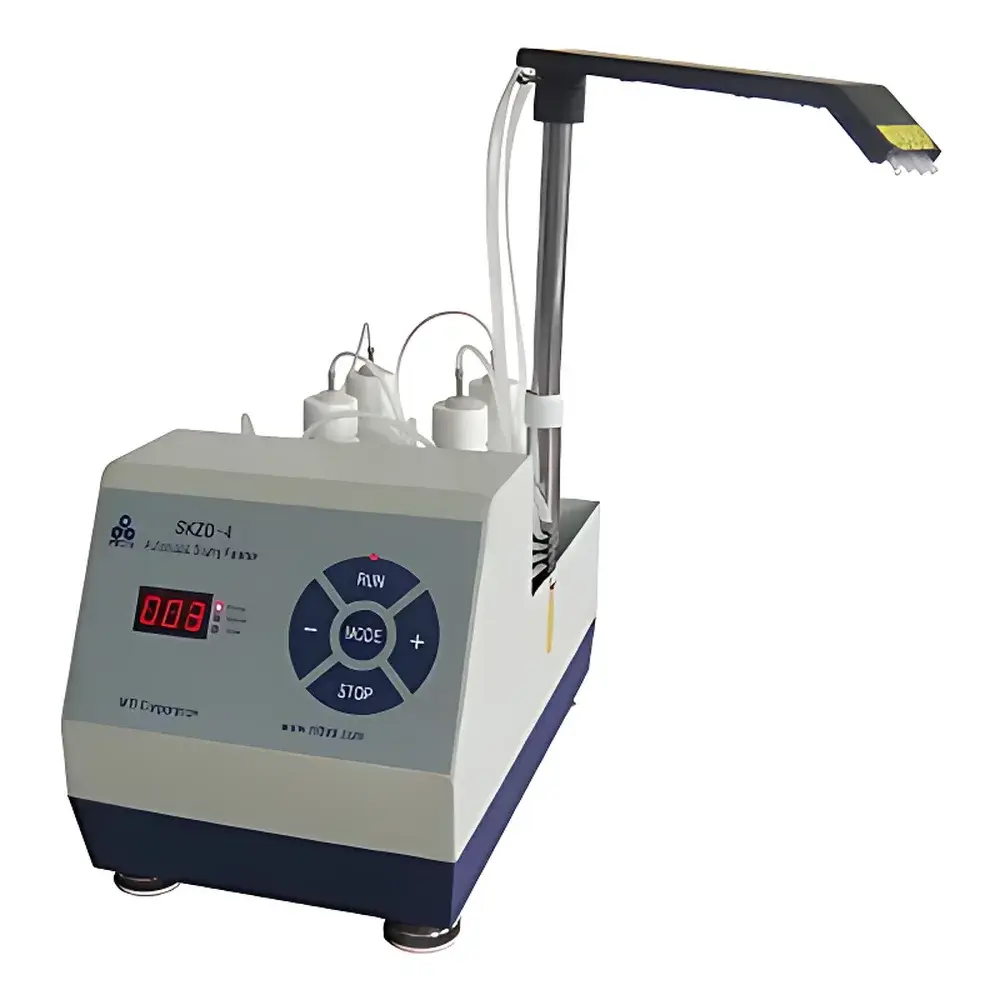
KJ GROUP SKZD-4 Automated Dispensing System for Precision Lapping & Polishing
| Brand | KJ GROUP |
|---|---|
| Origin | Liaoning, China |
| Manufacturer Type | Authorized Distributor |
| Country of Origin | China |
| Model | SKZD-4 |
| Pricing | Available Upon Request |
| Power Input | AC 110/220 V, 50/60 Hz → DC 12 V (25 W) |
| Number of Independent Channels | 4 |
| Reservoir Capacity | 500 mL per bottle |
| Flow Rate Range | 0.1–10 mL/min |
| Timer Range | 1–999 min |
| Operating Temperature | 5–40 °C |
| Relative Humidity | 0–90% RH (non-condensing) |
| Dimensions (W×D×H) | 230 × 370 × 450 mm |
| Weight | 10 kg |
Overview
The KJ GROUP SKZD-4 Automated Dispensing System is an engineered solution designed specifically for controlled, repeatable delivery of abrasive slurries and lubricants during precision lapping and polishing operations—particularly when integrated with UNIPOL-series lapping and polishing machines. Based on peristaltic pump technology, the SKZD-4 ensures stable, pulse-free fluid delivery across four independent channels, enabling simultaneous dispensing of up to four distinct suspensions or chemical agents without cross-contamination. Its core function is to replace manual dosing with programmable, time-synchronized liquid delivery, thereby eliminating operator variability, reducing material waste, and supporting unattended operation over extended polishing cycles. The system operates on a microprocessor-controlled architecture with real-time flow regulation and end-of-timer cutoff logic—critical for maintaining consistent slurry film thickness and surface removal kinetics across diverse sample geometries and materials including silicon wafers, optical glasses, ceramics, and metallographic specimens.
Key Features
- Four-channel independent peristaltic pumping system, each with dedicated 500 mL reagent reservoirs and adjustable flow control (0.1–10 mL/min)
- Microprocessor-based timer with programmable duration from 1 to 999 minutes; automatic pump shutoff upon completion to prevent over-dosing
- DC 12 V power supply interface compatible with universal AC input (110/220 V, 50/60 Hz), ensuring operational flexibility in global laboratory environments
- Compact benchtop footprint (230 × 370 × 450 mm) optimized for integration adjacent to UNIPOL lapping platforms and other sample preparation stations
- Calibration-stable flow performance with high repeatability (< ±2% CV under constant load conditions), validated using gravimetric measurement protocols
- Low-maintenance design: chemically resistant tubing, no valves or seals subject to particulate clogging, suitable for abrasive suspensions containing alumina, silica, or diamond particles
Sample Compatibility & Compliance
The SKZD-4 supports compatibility with a broad range of polishing media—including aqueous and glycol-based slurries, colloidal silica dispersions, cerium oxide suspensions, and oil-based lubricants—commonly used in semiconductor wafer planarization, optical component finishing, and metallurgical specimen preparation. While not certified to ISO/IEC 17025 or ASTM E1558, its programmable dispensing parameters align with standard operating procedures defined in ASTM E3-22 (Standard Guide for Preparation of Metallographic Specimens) and ISO 14837-1:2021 (Fine Ceramics — Determination of Surface Roughness). The device meets general electrical safety requirements per IEC 61010-1 for laboratory equipment and operates within ambient conditions compliant with GLP environmental monitoring guidelines (temperature: 5–40 °C; humidity: ≤90% RH non-condensing).
Software & Data Management
The SKZD-4 operates via an embedded microcontroller with a tactile membrane keypad and LED display—requiring no external software, drivers, or PC connectivity. All operational parameters (flow rate per channel, timer duration, start/stop sequence) are configured directly on-device and retained in non-volatile memory. While it does not support digital data logging or USB/Ethernet export, its deterministic behavior enables full traceability in SOP-driven workflows: each dispensing cycle is defined by fixed, documented settings that satisfy audit requirements under GMP Annex 11 and FDA 21 CFR Part 11 for “static” process instrumentation where configuration records serve as the primary evidence of consistency. Optional external timer logs or video documentation of start/stop events may be employed to augment process verification.
Applications
- Automated slurry delivery in multi-step lapping/polishing sequences for silicon carbide, sapphire, and GaN wafers
- Controlled application of colloidal ceria during optical lens polishing to minimize subsurface damage
- Sequential dispensing of coarse-to-fine abrasives in metallographic sample preparation (e.g., Al₂O₃ → SiO₂ → diamond suspension)
- Uniform lubricant metering during low-force polishing of brittle materials such as fused quartz or lithium niobate
- Reproducible reagent dosing in failure analysis labs performing cross-sectioning of packaged ICs or PCB substrates
FAQ
Is the SKZD-4 compatible with non-KJ GROUP lapping machines?
Yes—the unit outputs standardized 12 V DC power and uses gravity-assisted or low-pressure peristaltic delivery, making it adaptable to most lapping platforms with compatible mounting geometry and slurry tray positioning.
Can flow rates be calibrated for specific slurries?
Flow calibration is performed manually using timed gravimetric measurement; the system does not include auto-calibration but supports user-defined reference curves based on viscosity and tubing compliance.
What maintenance is required for long-term reliability?
Routine replacement of silicone tubing every 3–6 months (depending on slurry abrasiveness) and periodic visual inspection of pump rollers constitute the full preventive maintenance protocol.
Does the SKZD-4 support continuous dispensing beyond 999 minutes?
No—the maximum timer setting is 999 minutes; for longer processes, users must implement external relay control or sequential programming via external PLC integration.
Is the device suitable for use in cleanroom Class 1000 environments?
Yes—its sealed electronics, absence of moving parts beyond the pump head, and lack of aerosol-generating components meet basic cleanroom compatibility requirements; however, optional stainless-steel housing upgrades are recommended for ISO Class 5+ applications.



