
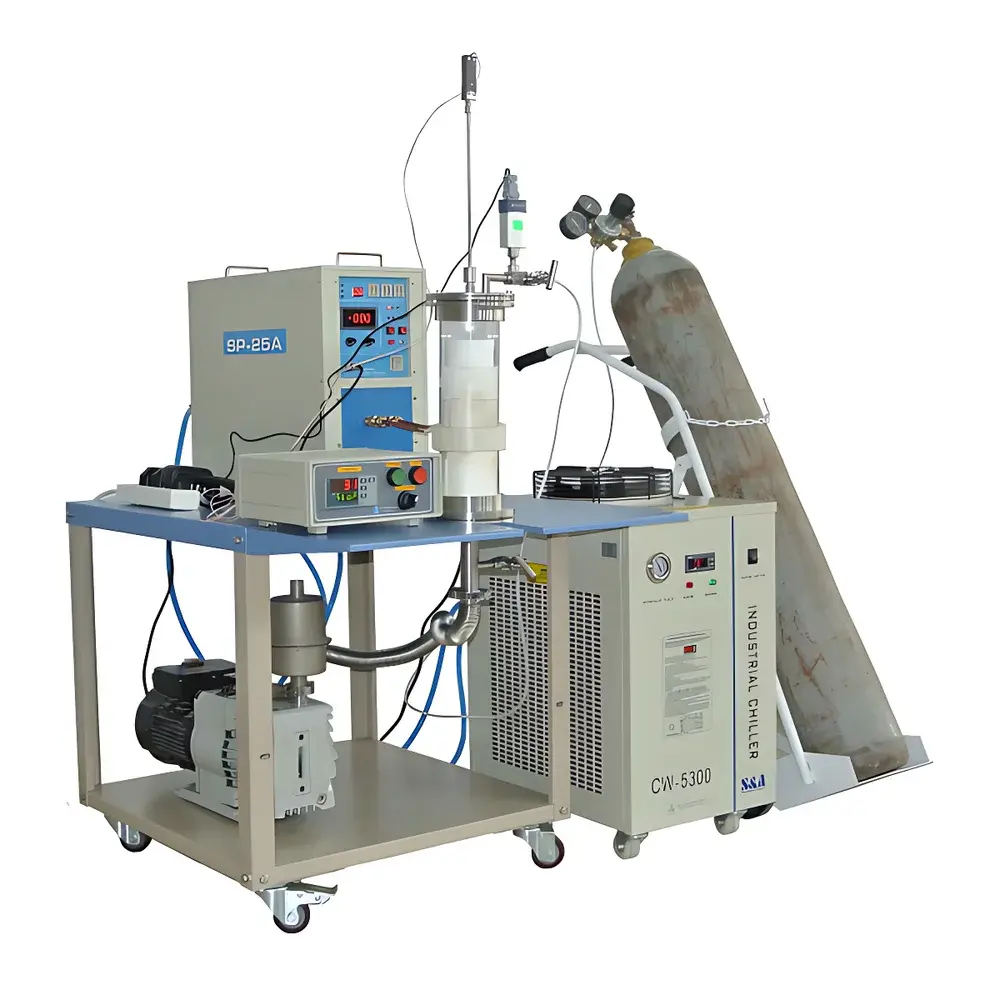
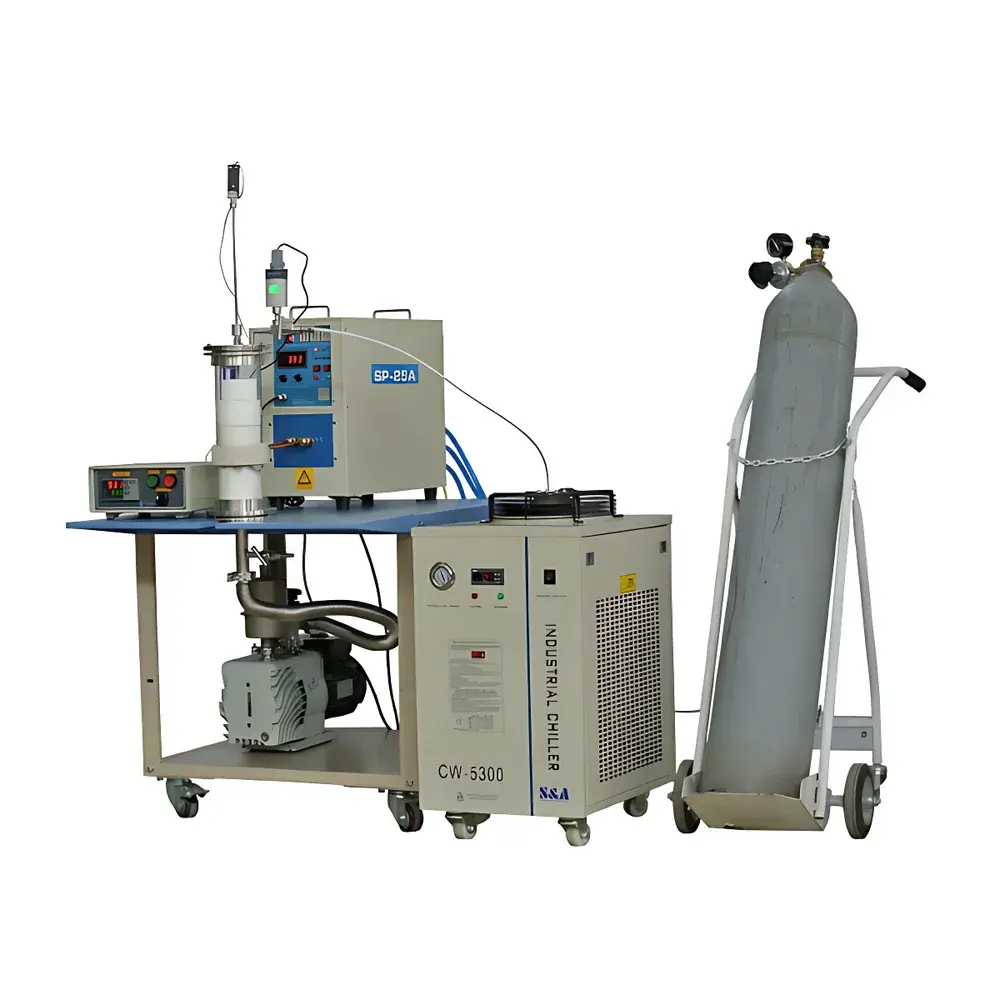
KJ GROUP SP-25TC 25 kW Programmable Temperature-Controlled Induction Melting Furnace
| Brand | KJ GROUP |
|---|---|
| Origin | Anhui, China |
| Manufacturer Type | Authorized Distributor |
| Country of Origin | China |
| Model | SP-25TC |
| Pricing | Upon Request |
| Maximum Input Power | 25 kW |
| Operating Frequency Range | 30–80 kHz |
| Continuous Working Temperature | 1000–2000 °C |
| Max. Short-Term Temperature | 1700 °C (<30 min) |
| Temperature Control Accuracy | ±5 °C |
| Programmable Ramp Segments | 30 |
| Max. Heating Rate | 1 °C/s (0–1000 °C), 0.5 °C/s (1200–1700 °C) |
| Quartz Tube Dimensions | Ø100 mm OD × Ø92 mm ID × 355 mm L |
| Graphite Crucible | Ø40 mm OD × Ø37.1 mm ID × 100.5 mm H |
| Vacuum System | Dual-stage rotary vane pump (120 L/min, base pressure 10⁻² torr) |
| Cooling | Recirculating chiller (12 L stainless steel tank, 16 L/min flow, 5–30 °C setpoint) |
| Safety Protections | Auto water-pressure cutoff, over-temperature shutdown, over-power limiter, thermocouple break detection |
| Compliance | Designed for ISO/IEC 17025-compliant lab environments |
Overview
The KJ GROUP SP-25TC is a compact, high-frequency induction melting furnace engineered for precise, repeatable high-temperature synthesis under controlled inert or reduced-pressure atmospheres. It operates on the principle of electromagnetic induction: an alternating current (30–80 kHz) passes through a water-cooled copper coil, generating a time-varying magnetic field that induces eddy currents within electrically conductive materials—primarily graphite crucibles and metallic samples—resulting in resistive self-heating. This contactless heating method eliminates contamination from external heating elements and enables rapid thermal response, uniform temperature distribution across the sample zone, and exceptional reproducibility in crystal growth, alloy preparation, and refractory metal processing. The system is rated for continuous operation up to 2000 °C (with graphite crucibles) and short-term exposure to 1700 °C—ideal for synthesizing intermetallics, rare-earth alloys, and oxide-based single crystals where thermal gradients and atmospheric purity critically influence phase formation and microstructural homogeneity.
Key Features
- High-purity alumina fiber insulation (rated to 1800 °C) surrounds the crucible chamber, minimizing radial heat loss and protecting structural components from thermal degradation.
- 30-segment programmable PID temperature controller with dual-sensor input (main furnace and sample-integrated thermocouple via top-flange armored port), enabling precise ramp/soak profiles and real-time deviation correction.
- Integrated safety architecture includes automatic water-flow interlock, over-temperature cut-off (hardware and software redundant), over-power limiting, and thermocouple failure detection—all logged with timestamps for traceability.
- Dual-port stainless steel flange assembly (top: needle valve + thermocouple feedthrough; bottom: KF25 vacuum interface + secondary needle valve) ensures leak-tight sealing and flexible gas/vacuum management.
- Recirculating chiller with stainless steel reservoir (12 L), adjustable setpoint (5–30 °C), and 16 L/min flow rate maintains stable coil and power electronics cooling under sustained 25 kW load.
- Modular design supports reconfiguration as a Rapid Thermal Processing (RTP) station or Hybrid Physical-Chemical Vapor Deposition (HPCVD) platform via optional accessory kits and gas delivery upgrades.
Sample Compatibility & Compliance
The SP-25TC accommodates standard high-purity graphite crucibles (Ø40 mm OD, 100.5 mm height) with optional SiC internal coating to suppress carbon dissolution during reactive metal melting (e.g., Ti, Zr, Nb). Sample volume must not exceed 50% of crucible capacity to prevent splashing and ensure convective stability. Quartz tube (Ø100 mm × 355 mm) provides optical access and inert containment for processes requiring visible monitoring or UV-transparent reaction zones. The system meets mechanical and electrical safety requirements per IEC 61000-6-2 (immunity) and IEC 61000-6-4 (emission), and its operational parameters align with ASTM E1112 (standard guide for high-temperature materials testing) and ISO 15184 (laboratory furnace classification). When operated with validated software and electronic logbooks, it supports compliance with FDA 21 CFR Part 11 for electronic records and signatures in regulated R&D environments.
Software & Data Management
Temperature profiles, power output, coolant temperature, and vacuum pressure are recorded at user-defined intervals (1–60 s) via RS485/Modbus RTU or optional Ethernet interface. Data export is supported in CSV and Excel-compatible formats for post-processing in MATLAB, Python (Pandas), or statistical analysis platforms. Optional KJ-LabControl Suite provides remote monitoring, alarm notification (email/SMS), audit trail generation with operator ID and timestamp, and electronic signature capability for SOP adherence. All logs include metadata (system ID, firmware version, calibration status) to satisfy ISO/IEC 17025 clause 7.5.2 on result validity and traceability.
Applications
- Growth of oxide and fluoride single crystals (e.g., YAG, LiNbO₃, CaF₂) using vertical Bridgman or gradient freeze methods.
- Melting and homogenization of high-melting-point alloys (Ni-, Co-, Fe-based superalloys; Cu-Zr, Mg-Y systems) under dynamic argon purge (≤200 mL/min, <0.02 MPa gauge).
- Preparation of master alloys for subsequent arc melting or directional solidification studies.
- Thermal treatment of ceramic precursors prior to sintering or hot isostatic pressing (HIP).
- Rapid thermal annealing of thin-film metallizations and semiconductor heterostructures (in RTP configuration).
- Chemical vapor transport synthesis of transition-metal dichalcogenides (e.g., MoS₂, WSe₂) using iodine or bromine carriers (in HPCVD mode).
FAQ
What is the maximum recommended operating pressure inside the quartz tube during argon purging?
The absolute gauge pressure must remain below 0.02 MPa (≈0.2 bar) at all times to prevent quartz fracture or flange ejection. A mass flow controller is strongly advised for stable, low-flow (<200 mL/min) inert gas delivery.
Can the SP-25TC achieve and hold vacuum better than 10⁻² torr without add-on components?
No—the standard dual-stage rotary vane pump achieves ~10⁻² torr. For ultra-high vacuum (UHV) applications such as reactive evaporation or surface science studies, a turbomolecular pump (10⁻⁵ torr base) is required as an optional upgrade.
Is the temperature controller compatible with Type S or Type B thermocouples?
Yes—the system accepts Type S (Pt/Pt–10% Rh) and Type B (Pt–30% Rh/Pt–6% Rh) thermocouples via the armored top-flange port. Calibration certificates traceable to NIST standards are available upon request.
Does the furnace support integration into automated production lines?
Yes—digital I/O ports (8-in/8-out) and Modbus TCP/Ethernet enable PLC-level coordination with robotic sample handlers, gas manifolds, and downstream quenching modules.
What maintenance intervals are recommended for the graphite crucible and quartz tube?
Graphite crucibles should be inspected after each 10–15 melts for cracking or excessive erosion; quartz tubes require visual inspection pre- and post-run for devitrification or microfractures—replacement is mandatory if haze, cloudiness, or surface pitting is observed.



