
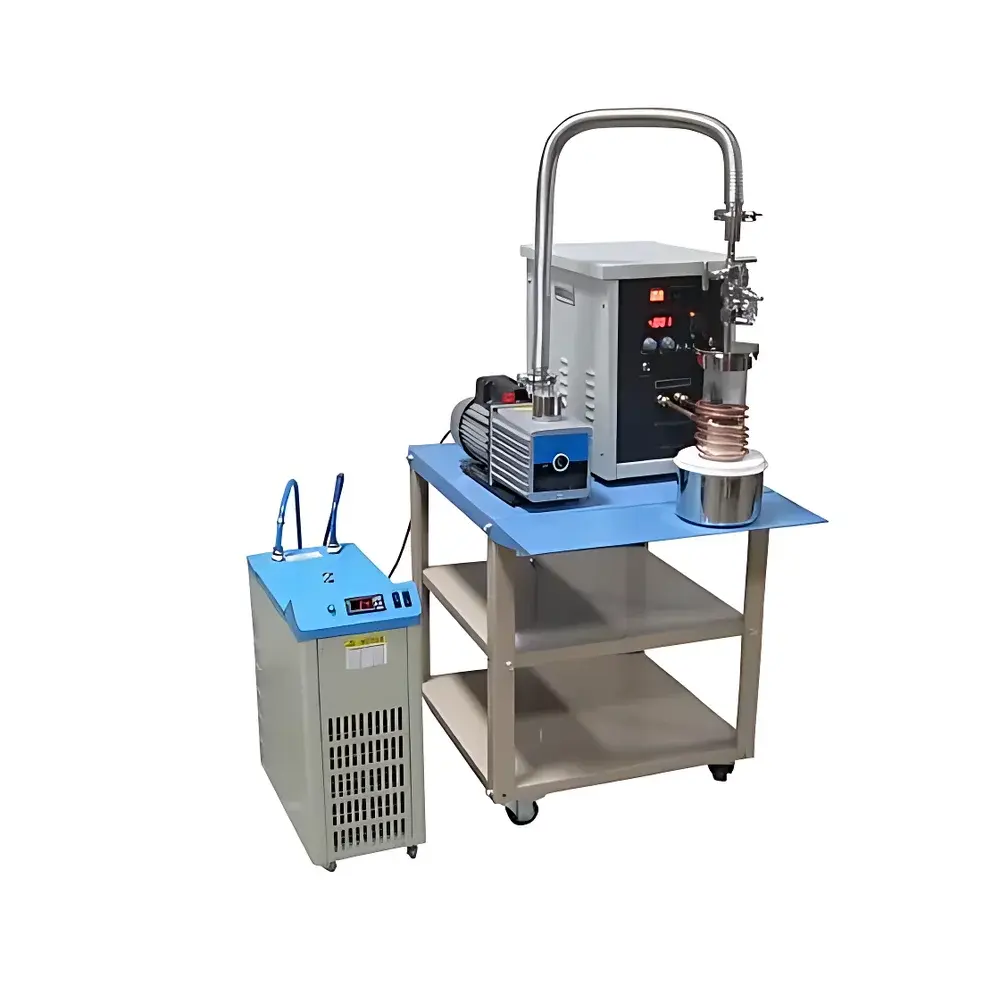
KJ GROUP SP-25VIM Vacuum Induction Melting Furnace
| Brand | KJ GROUP |
|---|---|
| Origin | Liaoning, China |
| Manufacturer Type | Authorized Distributor |
| Origin Category | Domestic (China) |
| Model | SP-25VIM |
| Pricing | Available Upon Request |
| Induction Heater | SP-25A (2–25 kW, 30–80 kHz) |
| Cooling System | Integrated Chiller (4 L/min, 4 L reservoir, 5–35 °C) |
| Vacuum System | 550 W Pump (226 L/min) with KF25 Flange |
| Quartz Crucible | Ø36 mm ID × 78 mm H (79 mL capacity) |
| Quartz Tube | Ø75 mm ID × 300 mm L |
| Induction Coil | Ø85 mm ID × 50 mm H |
| Operating Vacuum Level | ≤5 × 10⁻² mbar (with standard pump) |
| Argon Purity Requirement | ≥99.99% |
| Max Sample Mass | ~100 g (steel equivalent) |
| Safety Protections | Auto-shutdown on overpressure, overtemperature, coolant flow loss, and power overload |
Overview
The KJ GROUP SP-25VIM Vacuum Induction Melting Furnace is a compact, laboratory-scale metallurgical system engineered for controlled melting, alloying, and casting of small-volume metallic samples under inert or reduced-pressure atmospheres. It operates on the principle of electromagnetic induction heating: high-frequency alternating current (30–80 kHz) passes through a water-cooled copper coil, generating eddy currents within electrically conductive charge materials—typically metals or alloys placed inside a quartz crucible. This non-contact heating method ensures rapid, uniform thermal energy transfer without contamination from external heating elements. The integrated vacuum chamber (rated to ≤5 × 10⁻² mbar with标配 pump) and high-purity argon backfill capability enable oxidation-sensitive processing of reactive metals (e.g., Ti, Zr, Mg), refractory alloys, and prototype compositions during early-stage materials development. Designed specifically for university research labs, national institutes, and R&D centers, the SP-25VIM supports iterative alloy design, phase diagram validation, master alloy preparation, and small-batch ingot synthesis—where reproducibility, traceability, and process containment are critical.
Key Features
- Integrated SP-25A solid-state RF induction generator delivering 2–25 kW output power with digitally adjustable frequency (30–80 kHz) and precise duty-cycle control (up to 80%)
- Full-spectrum thermal safety architecture: real-time monitoring of coolant pressure/temperature, coil current, and chamber overpressure; automatic shutdown upon deviation from preset thresholds
- Ceramic refractory assembly fabricated from high-purity alumina (Al₂O₃ ≥99.5%), including crucible support base, crucible holder, and sealing lid—resistant to thermal shock up to 1600 °C
- Modular vacuum train comprising a 550 W two-stage rotary vane pump (226 L/min pumping speed), KF25 quick-release flange interface, and integrated vacuum gauge port
- Self-contained closed-loop chiller unit (4 L reservoir, 4 L/min flow rate, temperature stability ±0.5 °C across 5–35 °C operating range) with leak-detection circuitry
- Standard quartz processing envelope: Ø75 mm ID × 300 mm L tube with matching Ø36 mm ID × 78 mm H crucible (79 mL volume), enabling atmospheric control via argon purging or dynamic vacuum cycling
Sample Compatibility & Compliance
The SP-25VIM accommodates metallic feedstocks in granular, chip, or pre-alloyed rod form—including ferrous and non-ferrous systems such as stainless steels, Ni-based superalloys, Al-Si composites, Ti-6Al-4V, and rare-earth-containing intermetallics. Maximum recommended charge mass is 100 g for steel-equivalent density; lower masses apply for low-density metals (e.g., ~35 g for pure aluminum) to ensure complete melt homogeneity and avoid crucible overflow. All wetted components comply with ISO 8502-3 for surface cleanliness prior to installation. While not certified to ASME BPVC Section VIII or PED 2014/68/EU out-of-the-box, the furnace’s mechanical design adheres to fundamental pressure vessel safety principles (ASME B31.1 guidance for auxiliary piping). For GLP/GMP-aligned workflows, users may implement supplementary audit trails via external data loggers interfaced with analog outputs (0–10 V temperature feedback, 4–20 mA power signal).
Software & Data Management
The SP-25A induction controller features a front-panel membrane keypad with LCD display for manual parameter entry (heating duration: 1–99 s; cooling delay: 1–99 s; power ramp profiles). Though no proprietary PC software is bundled, the system provides isolated analog I/O ports compatible with third-party SCADA platforms (e.g., LabVIEW, Ignition, Siemens Desigo CC) for time-synchronized acquisition of coil current, coolant temperature, and chamber pressure. All operational events—including safety-triggered shutdowns—are timestamped and stored in non-volatile memory (retention ≥10 years). For FDA 21 CFR Part 11 compliance, laboratories may deploy validated electronic lab notebooks (ELNs) that capture operator ID, batch ID, and parameter sets alongside exported CSV logs.
Applications
- Rapid prototyping of novel alloy compositions for aerospace and biomedical implant applications
- Thermodynamic studies requiring repeated melting-quench cycles under repeatable redox conditions
- Preparation of master alloys for subsequent arc-melting or investment casting trials
- Investigation of segregation behavior and solidification microstructures via directional quenching using custom chill plates
- Small-scale recycling trials involving mixed scrap feeds under controlled deoxidation atmospheres
- Calibration reference material synthesis where chemical homogeneity and minimal crucible interaction are essential
FAQ
What is the maximum operating temperature achievable with the SP-25VIM?
The system is designed for continuous operation up to 1600 °C in inert gas environments; actual attainable temperature depends on sample emissivity, crucible geometry, and power coupling efficiency.
Can the furnace be upgraded for higher vacuum performance?
Yes—replacing the standard rotary vane pump with a turbomolecular pump (e.g., 300 L/s model) and adding a capacitance manometer enables base pressures down to 1 × 10⁻⁵ mbar, suitable for ultra-high-purity metal refining.
Is the quartz tube replaceable, and what is its expected service life?
Quartz consumables are field-replaceable; typical lifespan is 20–50 melts depending on thermal cycling severity and metal reactivity—visible devitrification or microcracking indicates replacement necessity.
Does the system support automated sequence programming?
Not natively; however, the analog control interface allows integration with programmable logic controllers (PLCs) for multi-step thermal profiles, including pre-evacuation, heating, hold, and controlled backfill sequences.
What electrical infrastructure is required beyond the stated AC380V supply?
A dedicated 63 A circuit breaker with Class B RCD protection and earth resistance ≤4 Ω is mandatory; upstream harmonic filtering is recommended when multiple RF units operate on shared busbars.



