
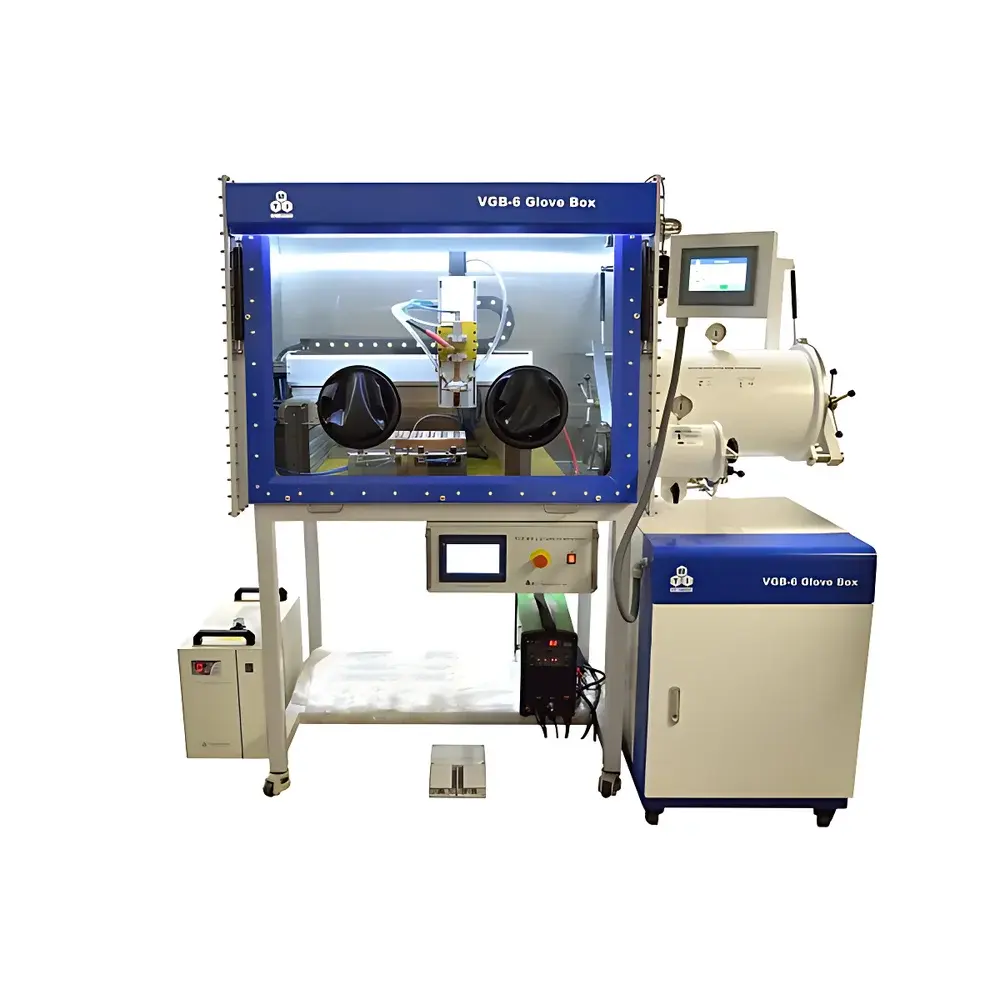
KJ GROUP SP-MSM32 High-Throughput Arc Melting System
| Brand | KJ GROUP |
|---|---|
| Origin | Liaoning, China |
| Manufacturer Type | Authorized Distributor |
| Country of Origin | China |
| Model | SP-MSM32 High-Throughput Arc Melting System |
| Dimensions (L×W×D) | 1200 × 900 × 750 mm |
| Maximum Melting Temperature | 3000 °C |
| Number of Melting Positions | 32 |
| Tungsten Electrode Diameter | 4 mm |
| Electrode Travel Range (X×Y×Z) | ≥200 × 400 × 50 mm |
| Water-Cooled Crucible Diameter | 25 mm |
| Power Supply Output Current Range | 10–250 A (adjustable) |
| Vacuum Glovebox Chamber Size | 1200 × 900 × 750 mm (single-front access) |
| Internal Atmosphere Purity | H₂O & O₂ < 1 ppm (with regeneration-capable purification system) |
| Cooling System | KJ-5000 Recirculating Chiller |
| Protective Atmosphere | 5N Argon or 5% H₂ + 95% Ar |
Overview
The KJ GROUP SP-MSM32 High-Throughput Arc Melting System is an integrated, vacuum-compatible metallurgical platform engineered for rapid compositional screening and phase diagram mapping of refractory and high-temperature alloys. It combines a Class 100 cleanroom-grade inert atmosphere glovebox, a precision X-Y-Z motion-controlled arc melting station, and a dual water-cooled copper crucible array to enable parallel processing of up to 32 discrete samples per cycle. Operating on the principle of DC arc discharge between a consumable tungsten electrode and conductive sample material under controlled inert or reducing atmospheres, the system achieves localized heating exceeding 3000 °C—sufficient to melt refractory metals including Mo, Nb, Ta, W, and Ni-based superalloy precursors. Its design prioritizes thermal stability, positional repeatability, and atmospheric integrity, making it suitable for labs engaged in combinatorial materials science, thermodynamic modeling validation, and pre-production alloy development under GLP-aligned workflows.
Key Features
- Modular vacuum glovebox with 3-mm 304 stainless steel chamber, reinforced tempered glass viewport, and dual-compartment antechamber (360 × 600 mm / 150 × 300 mm) for safe sample transfer.
- Automated gas purification system featuring dual-bed regeneration: moisture removal via heated molecular sieve and oxygen scavenging via copper-based catalyst, monitored in real time by integrated dew point sensor (±0.1 ppm resolution) and paramagnetic O₂ analyzer (0–999 ppm range).
- Programmable XYZ motion controller with industrial-grade touchscreen HMI; enables fully autonomous electrode positioning over each of 32 individual 25-mm-diameter water-cooled copper crucibles.
- Dual 180 × 180 mm insulated water-cooled crucible plates mounted on vibration-damped base, compatible with sequential or simultaneous multi-position melting protocols.
- High-current DC power supply (10–250 A, adjustable), optionally upgradeable to 300 A at 380 V / 50 Hz, with active current regulation and arc stabilization circuitry.
- Integrated KJ-5000 recirculating chiller providing stable coolant flow (≤15 °C outlet) to both electrode and crucible assemblies, ensuring thermal management during extended duty cycles.
Sample Compatibility & Compliance
The SP-MSM32 accommodates metallic feedstocks in pellet, chip, or pressed powder form (typical mass range: 0.5–5 g per crucible). It supports reactive systems requiring strict oxygen and moisture exclusion—including Ti-, Zr-, Mg-, and rare-earth-containing alloys—by maintaining sustained atmosphere purity below 1 ppm H₂O and O₂. The glovebox conforms to ISO 14644-1 Class 5 (ISO Class 5) particulate cleanliness requirements when operated with HEPA filtration. All electrical subsystems comply with IEC 61000-6-3 (EMI emission) and IEC 61000-6-2 (immunity) standards. Gas handling components meet CGA G-4.1 specifications for high-purity argon service. The system architecture permits integration into FDA 21 CFR Part 11–compliant environments when paired with validated electronic logbook software and audit-trail-enabled controllers.
Software & Data Management
Motion control, power delivery, and environmental monitoring are coordinated through a unified embedded Linux-based HMI with password-protected user roles (Operator, Technician, Administrator). All process parameters—including arc current, electrode position coordinates, chamber pressure, O₂/H₂O readings, and chiller temperature—are timestamped and logged internally (≥16 GB onboard storage) with CSV export capability. Optional OPC UA server module enables seamless connectivity to LIMS or MES platforms. Data integrity safeguards include automatic backup upon session termination, cyclic redundancy checksum verification, and configurable retention policies aligned with ISO/IEC 17025 documentation requirements.
Applications
- High-throughput synthesis of alloy libraries for phase stability assessment and CALPHAD model calibration.
- Rapid prototyping of Ni-, Co-, and Fe-based superalloys targeting turbine blade or nuclear cladding applications.
- Preparation of homogeneous master alloys for subsequent casting, additive manufacturing feedstock production, or thin-film sputtering target fabrication.
- Thermodynamic investigation of immiscible systems and metastable phase formation under non-equilibrium solidification conditions.
- Refinement of melt homogenization protocols prior to directional solidification or Bridgman growth experiments.
FAQ
What protective atmosphere is required for optimal operation?
High-purity argon (5N, ≤0.1 ppm O₂/H₂O) is standard; for oxide-prone systems (e.g., Ti, Al, Mg), a reducing mixture of 5% H₂ + 95% Ar is recommended. Gas must pass through a certified dual-stage regulator with integrated particulate and moisture filters.
Is the system compatible with automated sample loading?
The current configuration supports manual loading; however, the XYZ motion architecture and open communication protocol (Modbus TCP) allow third-party robotic integration via custom end-effector mounting on the glovebox rear port.
How is electrode wear compensated during long-duration campaigns?
Tungsten electrodes feature calibrated Z-axis auto-feed compensation triggered by arc voltage drift detection; replacement intervals are tracked in the maintenance log with predictive alerts based on cumulative arc-on time.
Can the glovebox accommodate larger crucible configurations?
Yes—the base plate is modular; alternative crucible arrays (e.g., 16-position large-bore or 64-position micro-crucible layouts) are available as factory-configured options with corresponding motion profile reprogramming.
What safety certifications does the system carry?
The enclosure meets CE marking requirements under Machinery Directive 2006/42/EC and Low Voltage Directive 2014/35/EU. Laser safety interlocks (Class 1) are installed on all viewport access points, and arc flash mitigation complies with NFPA 70E Category 2 PPE guidelines.
Related Products



