
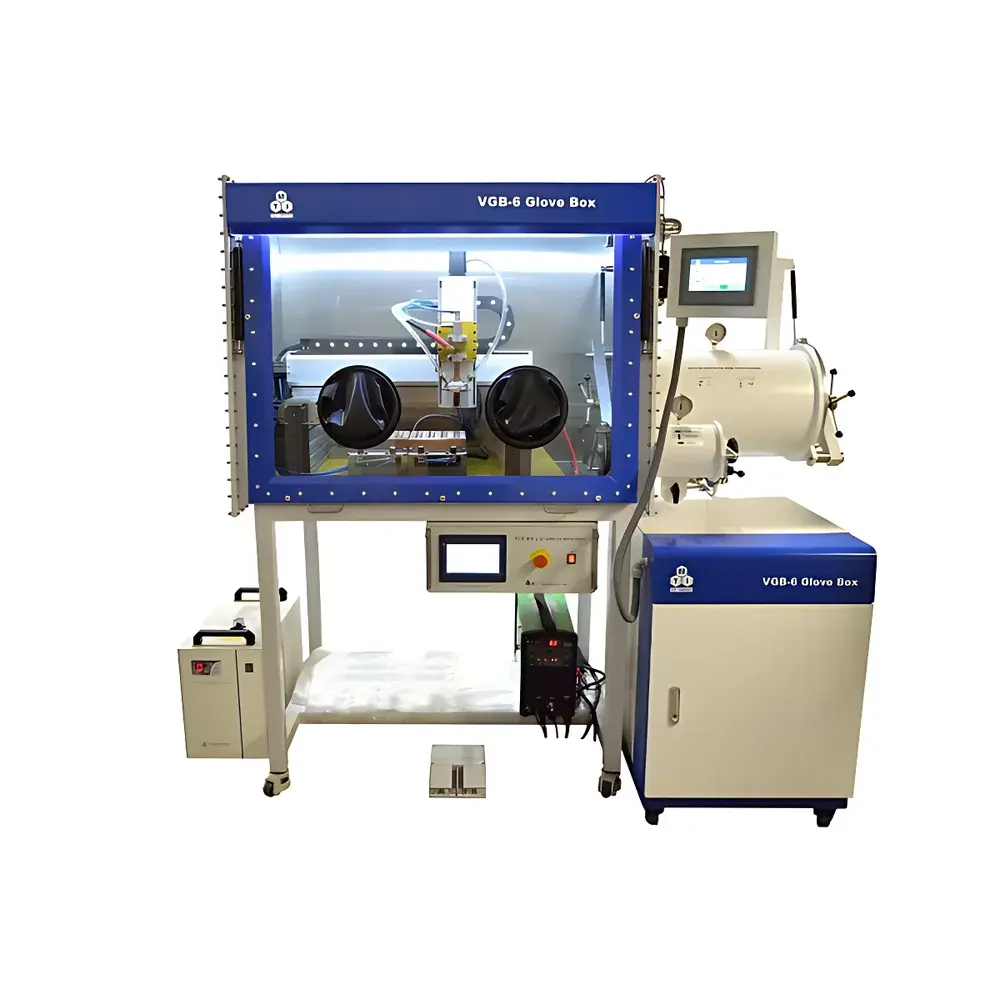
KJ GROUP SP-MSM360 32-Position High-Throughput Arc Melting System
| Brand | KJ GROUP |
|---|---|
| Origin | Liaoning, China |
| Manufacturer Type | Authorized Distributor |
| Country of Origin | China |
| Model | SP-MSM360 |
| Pricing | Upon Request |
| Vacuum Glove Box Dimensions | 1200 × 900 × 750 mm (front-opening), Transfer Chamber: 360 × 600 mm / 150 × 300 mm |
| Purification Performance | H₂O ≤ 1 ppm, O₂ ≤ 1 ppm (with auto-regeneration) |
| Electrode | Ø4 mm Tungsten, Water-Cooled |
| Electrode Travel Range | ≤380 × 300 × 50 mm (X-Y-Z) |
| Crucible Array | 32 × Ø25 mm Water-Cooled Copper Crucibles on 180 × 180 mm Insulated Base |
| Max Melting Temperature | 3500 °C |
| Power Supply | AC 380 V, 50 Hz |
| Output Current | 15–315 A |
| Cooling | KJ-5000 Recirculating Chiller |
| Protective Atmosphere | Ultra-High-Purity Argon (≥99.999%, H₂O ≤ 5 ppm, O₂ ≤ 5 ppm) |
| Safety | Integrated UV/IR-blocking viewing window, mandatory safety goggles required during operation |
Overview
The KJ GROUP SP-MSM360 32-Position High-Throughput Arc Melting System is an integrated, vacuum-compatible materials synthesis platform engineered for rapid compositional screening and phase diagram mapping of refractory and high-entropy alloys. It combines a Class-1000 inert-atmosphere glove box, a precision X-Y-Z motorized electrode positioning system, and a high-current DC arc melting furnace into a single synchronized workflow. The system operates on the principle of consumable-electrode arc melting under controlled inert gas—where a high-current DC arc (up to 315 A) is struck between a tungsten electrode and conductive sample pellets placed in water-cooled copper crucibles. This generates localized thermal energy sufficient to achieve temperatures up to 3500 °C, enabling full melting and homogenization of transition metals, intermetallics, carbides, and borides. Unlike induction or resistance melting, arc melting provides superior control over localized heat input, minimal crucible contamination, and direct atmospheric isolation—critical for oxygen- and nitrogen-sensitive alloy systems such as Ti-Al, Ni-Co-Cr-Fe-Mo, and Nb-Si-based composites.
Key Features
- 32-position modular crucible array (Ø25 mm each) mounted on dual 180 × 180 mm insulated water-cooled bases, enabling parallel processing of compositionally graded libraries without cross-contamination.
- Motorized X-Y-Z stage with touchscreen-driven motion control (programmable trajectory, dwell time, current ramping), ensuring repeatable electrode positioning accuracy within ±0.1 mm.
- Integrated vacuum glove box (304 stainless steel shell, 3 mm thickness; tempered glass viewport with UV/IR attenuation) certified for sustained O₂/H₂O < 1 ppm via dual-bed purification (copper-based deoxidizer + molecular sieve dehydrator) with auto-regeneration heating module.
- Dedicated KJ-5000 recirculating chiller (±0.5 °C temperature stability) supplying closed-loop cooling to both tungsten electrode and crucible block—essential for thermal management at >3000 °C melt cycles.
- Real-time environmental monitoring: embedded dew point sensor (±0.1 ppm resolution) and paramagnetic oxygen analyzer (0–999 ppm range) feed data to the central PLC for automated purge compensation and alarm-triggered shutdown.
- Compliant power supply with adjustable current output (15–315 A DC), soft-start ramping, and arc-stability feedback loop to minimize spatter and ensure reproducible melt pool geometry across all 32 positions.
Sample Compatibility & Compliance
The SP-MSM360 accommodates metallic, intermetallic, and ceramic precursor powders (particle size ≤ 100 µm) compressed into cylindrical pellets (Ø12–22 mm, height 3–8 mm). Compatible sample matrices include but are not limited to: Fe-, Co-, Ni-, Ti-, Al-, Nb-, Mo-, and W-based systems; Laves-phase compounds; MAX phases; and oxide-dispersion-strengthened (ODS) pre-alloys. All wetted surfaces contacting samples—crucibles, electrode tip, and glove box interior—are electropolished 304 SS or oxygen-free high-conductivity (OFHC) copper, minimizing trace element leaching. The system meets ISO 14644-1 Class 7 (10,000) cleanroom equivalency for particulate control and supports GLP-compliant operation when paired with audit-trail-enabled software (see Software section). It is designed for use in accordance with ASTM F2619 (Standard Guide for Arc Melting of Refractory Metals) and aligns with USP analytical instrument qualification protocols for critical research environments.
Software & Data Management
The SP-MSM360 employs a Windows-based HMI interface running on an industrial-grade embedded controller. All process parameters—including arc current profile, electrode Z-height, dwell duration per position, argon flow rate (mass flow controlled), and real-time chamber O₂/H₂O readings—are logged with timestamped CSV export. Optional integration with LabArchives ELN or Thermo Fisher SampleManager enables direct metadata ingestion (sample ID, composition, melt sequence, QC flags). Audit trail functionality complies with FDA 21 CFR Part 11 requirements when configured with electronic signatures and role-based access control (RBAC). Firmware updates are delivered via secure HTTPS, and configuration backups support ISO/IEC 27001-aligned data retention policies.
Applications
- Rapid phase diagram construction via combinatorial arc melting of composition-spread libraries (e.g., Ni–Cr–Fe–Mo quaternary sections).
- High-throughput synthesis of refractory high-entropy alloys (RHEAs) targeting elevated creep resistance and oxidation stability above 1200 °C.
- Preparation of master alloys for subsequent casting, additive manufacturing feedstock qualification, or thin-film sputtering target fabrication.
- Thermodynamic validation studies requiring equilibrium-melt-quench conditions under ultra-low pO₂ (≤10⁻⁶ atm).
- Education and training in metallurgical thermodynamics, where visual arc initiation, melt pool dynamics, and solidification microstructure correlation are demonstrable in real time.
FAQ
What purity grade of argon is required for optimal performance?
Ultra-high-purity argon (5N, ≥99.999%) with verified impurity levels of H₂O ≤ 5 ppm and O₂ ≤ 5 ppm is mandatory. In-line gas purifiers are recommended for extended campaigns.
Can the crucible layout be reconfigured for non-standard sample geometries?
Yes—custom crucible arrays (e.g., 16-position rectangular grid, 48-position hexagonal pattern) and non-circular crucible profiles (square, elliptical) are available as factory-engineered options.
Is remote monitoring supported?
Standard Ethernet/IP connectivity enables SNMP-based network health reporting and Modbus TCP readout of critical sensors; optional VPN-enabled remote desktop access is available under ITAR-compliant deployment agreements.
What maintenance intervals are recommended for the purification system?
Deoxidizer bed replacement every 6 months (or after 500 h cumulative operation); desiccant regeneration cycle initiated automatically every 72 h; full system leak check recommended quarterly per ASTM E493.
Does the system support inert-gas backfilling during sample transfer?
Yes—the dual-chamber transfer lock includes independent pressure-controlled argon backfill (0.5–1.2 bar) with programmable purge cycles and residual O₂ verification prior to gate opening.



