
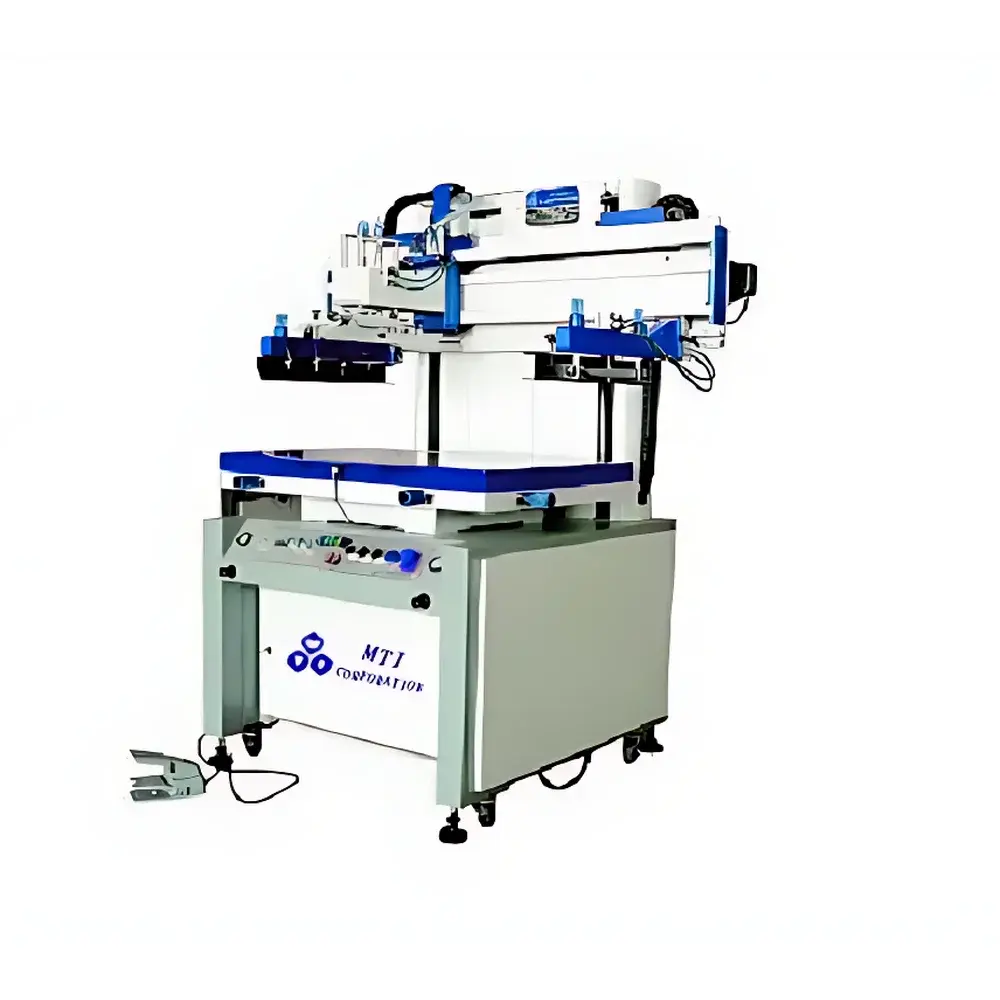
KJ GROUP SPC-32 Motorized Flatbed Screen Printing Machine
| Brand | KJ GROUP |
|---|---|
| Origin | Liaoning, China |
| Manufacturer Type | Authorized Distributor |
| Country of Origin | China |
| Model | SPC-32 |
| Pricing | Upon Request |
| Power Supply | Single-phase AC 208–240 V, 50/60 Hz |
| Rated Power | 2500 W |
| Print Table Dimensions | 330 mm × 400 mm |
| Maximum Print Area | 200 mm × 300 mm |
| Print Height Adjustment Range | 30 mm |
| Production Throughput | 300–500 pcs/h |
| Repeatability Accuracy | ±0.03 mm |
| Environmental Operating Conditions | Altitude <1000 m |
| Cooling | Integrated recirculating chiller (deionized or purified water) |
| Gas Requirement | Argon purge (≥99.99% purity), supplied via external cylinder with Ø6 mm dual-ferrule compression fitting |
| Electrical Safety | Dedicated 63 A circuit breaker, mandatory earth grounding |
| Mechanical Guidance | Precision linear rails with variable-frequency motor drive |
| 刮刀 System | Pneumatically assisted floating squeegee assembly with adjustable pressure and stroke speed |
| Alignment | Micrometer-driven X/Y/Z fine alignment stage for PCB-to-screen registration |
| Dual-side Independent Adjustment | Left/right independent lateral offset control for asymmetric or multi-size mesh frame compatibility |
Overview
The KJ GROUP SPC-32 Motorized Flatbed Screen Printing Machine is a precision-engineered benchtop coating system designed specifically for controlled deposition of functional inks and pastes in energy device R&D environments—particularly proton exchange membrane fuel cells (PEMFCs), solid oxide fuel cells (SOFCs), and thin-film photovoltaic devices such as perovskite and silicon heterojunction solar cells. It operates on the principle of contact screen printing, where a conductive or catalytic ink is forced through a tensioned stainless-steel or polyester mesh under controlled squeegee pressure and translational motion. The machine integrates a rigid aluminum-alloy frame, high-tolerance linear motion guidance, and closed-loop motorized actuation to ensure micron-level repeatability across repeated print cycles. Its design prioritizes process stability over throughput scalability—making it suitable for laboratory-scale formulation screening, electrode architecture optimization, and pre-pilot batch fabrication under GLP-aligned workflows.
Key Features
- Precision micrometer-based X/Y/Z alignment stage enabling sub-10 µm registration accuracy between substrate (e.g., carbon paper, FTO glass, or silicon wafer) and stencil/mesh
- Floating pneumatic squeegee system with independently adjustable downforce (0.5–5.0 kgf) and forward stroke velocity (5–50 mm/s), minimizing shear-induced ink deformation
- Variable-frequency DC servo drive ensures smooth acceleration/deceleration profiles and eliminates mechanical backlash during print head translation
- Dual-side independent lateral adjustment accommodates asymmetrical mesh frames and enables rapid reconfiguration between single- and double-sided printing modes
- Integrated recirculating chiller maintains thermal stability of the print table (<±0.5 °C drift over 4 h), critical for viscosity-sensitive inks (e.g., Pt/C catalyst inks, PEDOT:PSS dispersions)
- Argon-purged printing chamber minimizes oxidative degradation of air-sensitive materials (e.g., NiOx hole transport layers, SnO₂ electron extraction layers)
Sample Compatibility & Compliance
The SPC-32 accepts rigid and semi-rigid substrates up to 330 mm × 400 mm and 10 mm thick—including silicon wafers, ITO/FTO-coated glass, carbon fiber paper, metal foils, and ceramic substrates. Mesh frame compatibility spans standard 250 mm × 300 mm to 400 mm × 500 mm formats with tensioning ranges from 15–35 N/cm. The system conforms to ISO 12232:2019 (imaging performance evaluation) for positional repeatability verification and supports traceable calibration using NIST-traceable step gauges and optical alignment targets. While not certified for GMP manufacturing, its mechanical stability, audit-ready parameter logging (via optional RS-485 interface), and argon environment enable compliance with internal QC protocols aligned with ASTM D4145 (screen printing quality standards) and IEC 61215-2 (photovoltaic module qualification testing requirements).
Software & Data Management
The SPC-32 operates via a dedicated industrial HMI panel with non-volatile memory storing up to 99 user-defined print recipes—including squeegee pressure, stroke speed, snap-off gap, dwell time, and alignment offsets. All parameter changes are timestamped and logged locally (SD card backup optional). For integration into automated lab ecosystems, an RS-485 Modbus RTU interface supports bidirectional communication with LIMS or MES platforms. Audit trails comply with ALCOA+ principles (Attributable, Legible, Contemporaneous, Original, Accurate, Complete, Consistent, Enduring, Available) when paired with external data acquisition software. No cloud connectivity or proprietary cloud platform is embedded—ensuring full data sovereignty and compatibility with air-gapped research networks.
Applications
- Deposition of catalyst inks (e.g., Pt/C, IrO₂, NiFe LDH) onto gas diffusion layers for PEMFC/SOFC MEA fabrication
- Patterned printing of transparent conductive oxides (TCOs) and metal grid pastes for bifacial solar cell front electrodes
- Multi-layer stack printing of perovskite photovoltaic architectures (ETL/Perovskite/HTL) with interlayer registration tolerance ≤±25 µm
- Functional ceramic paste printing for micro-solid oxide electrolyte membranes and sensor electrode arrays
- Research-grade patterning of conductive polymer inks (e.g., PEDOT:PSS, PANI) for flexible printed electronics prototyping
FAQ
What substrate thicknesses can the SPC-32 accommodate?
Standard configuration supports substrates 0.1–10 mm thick; optional Z-axis extension kits increase maximum clearance to 25 mm.
Is the machine compatible with UV-curable inks?
Yes—provided the argon atmosphere is maintained during printing to prevent premature surface inhibition; post-print UV curing requires external lamp integration.
Does the system support automatic mesh cleaning cycles?
No—mesh cleaning is manual; however, the open-frame design allows easy access for solvent wiping or ultrasonic bath immersion.
Can print parameters be exported for regulatory documentation?
Yes—recipe files and operation logs export as CSV via USB port; timestamps and operator IDs are embedded for 21 CFR Part 11–aligned recordkeeping when used with validated third-party software.
What maintenance intervals are recommended?
Linear rail lubrication every 200 operational hours; squeegee blade replacement every 5,000 prints or upon visible wear; chiller fluid exchange annually or per conductivity monitoring.



