
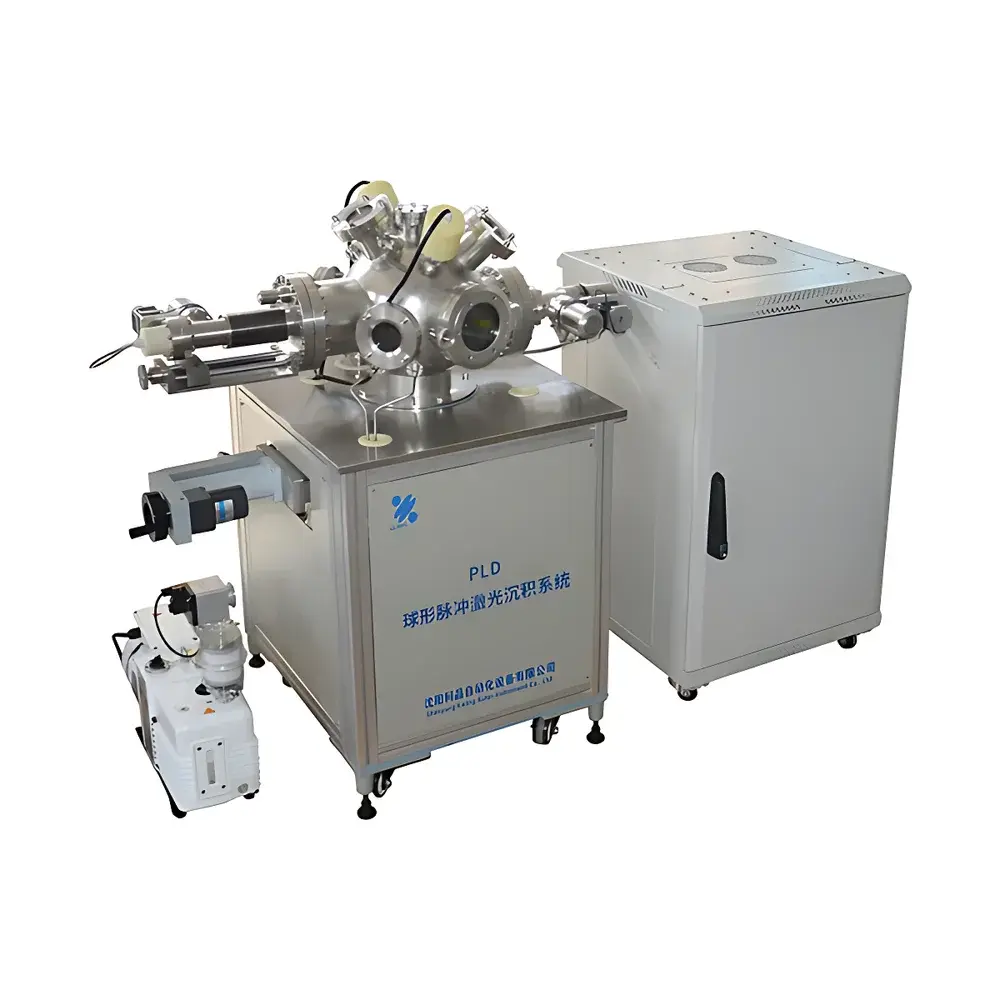
KJ GROUP Spherical Pulsed Laser Deposition (PLD) System
| Brand | KJ GROUP |
|---|---|
| Origin | Liaoning, China |
| Manufacturer Type | Authorized Distributor |
| Origin Category | Domestic |
| Model | Spherical Pulsed Laser Deposition (PLD) System |
| Pricing | Upon Request |
| Operating Temperature | 10–35 °C |
| Relative Humidity | ≤75% |
| Power Supply | 220 V, Single-Phase, 50 ± 0.5 Hz |
| Max Power Consumption | <4 kW |
| Cooling Water Pressure | 0.2–0.4 MPa |
| Cooling Water Temperature | 15–25 °C |
| Vacuum Chamber | Spherical, Ø300 mm, Manual Front Door |
| Chamber Material | 304 Stainless Steel, TIG-Welded, Glass-Bead Blasted + Electrochemical Passivation |
| Ultimate Vacuum | ≤6.67×10⁻⁵ Pa (after bake-out, with 600 L/s turbo-molecular pump & 8 L/s backing pump) |
| Leak Rate | ≤5.0×10⁻⁷ Pa·L/s |
| Pump-Down Time to 8.0×10⁻⁴ Pa | ≤40 min |
| Vacuum Hold (12 h, pump-off) | ≤20 Pa |
| Substrate Holder | Ø40 mm, 1–20 RPM rotation |
| Substrate-to-Target Distance | 40–90 mm |
| Max Substrate Temperature | 800 °C, Temp Control Accuracy: ±1 °C |
| Rotating Target Carousel | 4 Positions, Ø40 mm per target, individual shuttering, coaxial laser incidence |
| Integrated Features | In-chamber bake-out heater, LED illumination, water-pressure alarm |
| Gas Flow Control | 1 Channel MFC, 0–100 sccm |
Overview
The KJ GROUP Spherical Pulsed Laser Deposition (PLD) System is a research-grade thin-film synthesis platform engineered for precision stoichiometric transfer from complex multi-element targets to substrates under controlled ultra-high vacuum (UHV) conditions. PLD operates on the principle of pulsed laser ablation: a high-intensity nanosecond or femtosecond laser beam is focused onto a solid target inside a vacuum chamber, generating a transient plasma plume composed of atoms, ions, electrons, and clusters. This plume expands directionally toward a heated substrate, where kinetic energy and surface diffusion enable epitaxial or polycrystalline film growth with minimal thermal budget and exceptional compositional fidelity. Unlike sputtering or chemical vapor deposition, PLD preserves the stoichiometry of compound targets—including oxides, nitrides, carbides, borides, silicides, sulfides, and fluorides—even for metastable phases such as diamond-like carbon or cubic boron nitride—making it indispensable for functional oxide electronics, superconducting heterostructures, and emerging quantum materials.
Key Features
- Spherical UHV Chamber Architecture: A symmetrical Ø300 mm spherical stainless-steel (304) vacuum vessel minimizes shadowing effects and ensures uniform plume expansion geometry, enhancing film homogeneity across the substrate surface.
- Advanced Surface Engineering: All internal components undergo glass-bead blasting followed by electrochemical passivation—critical for reducing outgassing rates, minimizing metallic contamination, and sustaining long-term vacuum integrity.
- High-Fidelity Vacuum Performance: Achieves ≤6.67×10⁻⁵ Pa after bake-out using a 600 L/s turbo-molecular pump backed by an 8 L/s dry scroll pump; leak rate certified at ≤5.0×10⁻⁷ Pa·L/s per ASTM E493-22.
- Thermally Stable Substrate Stage: Precision-controlled heating up to 800 °C with ±1 °C stability over 12 h, enabling in-situ annealing and crystallization during deposition—compatible with thermocouple-based feedback loops traceable to NIST standards.
- Four-Position Rotating Target Carousel: Each Ø40 mm target position features independent mechanical shutters and synchronized co-rotation (planetary motion), allowing sequential multi-target deposition without venting—essential for graded heterostructures and combinatorial library synthesis.
- Integrated Process Monitoring: Equipped with in-chamber LED illumination, water-pressure interlock alarm, and bake-out heater—all monitored via front-panel indicators and logged via RS485 interface for GLP-compliant audit trails.
Sample Compatibility & Compliance
The system accommodates standard semiconductor wafers (Si, GaAs, sapphire), single-crystal oxides (STO, LAO, MgO), metallic foils, and flexible polymer substrates (e.g., Kapton®) up to Ø40 mm. Substrate rotation (1–20 RPM) ensures azimuthal uniformity, while adjustable target-to-substrate spacing (40–90 mm) permits optimization of plume density and kinetic energy distribution. The chamber conforms to ISO 10110-7 optical surface cleanliness requirements and meets IEC 61000-6-2/6-4 electromagnetic compatibility standards. Vacuum protocols align with ASTM F2430-18 for residual gas analysis and USP particulate matter control in cleanroom-adjacent installations.
Software & Data Management
While hardware operation is managed via dedicated analog/digital front-panel controls, all critical parameters—including temperature setpoint, rotation speed, MFC flow rate, vacuum pressure (via Bayard-Alpert gauge), and water-pressure status—are accessible via isolated RS485 serial output. Integration with third-party SCADA systems (e.g., LabVIEW™, Python-PySerial) enables time-stamped logging compliant with FDA 21 CFR Part 11 requirements when paired with electronic signature-capable HMI software. Audit trail records include operator ID, timestamp, parameter values, and system state transitions—supporting ISO/IEC 17025 accreditation workflows.
Applications
- Growth of high-Tc cuprate superconductors (e.g., YBCO) on lattice-matched substrates for Josephson junction fabrication.
- Deposition of ferroelectric BiFeO3 and multiferroic heterostructures requiring precise cation stoichiometry.
- Synthesis of wide-bandgap transparent conducting oxides (e.g., ITO, AZO) for optoelectronic device prototyping.
- In-situ formation of metal–insulator interfaces (e.g., LaAlO3/SrTiO3) for 2D electron gas studies.
- Combinatorial screening of perovskite photovoltaic absorbers (e.g., CsPbBr3, MAPbI3) using multi-target sequential deposition.
- Preparation of protective hard coatings (TiN, CrN) on cutting tools and biomedical implants.
FAQ
What vacuum level is required for high-quality oxide film growth?
For stoichiometric oxide deposition (e.g., SrTiO3, La0.7Sr0.3MnO3), base pressure ≤1×10⁻⁵ Pa is recommended prior to introducing reactive oxygen—achievable within 40 minutes using the integrated 600 L/s turbo-pump system.
Can the system be upgraded to support in-situ reflection high-energy electron diffraction (RHEED)?
Yes—the spherical chamber includes two 60°-angled CF-63 ports compatible with RHEED gun integration and phosphor screen viewport mounting without structural modification.
Is the substrate heater compatible with ultra-high-temperature operation (>1000 °C)?
The standard configuration supports up to 800 °C; optional Mo/SiC heater assemblies rated to 1200 °C are available under custom order (lead time: 12 weeks).
How is laser alignment maintained during multi-target runs?
The fixed laser entry port and coaxial targeting geometry ensure consistent beam incidence on the uppermost active target position; mechanical repeatability of the carousel is ±0.1°, verified per ISO 230-2.
Does the system meet GMP documentation requirements for regulated R&D environments?
All vacuum, temperature, and gas-flow subsystems generate machine-readable logs; when coupled with validated third-party data acquisition software, full 21 CFR Part 11 compliance—including electronic signatures and change control—is attainable.



