
KJ GROUP STX-202A Precision Diamond Wire Saw
| Brand | KJ GROUP |
|---|---|
| Origin | Liaoning, China |
| Model | STX-202A |
| Instrument Type | Precision Diamond Wire Saw |
| Frame Material | Aluminum Alloy |
| Power Supply | AC 220 V, 50 Hz, 10 A |
| Total Power | 100 W |
| Wire Length | ≤20 m |
| Wire Diameter | ≤0.45 mm |
| Wire Tensioning | Spring-loaded mechanical tensioner |
| Spindle Rotation Mode | Reciprocating |
| Spindle Speed | 2–260 rpm (adjustable) |
| Cutting Speed | 0.05–40 mm/min |
| Return Speed | 1–40 mm/min |
| Z-axis Stroke | ≤60 mm |
| Y-axis Stroke | ≤50 mm |
| Sample Holder Rotation | Horizontal 0–360°, Tilt ±15° |
| Max Wheel Inner Distance | 95 mm |
| Max Workpiece Size | Φ50 × 50 mm |
| Specimen Block Dimensions | 80 × 51 × 12 mm |
| Max Cutting Depth | ≤50 mm |
| Control System | PLC + 7-inch Touchscreen HMI |
| Operating Temp/Humidity | 0–45 °C, 10–85% RH (non-condensing) |
| Dimensions (W×D×H) | 414 × 500 × 810 mm |
| Weight | ~40 kg |
Overview
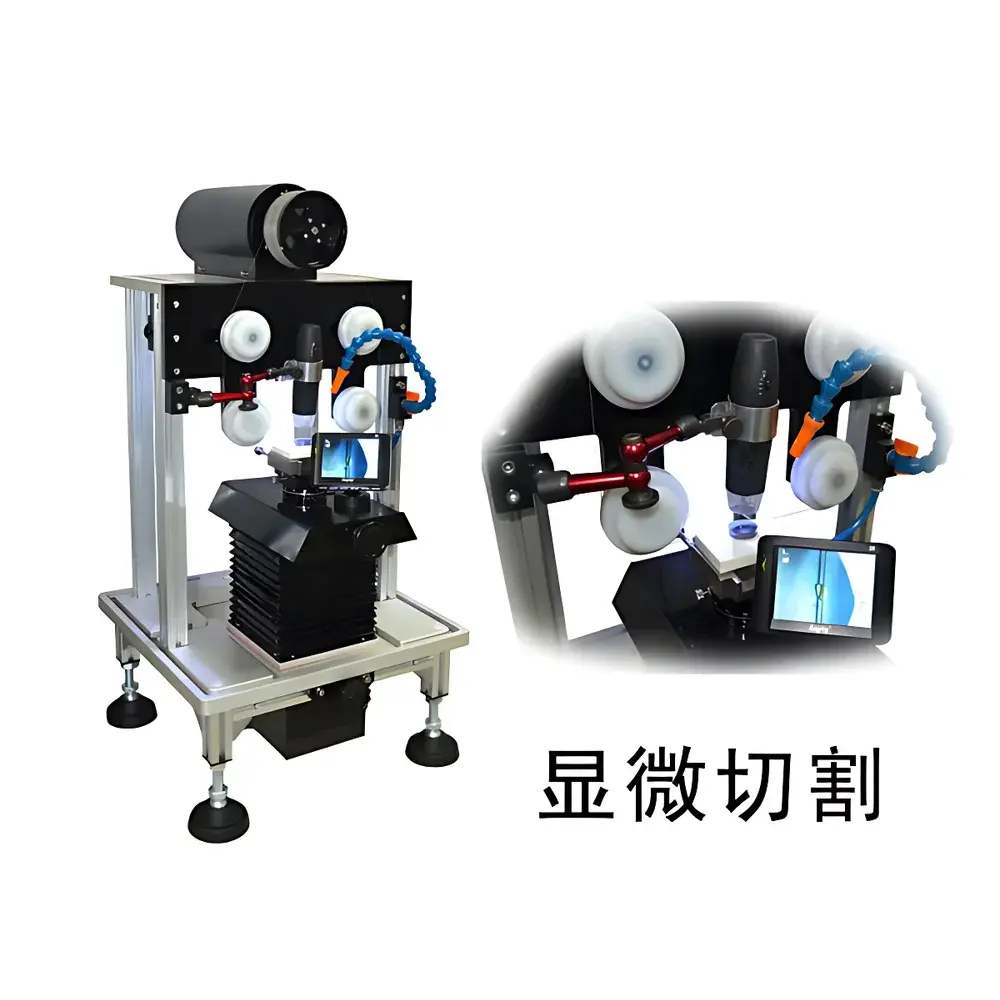
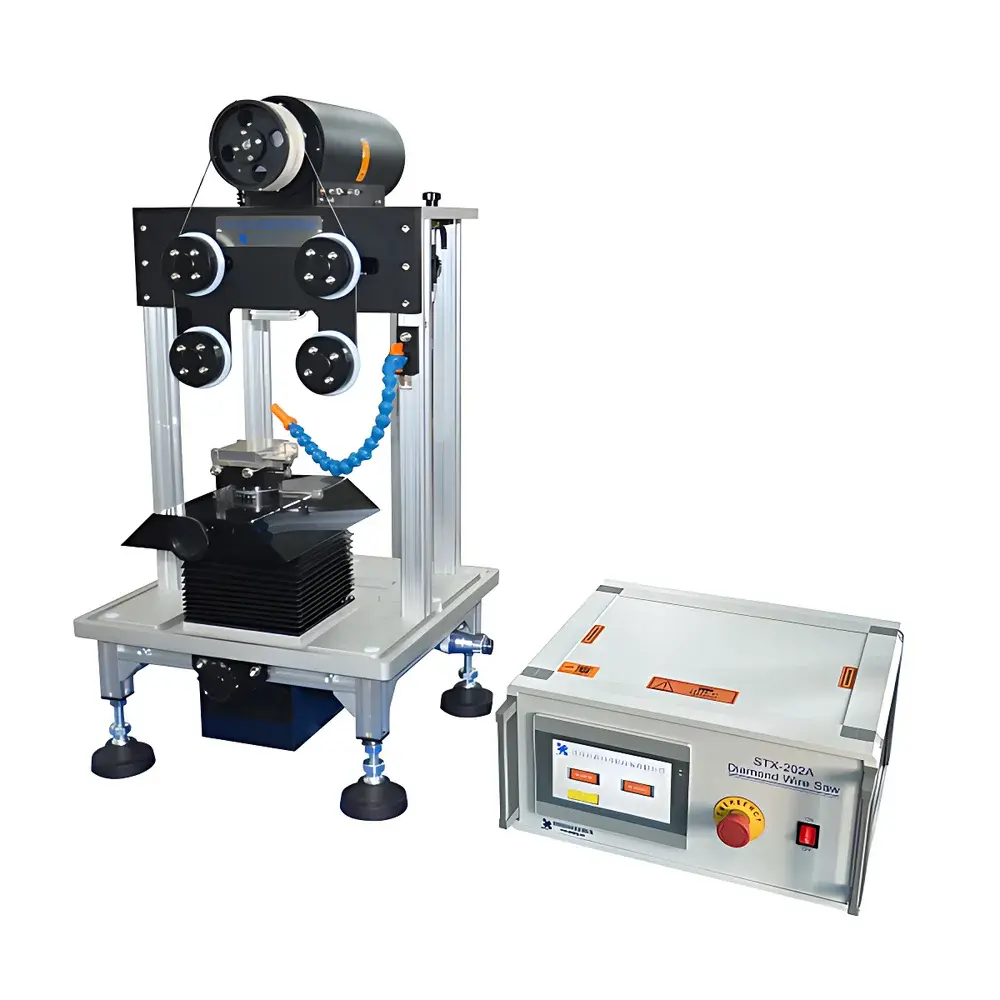
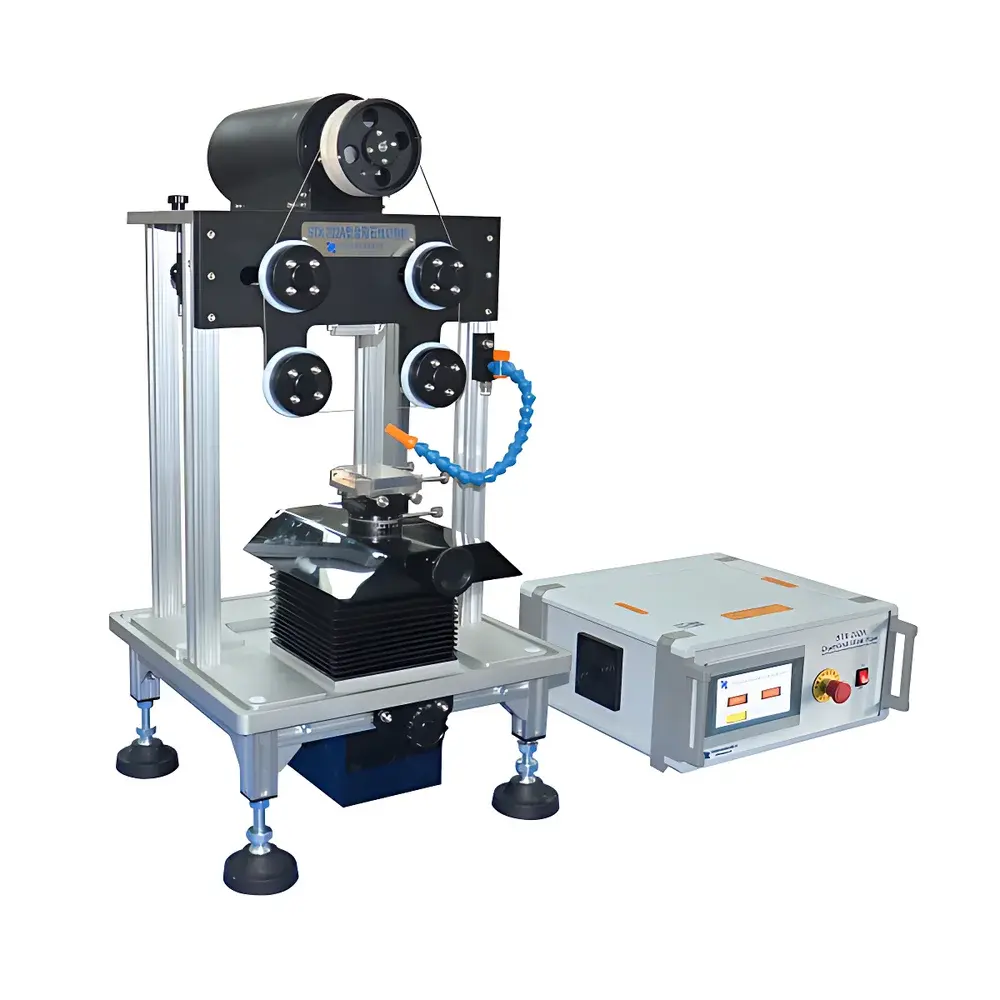
The KJ GROUP STX-202A Precision Diamond Wire Saw is an entry-level, benchtop diamond wire cutting system engineered for high-accuracy sectioning of brittle and hard materials in academic, industrial, and quality control laboratories. It operates on the principle of abrasive wire cutting: a thin, electroplated or resin-bonded diamond-impregnated wire traverses reciprocally between two precision-aligned guide wheels while under constant mechanical tension. As the wire moves at controlled linear velocity and rotational speed, the sample advances incrementally along the Z-axis—enabling deterministic material removal with minimal kerf loss and negligible subsurface damage. Unlike rotary saws or abrasive cut-off machines, this system avoids thermal shock, plastic deformation, or micro-cracking in sensitive crystalline or laminated specimens. Its design prioritizes dimensional repeatability, operator safety, and compatibility with post-cutting analytical workflows—including SEM sample preparation, XRD orientation analysis, TEM lamella extraction, and optical microscopy slide fabrication.
Key Features
- Spring-loaded mechanical tensioning system ensures stable, non-decaying wire tension throughout extended cutting cycles—critical for maintaining consistent kerf width and surface finish across multi-hour operations.
- Reciprocating spindle drive (2–260 rpm, adjustable) minimizes harmonic vibration and wire fatigue compared to unidirectional rotation, extending diamond wire service life and improving edge straightness.
- PLC-based motion control with integrated 7-inch touchscreen HMI enables programmable feed profiles, real-time speed monitoring, and repeatable parameter recall—supporting GLP-compliant documentation when paired with external logging systems.
- Manually adjustable 2D sample stage offers full 360° azimuthal rotation and ±15° tilt, facilitating angled cuts for crystallographic plane exposure (e.g., cleavage plane alignment in Si, sapphire, or Bi₂Te₃), cross-sectional analysis of layered devices, or beveled interface studies.
- Aluminum extrusion frame provides structural rigidity while reducing overall mass—enhancing portability without compromising vibration damping; surface-anodized finish resists coolant-induced corrosion.
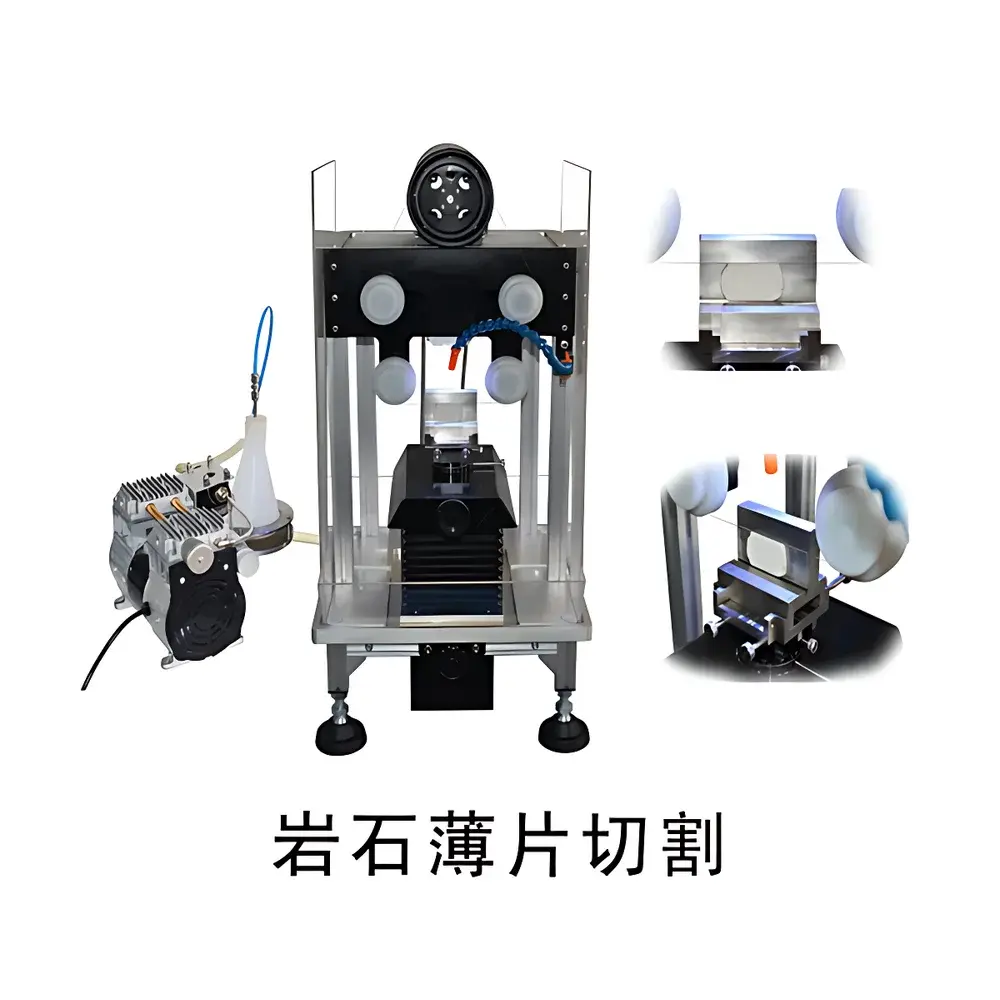
- Modular coolant delivery (pump included) supports continuous lubrication and debris flushing using standard cutting oils—reducing heat buildup and preventing wire loading during prolonged cuts of ceramics or composites.
Sample Compatibility & Compliance
The STX-202A accommodates a broad spectrum of materials with Mohs hardness below that of diamond (≤10), including but not limited to oxide ceramics (Al₂O₃, ZrO₂), semiconductor crystals (Si, Ge, GaAs), infrared optical substrates (ZnS, ZnSe), geological specimens (granite, basalt, meteorites), thermoelectric ingots (Bi₂Te₃, PbTe), and bio-mineralized tissues (dental enamel, cortical bone, calcified vascular plaques). Its sub-100 µm achievable slice thickness (down to 80 µm over ~25 mm span) meets ASTM E3–22 requirements for metallographic specimen preparation and ISO 14855-1 criteria for controlled-sectioning of heterogeneous biomaterials. While the instrument itself does not carry CE/UL certification out-of-the-box, its electrical architecture (isolated 24 V DC option available via STX-202A-DC variant) and grounding compliance (IEC 61000-6-3 emissions, IEC 61000-6-2 immunity) facilitate integration into ISO/IEC 17025-accredited labs. Users are advised to validate process parameters per internal SOPs and document calibration intervals for critical applications under FDA 21 CFR Part 11 or GMP environments.
Software & Data Management
The STX-202A utilizes embedded PLC firmware with no proprietary software dependency—eliminating licensing overhead and OS compatibility constraints. All operational parameters (speed, feed rate, stroke limits, dwell time) are configured directly via the touchscreen interface and stored in non-volatile memory. The system generates no native digital logs; however, it features RS-485 and optional USB-to-serial interfaces for integration with third-party SCADA platforms or LabVIEW-based data acquisition systems. When deployed alongside external video capture (e.g., USB microscope or machine vision camera), timestamped cutting sequences can be correlated with positional metadata for audit-ready traceability. For regulated environments, users may implement manual logbooks or electronic batch records aligned with ALCOA+ principles (Attributable, Legible, Contemporaneous, Original, Accurate, Complete, Consistent, Enduring, Available).
Applications
- Preparation of transmission electron microscopy (TEM) lamellae from ceramic electrolytes and battery cathode composites.
- Sectioning of geological thin sections (<30 µm) for petrographic analysis under polarized light microscopy.
- Cutting of single-crystal wafers (Si, GaN, sapphire) at defined Miller indices for epitaxial growth validation.
- Isolation of histological slices from mineralized soft-tissue interfaces (e.g., tendon-bone insertion sites, dental implant osseointegration zones).
- Dimensional trimming of thermoelectric modules prior to Seebeck coefficient measurement.
- Production of calibrated reference standards for profilometry and white-light interferometry.
FAQ
What types of diamond wire are compatible with the STX-202A?
The system accepts standard electroplated or resin-bonded diamond wires with diameters up to 0.45 mm; commonly used variants include φ0.25 mm (for ultra-thin sections), φ0.35 mm (general-purpose), and φ0.42 mm (high-material-removal-rate applications). Wire length must not exceed 20 m.
Is coolant mandatory during operation?
Yes—continuous coolant flow is required to dissipate frictional heat, suppress dust generation, and prevent premature wire wear. KJ GROUP recommends ISO VG 32–68 mineral-based cutting oil; water-soluble emulsions are not advised due to potential aluminum frame corrosion.
Can the STX-202A perform automated multi-step cutting sequences?
No—it supports only single-programmed linear cuts. Complex multi-pass or contour-cutting routines require external CNC integration or manual repositioning between passes.
What is the minimum achievable slice thickness?
Under optimal conditions (fresh wire, low feed rate, rigid mounting, and uniform material), thickness consistency within ±5 µm can be maintained across 1-inch (25.4 mm) samples—with nominal thicknesses as low as 80 µm routinely achieved.
Does the system comply with international electrical safety standards?
The base model meets Chinese GB/T 19001 requirements; for export use, the STX-202A-DC variant (24 V DC input) simplifies CE marking pathways. Final regulatory conformance depends on end-user installation environment and local authority interpretation.



