
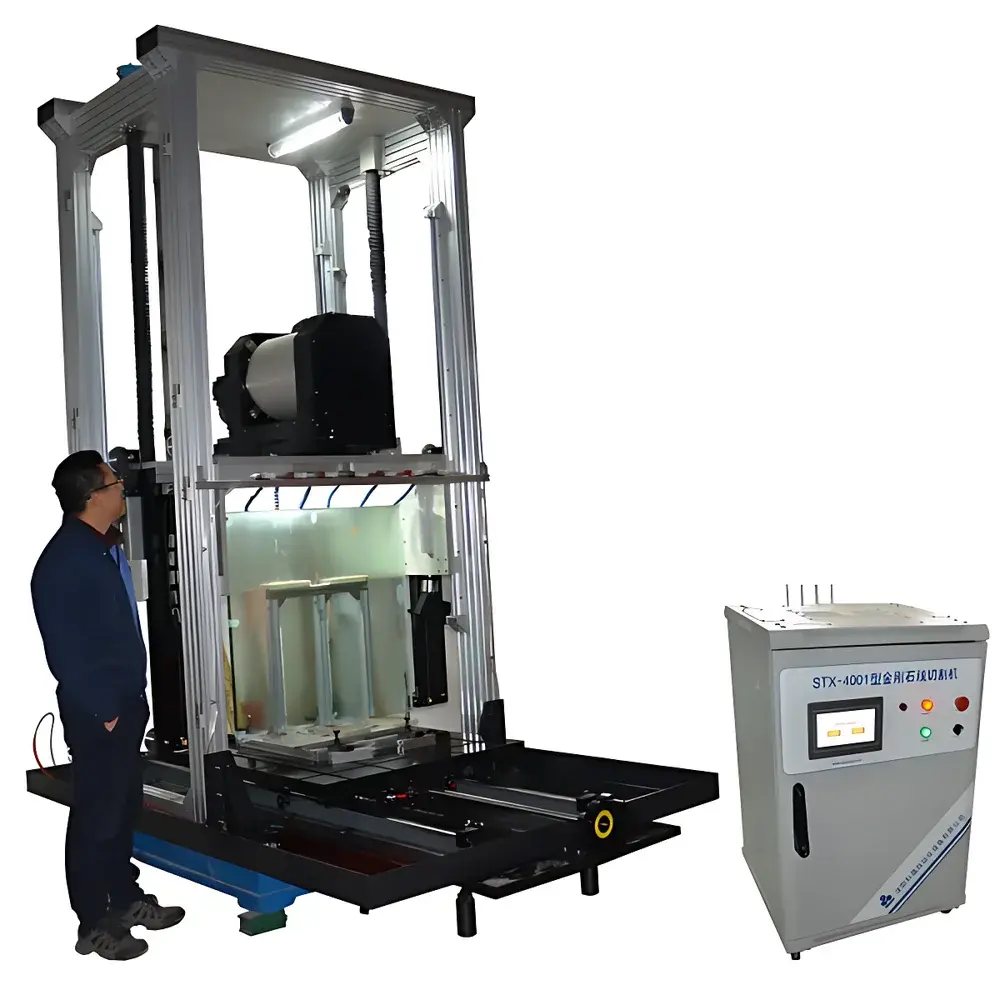
KJ GROUP STX-4001 Diamond Wire Saw
| Brand | KJ GROUP |
|---|---|
| Origin | Liaoning, China |
| Manufacturer Type | Authorized Distributor |
| Country of Origin | China |
| Model | STX-4001 |
| Instrument Type | Precision Diamond Wire Saw |
| Cutting Wire Speed | 0–5 m/s (adjustable) |
| Max. Wire Length | ≤400 m |
| Max. Wire Diameter | ≤0.65 mm |
| Z-Axis Travel | ≤1 m |
| Y-Axis Travel | ≤1 m |
| Y-Axis Feed | Manual (micrometer-controlled) |
| Tensioning System | Pneumatic (0–1 MPa adjustable) |
| Max. Workpiece Dimensions | Φ1 m × 1 m |
| Worktable Size | 1200 mm × 1000 mm |
| Worktable Load Capacity | 1.5 t (max) |
| Machine Dimensions (L×W×H) | 2850 × 1850 × 3350 mm |
| Net Weight | ≈2.5 t |
| Power Supply | AC 220 V / 50 Hz |
| Total Power Consumption | ≈6 kW |
| Safety Features | Wire-break auto-stop, wrap-angle protection |
| Control System | PLC + 10.1″ touchscreen HMI |
| Display | Digital real-time feedback |
| Ambient Requirements | Altitude <1000 m |
| Compliance | Designed per IEC 61000-6-2/6-4 EMC standards |
Overview
The KJ GROUP STX-4001 Diamond Wire Saw is an industrial-grade, discontinuous-feed precision cutting system engineered for high-fidelity sectioning of brittle, anisotropic, and high-value materials in research laboratories, geological core facilities, semiconductor R&D centers, and biomedical specimen preparation labs. It operates on the principle of abrasive wire sawing: a single-loop diamond-impregnated steel wire—tensioned pneumatically and driven at precisely controlled linear velocities—is reciprocated across a stationary workpiece mounted on a rigid, load-rated granite-fused steel worktable. Unlike continuous-feed or CNC-guided wire saws, the STX-4001 employs manual micrometer-based Y-axis advancement between cuts, enabling sub-10 µm incremental control over kerf depth and exceptional repeatability for applications where absolute dimensional fidelity outweighs throughput demands. Its 1-meter vertical (Z) and horizontal (Y) travel envelope, combined with a 1.5-ton static load capacity, accommodates oversized specimens—including geological cores, large-diameter sapphire boules, full-size silicon ingots, and intact cadaveric bone-implant constructs—without requiring pre-sectioning or fixturing compromises.
Key Features
- Robust structural architecture featuring reinforced welded steel frame with vibration-damping base, ensuring mechanical stability during prolonged cutting of dense or heterogeneous materials.
- Pneumatic tensioning system with pressure-regulated actuation (0–1 MPa range), dynamically optimized to match wire diameter (up to 0.65 mm) and material hardness—minimizing wire breakage while maintaining consistent cutting force.
- High-torque servo motor driving wire motion at 0–5 m/s, digitally regulated via closed-loop encoder feedback for velocity consistency across full load spectrum.
- PLC-based control system integrated with a 10.1-inch industrial touchscreen HMI, supporting parameter storage, real-time speed/position monitoring, and operational history logging compliant with GLP documentation requirements.
- Dedicated cooling circuit with recirculating pump, temperature-stabilized reservoir, and directional nozzles to deliver uniform coolant flow at the wire–workpiece interface—critical for thermal management in quartz, SiC, and infrared optical crystals.
- Comprehensive safety subsystem including dual-channel wire-break detection, mechanical wrap-angle limit switches, and emergency stop with hardware interlock—certified to EN ISO 13857 and EN 60204-1.
Sample Compatibility & Compliance
The STX-4001 is validated for use with materials whose Mohs hardness is below that of diamond (≥10), encompassing ceramics (Al₂O₃, ZrO₂, SiC), single crystals (Si, sapphire, Ge, ZnSe), optical glasses (fused silica, chalcogenide), metallic alloys (Ti-6Al-4V, Inconel), geological specimens (granite, basalt, meteorites), and biological composites (plastinated tissue, bone–dental implants, vascular stent–tissue blocks). Its non-contact, low-force cutting mechanism preserves crystallographic integrity, minimizes subsurface damage, and eliminates recast layers common in EDM or abrasive wheel methods. The system conforms to ISO 9001 manufacturing protocols and is supplied with CE Declaration of Conformity (2006/42/EC Machinery Directive, 2014/30/EU EMC Directive). Optional integration with DX-100 Single Crystal Orientation Analyzer enables crystallographic alignment prior to cleavage—supporting ASTM E112 grain size analysis and USP tablet friability testing sample prep.
Software & Data Management
While the STX-4001 does not incorporate PC-hosted software, its embedded PLC firmware supports traceable operation through timestamped digital logs stored locally on the HMI’s internal flash memory. Each cutting cycle records: start/stop time, wire speed, total wire travel distance, Y-axis micrometer setting, and fault events (e.g., tension deviation >±5 %, coolant flow interruption). Logs are exportable via USB to CSV format for inclusion in laboratory information management systems (LIMS) or FDA 21 CFR Part 11–compliant audit trails when paired with external validation documentation. Firmware updates are performed offline using encrypted SD card images, preserving system integrity during regulatory inspections.
Applications
- Geosciences: Preparation of petrographic thin sections (30 µm), polished rock slabs for SEM-EDS, and oriented core slices for anisotropy mapping.
- Materials Science: Kerf-limited slicing of thermoelectric ingots (Bi₂Te₃, PbTe), infrared window blanks (ZnS, Ge), and epitaxial wafer substrates prior to polishing.
- Medical Device R&D: Sectioning of osseointegrated titanium implants within human femoral heads, coronary stents embedded in calcified arterial segments, and dental prostheses with zirconia–resin interfaces.
- Electronics Manufacturing: Seed crystal separation from Czochralski-grown sapphire rods, segmentation of photovoltaic silicon bricks, and dicing of piezoelectric ceramic stacks.
- Museology & Forensics: Non-destructive slicing of meteorite fragments, jadeite artifacts, and forensic bone samples for micro-CT correlation studies.
FAQ
What is the maximum recommended wire length, and how is wire wear monitored?
The system supports up to 400 m of diamond-impregnated wire. Wire wear is assessed empirically via cutting rate decline (>15 % reduction at constant feed rate) and visual inspection for segment loss under 10× magnification—no automated wear sensor is included.
Is the machine compatible with deionized water or specialized coolants?
Yes. The recirculating coolant system accepts aqueous solutions (e.g., 5 % glycol–water mix) and non-aqueous dielectric fluids (e.g., polyalphaolefin-based cutting oils), provided viscosity remains below 40 cSt at 40 °C.
Can the STX-4001 be integrated into a cleanroom environment?
It is rated for ISO Class 8 environments. Optional HEPA-filtered air supply lines and stainless-steel coolant reservoir upgrades are available to meet ISO 14644-1 Class 7 requirements.
Does the system support automated multi-pass cutting sequences?
No. The STX-4001 is manually advanced per cut. For programmable multi-pass operation, consider the KJ GROUP STX-2020 series with CNC Y/Z axes.
What documentation is provided for IQ/OQ validation?
A Factory Acceptance Test (FAT) report, calibration certificate for the micrometer feed scale, and electrical safety test records per EN 61000-6-2 are supplied standard. Custom 21 CFR Part 11 validation packages are available upon request.



