
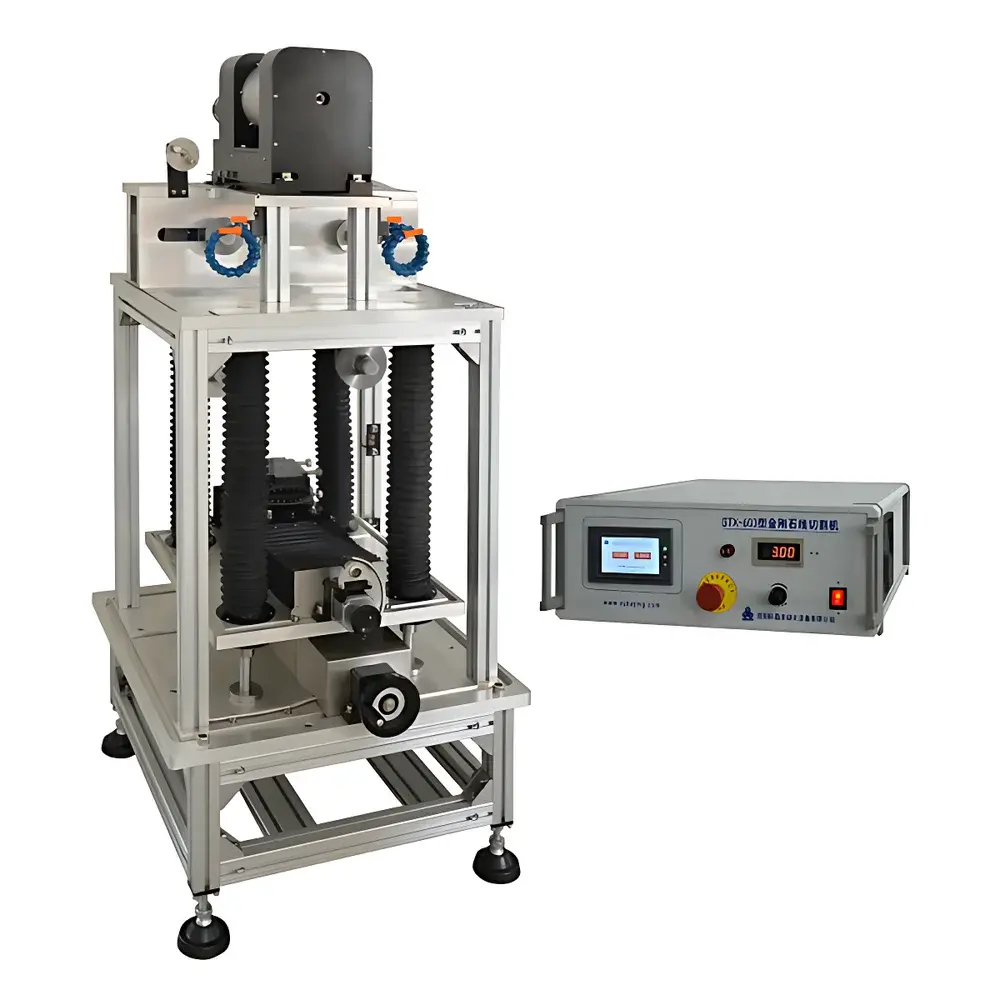
KJ GROUP STX-600 Series Diamond Wire Saw
| Brand | KJ GROUP |
|---|---|
| Origin | Liaoning, China |
| Manufacturer Type | Direct Manufacturer |
| Instrument Type | Precision Diamond Wire Saw |
| Diamond Wire Length | ≤150 m |
| Wire Diameter | φ0.25–0.45 mm |
| Wire Tensioning | Adjustable Pneumatic Tension (0.1–0.4 MPa) |
| Main Spindle Drive | AC Frequency-Controlled Motor + Reducer |
| Spindle Linear Speed | 5–8 m/s (adjustable) |
| Z-Axis Travel | ≤160 mm |
| Y-Axis Travel | ≤180 mm |
| Positioning Accuracy (X/Y/Z) | 0.01 mm |
| Rotational Stage | Manual 0–360° or Motorized ±10°/±15° |
| Max. Workpiece Size | Φ150 mm × 150 mm |
| Worktable Load Capacity | ≤10 kg (STX-604/605A), ≤5 kg (STX-605B) |
| Control System | PLC + 4.3″ or 7″ Touchscreen HMI |
| Safety Features | Wire Break Detection, Bobbin Overtravel Stop, Emergency Stop |
| Power Supply | AC 220 V, 50 Hz, 10 A |
| Total Power Consumption | 350–370 W |
| Ambient Operating Conditions | 0–45 °C, 10–85 % RH (non-condensing) |
| Compressed Air Requirement | ≥0.6 MPa |
| Coolant Required | Yes (cutting oil recommended) |
| Dimensions (L×W×H) | 640×700×1450 mm to 720×1030×1800 mm |
| Net Weight | 170–310 kg |
Overview
The KJ GROUP STX-600 Series Diamond Wire Saw is a CE-certified, precision-controlled laboratory cutting system engineered for high-fidelity sectioning of brittle, anisotropic, and heterogeneous materials. It operates on the principle of abrasive wire cutting—utilizing a continuously reciprocating diamond-impregnated monofilament wire under controlled tension and feed rate to achieve low-stress, kerf-minimized material removal. Unlike rotary saws or abrasive blades, this system eliminates mechanical shock, thermal degradation, and lateral deformation—critical for preserving crystallographic integrity, interfacial morphology, and microstructural fidelity in downstream analysis (e.g., SEM, XRD, TEM, EPMA). Designed specifically for research-grade sample preparation, the STX-600 series supports sub-0.2 mm thickness slicing with dimensional repeatability better than ±0.01 mm across Z- and Y-axis motion stages. Its closed-loop PLC architecture ensures deterministic execution of multi-step cutting protocols—including variable-speed traversal, dwell pauses, and programmable angular indexing—making it suitable for serial sectioning, wafer dicing, geological thin-sectioning, and biomedical tissue embedding workflows.
Key Features
- Pneumatically regulated wire tension: Adjustable pressure range (0.1–0.4 MPa) enables dynamic optimization for wire diameters from 0.25 mm to 0.45 mm—preventing fracture during fine-wire operation while maintaining consistent cutting force.
- High-efficiency wire utilization: Supports up to 150 m of diamond wire per spool; single-thread recirculation design reduces consumable waste and minimizes operator intervention between cuts.
- Sub-micron motion control: Precision stepper-driven Z- and Y-axes deliver 0.01 mm positional resolution and repeatable feed increments—essential for producing uniform-thickness slices from fragile crystals or laminated composites.
- Modular rotational stage integration: Optional motorized or manual 360° horizontal rotation and ±10°/±15° tilt enable oblique-angle sectioning, cross-sectional profiling, and crystallographic plane alignment (e.g., cleavage-plane targeting in layered semiconductors).
- Robust mechanical architecture: Extruded aluminum frame (STX-604/605A) or reinforced sheet-metal enclosure (STX-605B) provides vibration-damped stability during extended cutting cycles; all critical wear components—including PE guide and tension wheels—are replaceable and standardized.
- Integrated safety interlocks: Real-time monitoring of wire continuity, bobbin position limits, and emergency stop activation ensures compliance with IEC 61000-6-2/6-4 EMC and EN 60204-1 machinery safety directives.
Sample Compatibility & Compliance
The STX-600 accommodates a broad spectrum of hard-to-machine materials whose hardness falls below that of diamond (HV ~7000–10000), including but not limited to: oxide ceramics (Al2O3, ZrO2, Y2O3), semiconductor ingots (Si, Ge, GaAs), infrared optical crystals (ZnS, ZnSe, CaF2), geological specimens (granite, basalt, meteorites), thermoelectric alloys (Bi2Te3, PbTe), and bio-ceramic composites (hydroxyapatite scaffolds, dental zirconia). It meets ASTM E3–22 requirements for metallographic specimen preparation and ISO 14836:2021 guidelines for geological thin-section fabrication. When operated with validated cutting oil and documented SOPs, the system supports GLP-compliant sample prep workflows traceable to ISO/IEC 17025:2017 calibration frameworks. All electrical subsystems conform to CE marking criteria under the Machinery Directive 2006/42/EC and Low Voltage Directive 2014/35/EU.
Software & Data Management
Control is executed via an industrial PLC paired with either a 4.3″ or 7″ resistive touchscreen HMI interface. The embedded UI supports parameter storage (up to 99 user-defined programs), real-time spindle speed and axis position feedback, digital jog controls, and guided alignment routines using wired remote handwheel input. While no proprietary PC software is bundled, the controller exposes Modbus RTU over RS-485 for third-party SCADA integration—enabling audit-trail logging, remote diagnostics, and synchronized data capture in environments governed by FDA 21 CFR Part 11 (when deployed with validated timestamping and electronic signature modules). Cutting logs—including start/stop timestamps, total wire usage, cumulative feed distance, and fault event codes—are retained in non-volatile memory for post-process review and QA documentation.
Applications
- Preparation of TEM lamellae and SEM cross-sections from multilayered devices (e.g., battery electrodes, MEMS actuators, photovoltaic stacks)
- Geological petrographic thin-sectioning (30 µm standard thickness) compliant with ASTM D3282 and ISO 14688-1
- Sectioning of orthopedic implants (titanium alloy, PEEK, ceramic coatings) alongside adjacent bone tissue for histomorphometric analysis
- Dicing of sapphire wafers and SiC substrates prior to epitaxial growth or device fabrication
- Serial block-face imaging (SBEM) sample trimming for volume electron microscopy
- Cutting of thermoelectric module assemblies without delamination or interfacial cracking
- Production of IR-transmissive windows (ZnS, Ge) with surface roughness < Ra 0.8 µm after minimal post-polish
FAQ
What types of diamond wire are compatible with the STX-600?
The system accepts standard electroplated or resin-bonded diamond wires with nominal diameters of 0.125 mm, 0.25 mm, 0.35 mm, and 0.42 mm—each requiring corresponding tension and speed adjustments per material hardness.
Is compressed air mandatory for operation?
Yes. A clean, dry, oil-free air supply ≥0.6 MPa is required for pneumatic tension actuation. An optional quiet oil-free compressor (e.g., MTI-AIR-500) is available for lab-integrated deployment.
Can the STX-600 be used for automated serial sectioning?
With optional motorized rotation and Z-axis auto-feed upgrades, the system supports unattended multi-pass sectioning when combined with external trigger signals or time-based scheduling via Modbus command sets.
What coolant is recommended, and is flood cooling necessary?
A low-viscosity, sulfur-free cutting oil is strongly recommended to suppress heat, flush debris, and extend wire life. Continuous drip or low-pressure mist delivery suffices; full flood systems are not required.
Does KJ GROUP provide validation documentation for GMP/GLP environments?
Factory-installed IQ/OQ documentation packages—including calibration certificates for linear encoders and tension sensors—are available upon request. PQ protocols must be developed in situ per site-specific risk assessment and process requirements.



