
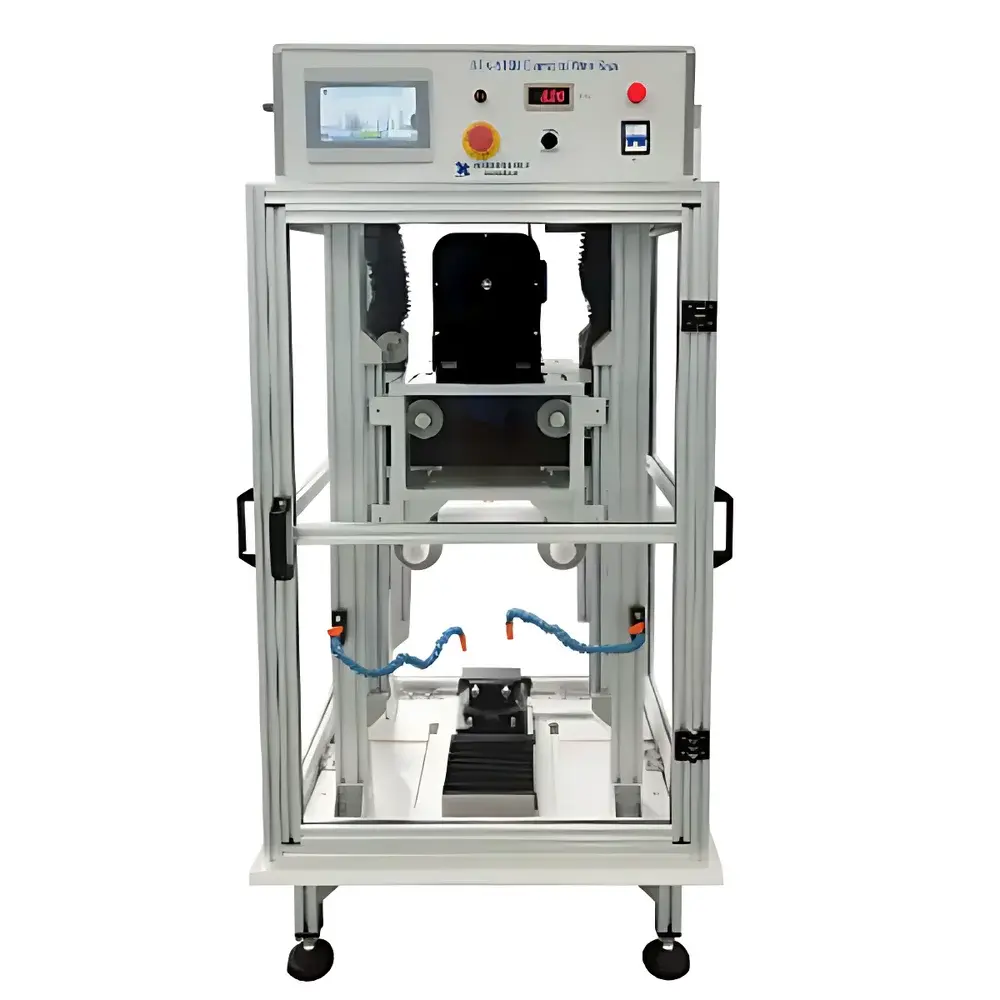
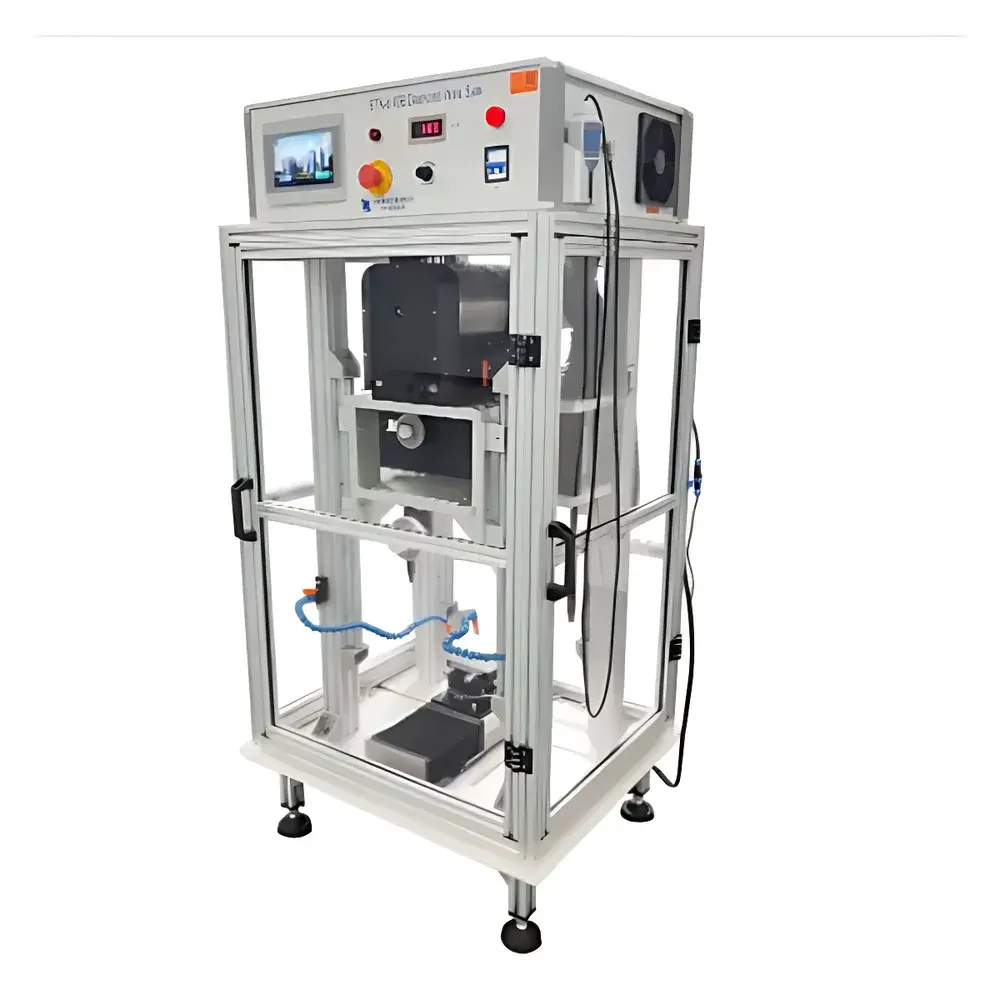
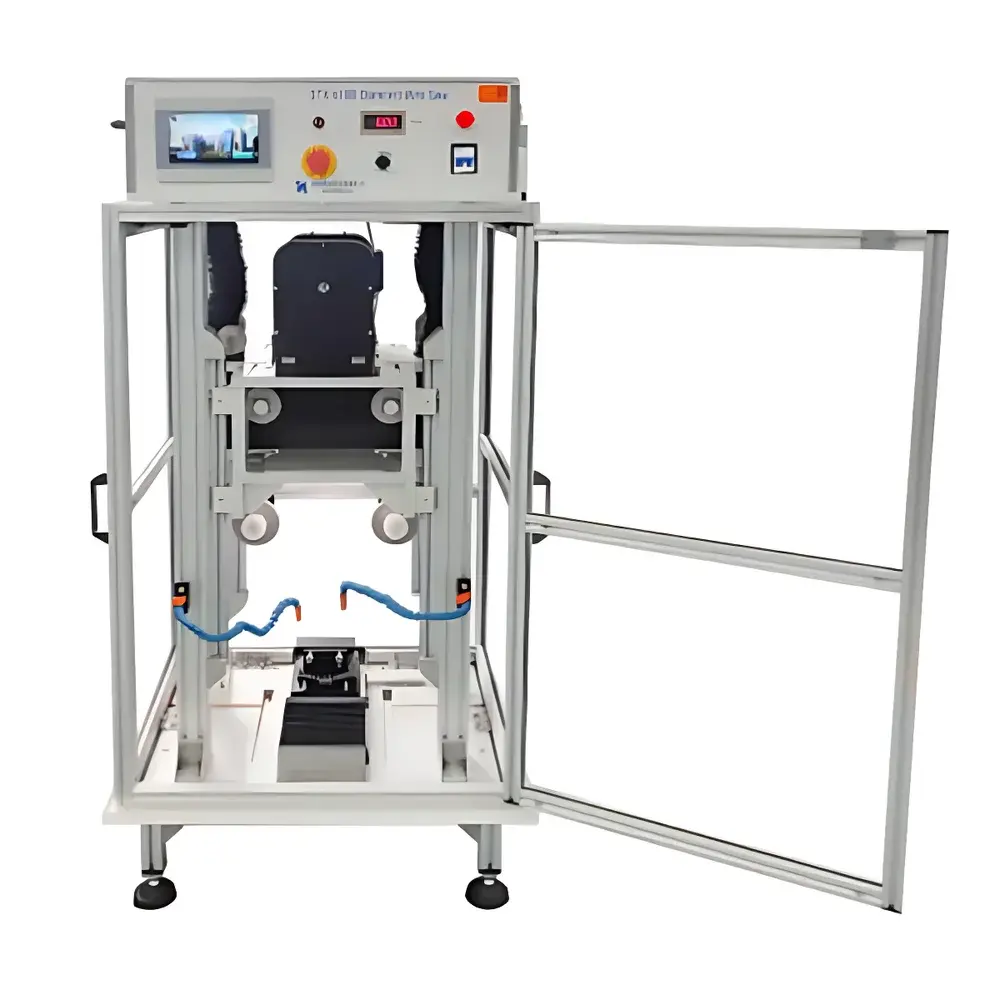
KJ GROUP STX-610B Diamond Wire Saw
| Brand | KJ GROUP |
|---|---|
| Origin | Liaoning, China |
| Manufacturer Type | Direct Manufacturer |
| Product Category | Domestic |
| Model | STX-610B |
| Instrument Type | Precision Diamond Wire Saw |
| Total Power | 500 W |
| Diamond Wire Length | ≤150 m |
| Wire Diameter | φ0.25–0.45 mm |
| Wire Tensioning | Adjustable Pneumatic Tension (0.1–0.4 MPa) |
| Cutting Mode | Reciprocating Rotation |
| Wire Speed | 0–8 m/s (adjustable) |
| Y-Axis Travel | ≤180 mm |
| Z-Axis Travel | ≤160 mm |
| Positioning Resolution (Y/Z) | 0.01 mm |
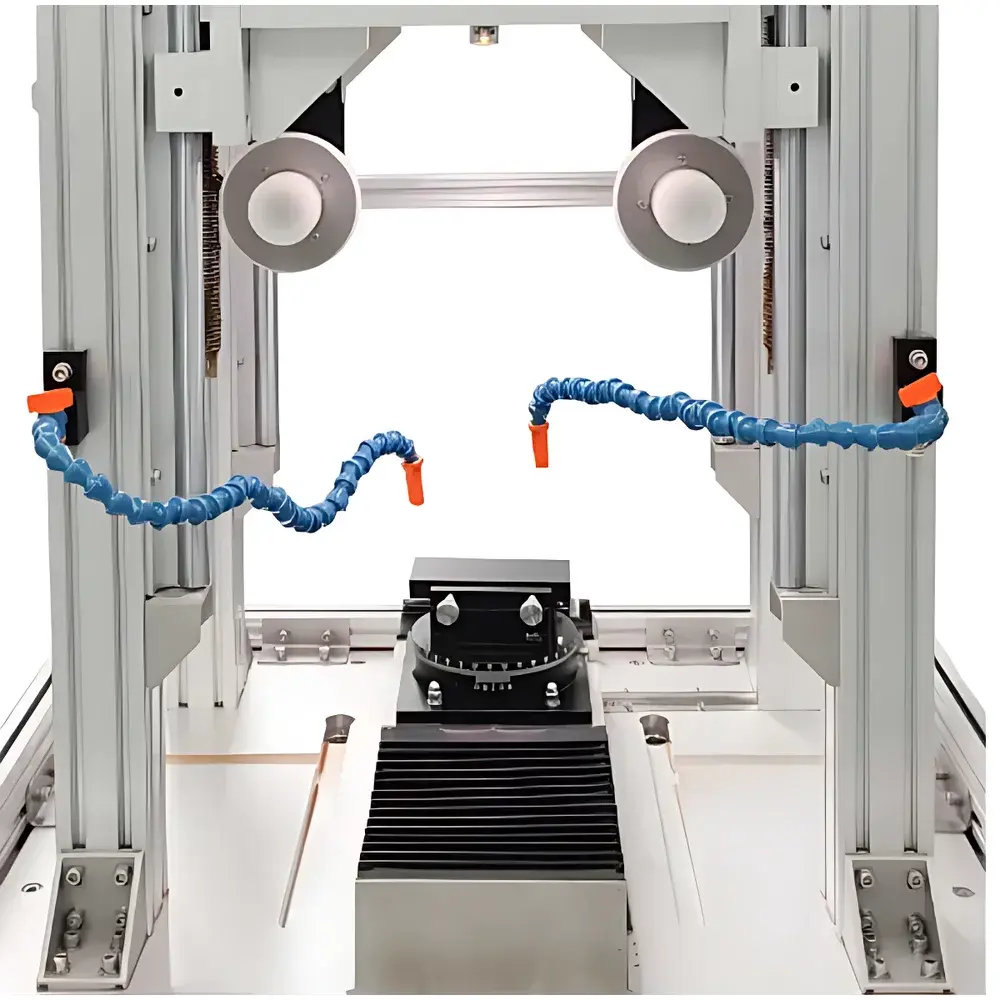
| Sample Mounting Stage | Manual 2D Rotary Table (0–360° horizontal, ±10° tilt) |
| Max Sample Size | Φ150 mm × 150 mm |
| Max Load Capacity | ≤5 kg |
| Guide Wheel Spacing (inner) | ≤180 mm |
| Control System | PLC + 7-inch Touchscreen HMI |
| Safety Features | Over-travel protection (spool, Y/Z axes), wire-break auto-stop, emergency stop switch |
| Frame Material | Aluminum Extrusion + Acrylic Transparent Enclosure |
| Dimensions (L×W×H) | 780 × 900 × 1580 mm |
| Net Weight | ≈225 kg |
| Power Supply | AC 220 V, 50 Hz, 10 A (with grounding) |
| Operating Environment | 0–45 °C, 10–85 % RH (non-condensing) |
| coolant (recommended | dedicated cutting oil) required |
Overview
The KJ GROUP STX-610B Diamond Wire Saw is an industrial-grade precision sample preparation instrument engineered for controlled sectioning of brittle, hard, and heterogeneous materials unsuitable for conventional electro-discharge or abrasive-based cutting methods. Unlike electrical discharge machining (EDM), which requires electrical conductivity, the STX-610B employs a tensioned diamond-impregnated wire in reciprocating motion to achieve cold-cutting via mechanical abrasion—enabling high-fidelity slicing of insulating and semi-conductive specimens without thermal damage or microstructural alteration. Its design adheres to fundamental principles of wire-saw kinematics: constant linear velocity control, dynamic tension regulation, and micron-level positional repeatability—critical for producing planar surfaces with minimal kerf loss (<0.3 mm typical), low subsurface damage, and preserved crystallographic integrity. The system is widely deployed in academic laboratories, materials R&D centers, and quality assurance facilities where reproducible cross-sectional analysis of advanced ceramics, single crystals, thermoelectrics, optical components, and biomedical composites is required prior to SEM, XRD, TEM, or mechanical testing.
Key Features
- Pneumatically regulated wire tensioning: Precise pressure control (0.1–0.4 MPa) ensures consistent diamond grit exposure and uniform cutting force across variable material hardness—reducing wire breakage and improving surface finish reproducibility.
- Reciprocating wire drive architecture: AC inverter-driven motor with integrated gear reduction delivers stable line speeds from 0 to 8 m/s, enabling optimization for both rapid rough-cutting and fine finishing passes.
- Dual-axis precision motion system: Stepper-motor-driven Y- and Z-axes provide 0.01 mm resolution positioning over 180 mm (Y) and 160 mm (Z) travel ranges—supporting multi-angle, sequential, or stepped cuts with programmable feed rates.
- Manual 2D rotary sample stage: Enables angular alignment up to ±10° tilt and full 360° rotation—essential for cleaving along specific crystallographic planes or preparing beveled interfaces for interfacial analysis.
- Integrated safety architecture: Includes redundant hardware interlocks—spool over-travel limit switches, axis end-stop sensors, real-time wire-break detection, and a certified emergency stop circuit—compliant with IEC 60204-1 machinery safety standards.
- Modular aluminum frame with acrylic enclosure: Provides structural rigidity while permitting visual process monitoring and operator protection against coolant splash and wire fragmentation—meeting ISO 13857 clearance requirements for guarded access zones.
Sample Compatibility & Compliance
The STX-610B accommodates a broad spectrum of research-grade materials—including polycrystalline and single-crystal ceramics (Al2O3, SiC, ZrO2), optical substrates (CaF2, MgF2, sapphire), semiconductor wafers (Si, GaAs, SiC), geological thin sections (granite, basalt, shale), magnetic alloys (NdFeB, SmCo), organic-inorganic hybrids (perovskites, MOFs), and soft biological matrices (calcified tissue, polymer scaffolds). All cuts are performed under continuous coolant delivery (typically KJ GROUP-recommended synthetic cutting oil), minimizing heat accumulation and preventing oxidation or hydration artifacts. While not certified to GLP or GMP out-of-the-box, the machine’s deterministic motion control, traceable parameter logging (via touchscreen history buffer), and physical safety features support integration into validated workflows compliant with ASTM E3, ISO 14732, and USP for specimen preparation consistency.
Software & Data Management
The STX-610B utilizes a PLC-based control platform interfaced through a 7-inch resistive touchscreen HMI. No external PC or proprietary software installation is required. All operational parameters—including wire speed, tension setpoint, Y/Z coordinate positions, feed rate, and cycle count—are stored locally in non-volatile memory and displayed numerically in real time. The interface supports manual jogging via wired pendant controller for precise tool-to-sample alignment (zero-point calibration), as well as pre-programmed multi-step cutting sequences with dwell times and direction reversal logic. Although the system does not feature network connectivity, USB export of session logs (timestamped start/stop events, error codes, and parameter snapshots) is supported for audit trail documentation in regulated environments. Firmware updates are performed offline using standard industrial protocols (e.g., Modbus RTU over RS-485).
Applications
- Preparation of transmission electron microscopy (TEM) lamellae from bulk ceramic and metallic samples
- Cutting of infrared-transparent windows (e.g., ZnSe, Ge) with minimal edge chipping
- Sectioning of thermoelectric modules (Bi2Te3, PbTe) for Seebeck coefficient mapping
- Isolation of oriented crystal wafers for X-ray topography and Laue diffraction
- Serial sectioning of geological core samples for digital rock physics reconstruction
- Fabrication of bioactive glass scaffolds with controlled pore geometry for histomorphometric analysis
- Trimming of sintered NdFeB magnets prior to coercivity and remanence measurement per IEC 60404-5
FAQ
What types of materials can be cut with the STX-610B?
The system cuts any solid material with Mohs hardness below 9.5—including conductive metals, insulating oxides, covalent ceramics, layered crystals (e.g., graphite, MoS2), and hydrated biomaterials—provided appropriate wire grit size and coolant selection are applied.
Is compressed air mandatory for operation?
Yes. Pneumatic tensioning requires a clean, dry air supply ≥0.6 MPa. An inline filter-regulator-lubricator (FRL) unit is recommended to prevent moisture-induced cylinder corrosion.
Can the machine perform angled or beveled cuts?
Yes—via the manual 2D rotary stage, which allows independent adjustment of horizontal orientation (0–360°) and tilt angle (±10°) prior to cutting. For automated angular indexing, external CNC integration is required.
What is the typical kerf width and surface roughness achievable?
Using φ0.35 mm wire at optimal speed/tension, kerf loss averages 0.25–0.32 mm. Ra values range from 0.8–2.5 µm on silicon carbide and fused quartz, depending on feed rate and coolant flow rate.
Does the STX-610B comply with FDA 21 CFR Part 11 requirements?
No—the system lacks electronic signature capability, audit trail encryption, and user role-based access control. It may serve as a pre-analytical tool within a Part 11-compliant laboratory if operated under documented SOPs and manually recorded parameters.



