
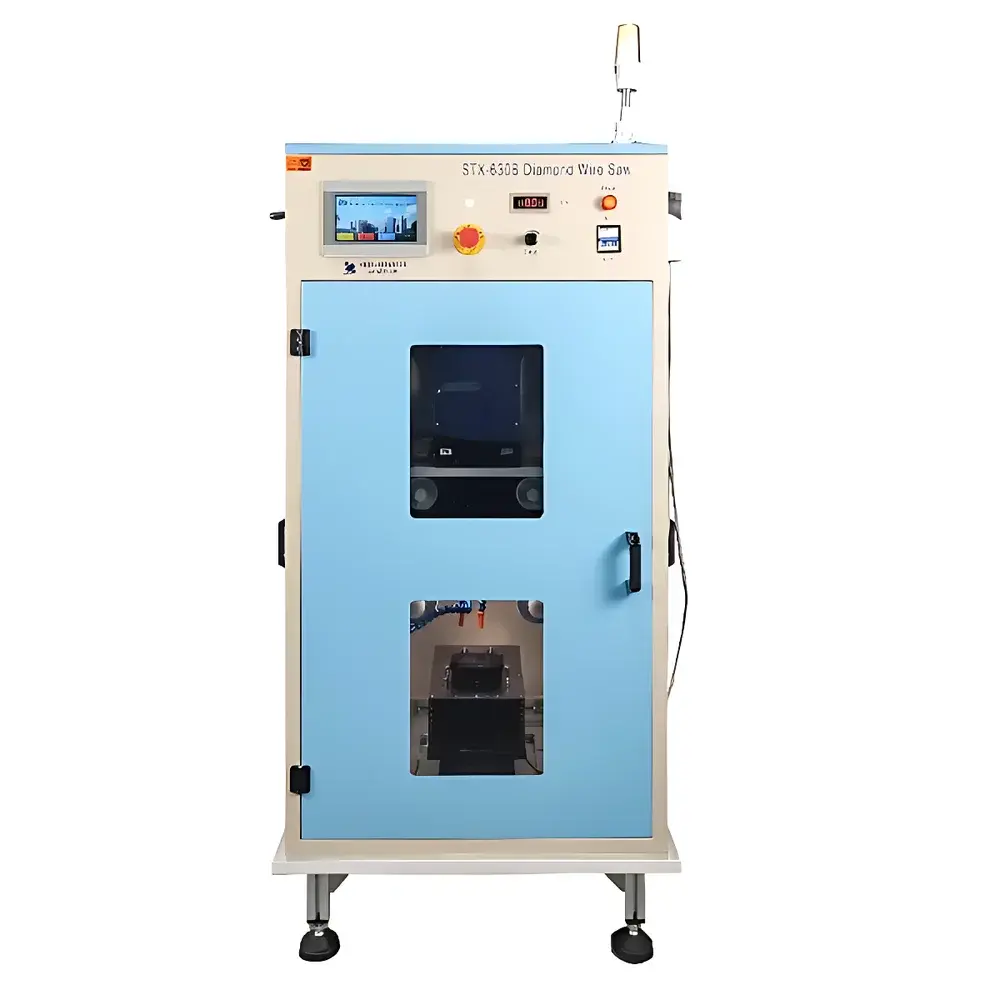
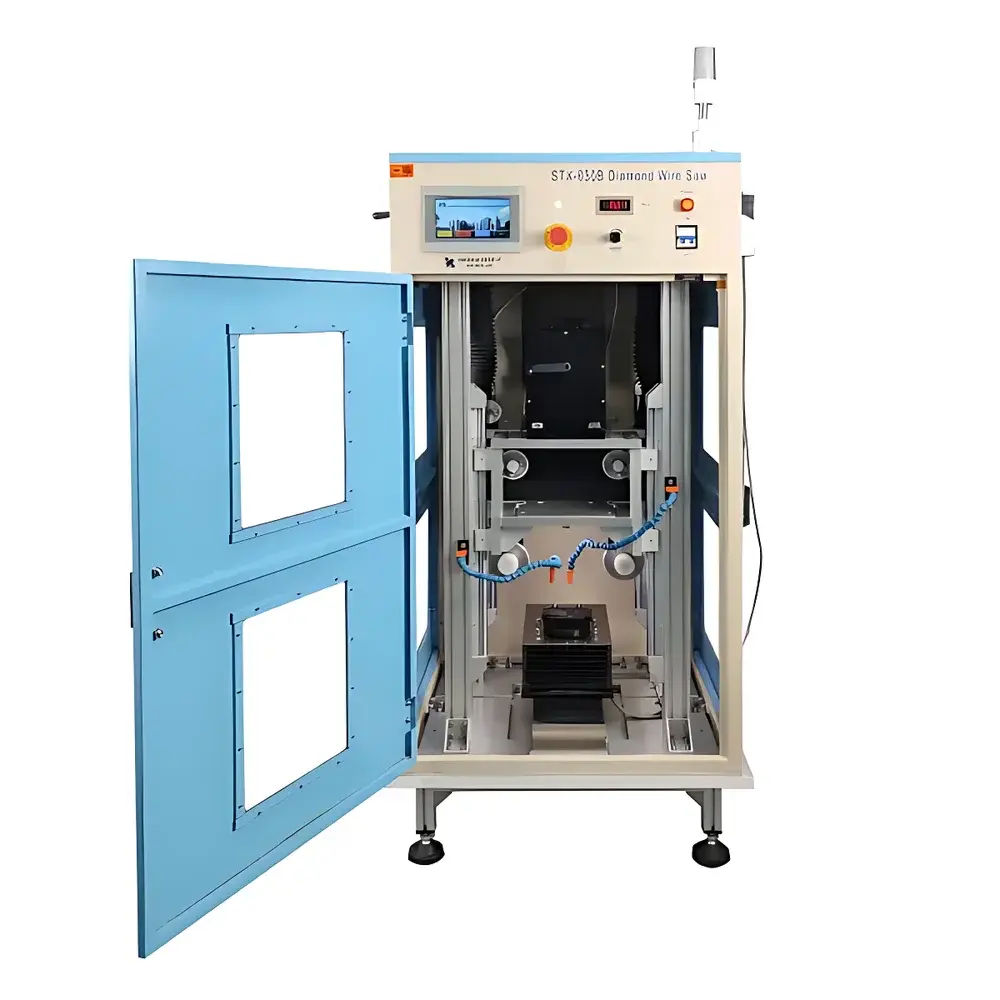
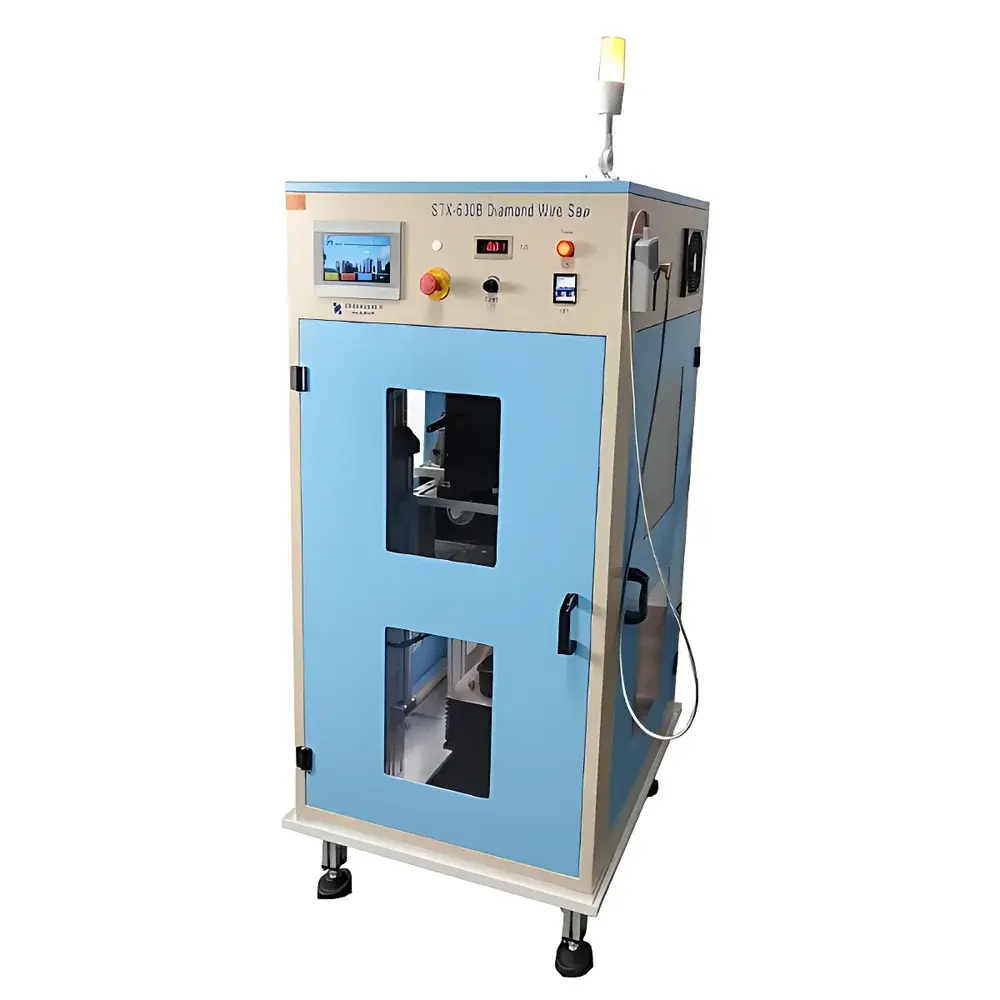
KJ GROUP STX-630B Diamond Wire Saw
| Brand | KJ GROUP |
|---|---|
| Origin | Liaoning, China |
| Manufacturer Type | Direct Manufacturer |
| Product Category | Domestic |
| Model | STX-630B |
| Pricing | Upon Request |
| Power Supply | AC 220 V, 50 Hz |
| Total Power Consumption | 620 W |
| Diamond Wire Length | ≤150 m |
| Wire Diameter | Ø0.25–0.45 mm |
| Wire Tensioning | Pneumatically Adjustable (0.1–0.4 MPa) |
| Cutting Motion | Reciprocating Rotation |
| Main Drive Motor | AC Variable-Frequency Motor (370 W) |
| Wire Speed | 0–15 m/s (Adjustable) |
| Y-Axis Travel | ≤180 mm |
| Z-Axis Travel | ≤160 mm |
| Positioning Resolution (Y/Z) | 0.01 mm |
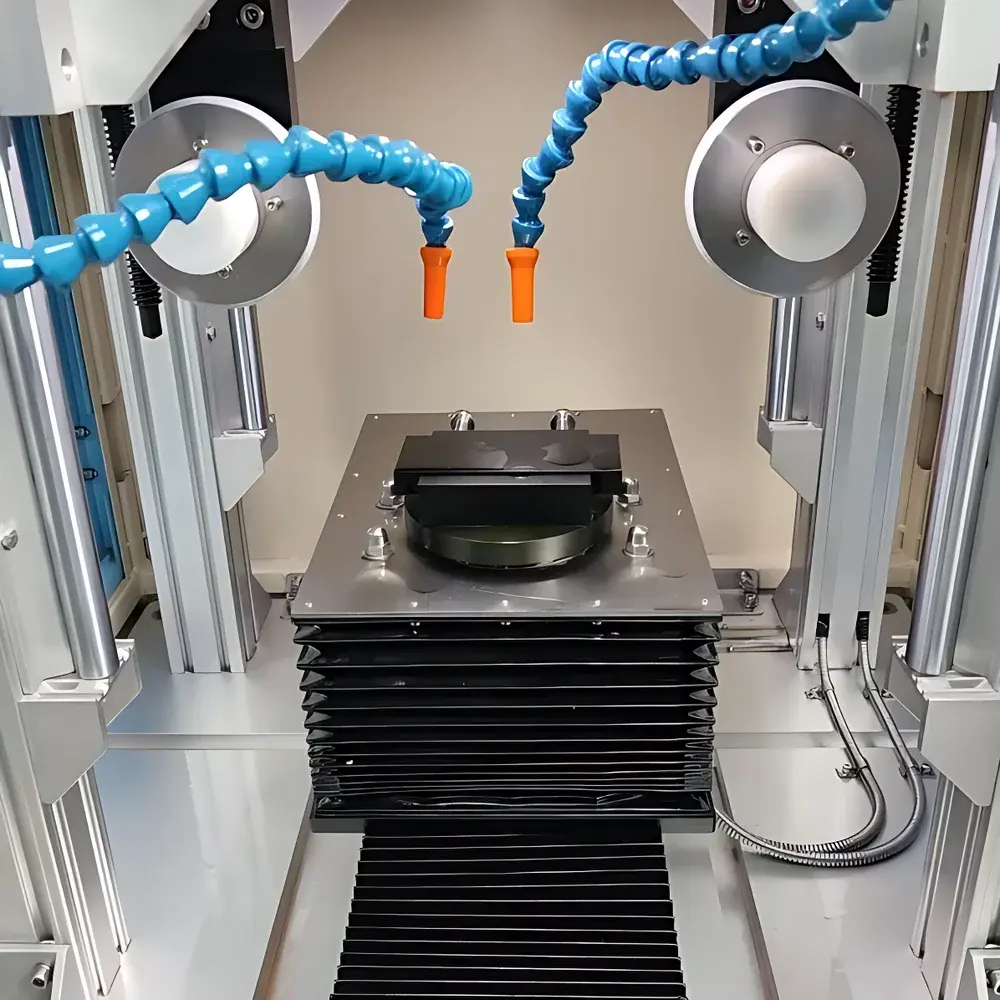
| Rotary Sample Stage | 0–360° horizontal rotation, ±10° tilt |
| Max. Sample Load | 5 kg |
| Max. Sample Dimensions | Φ150 mm × 150 mm |
| Guide Wheel Spacing (inner) | ≤180 mm |
| Control System | PLC + 7-inch Touchscreen HMI |
| Safety Features | Over-travel protection (spool/Y/Z), wire-break stop, emergency stop, interlocked door sensor (auto-pause in operation mode) |
| Frame Material | Aluminum Extrusion + Powder-Coated Steel Enclosure with Transparent Acrylic Viewing Window |
| Dimensions (L×W×H) | 780 × 830 × 1680 mm |
| Net Weight | ≈275 kg |
| Cooling Requirement | External Cutting Fluid (e.g., Specialty Mineral-Based Cutting Oil) |
| Compressed Air Supply | ≥0.6 MPa |
| Operating Environment | 0–45 °C, 10–85% RH (non-condensing), vibration- and corrosion-free |
Overview
The KJ GROUP STX-630B Diamond Wire Saw is a fully enclosed, precision-controlled laboratory cutting system engineered for the non-contact, low-damage sectioning of brittle, hard, and heterogeneous materials. Unlike electrical discharge machining (EDM) or conventional abrasive saws, this instrument utilizes tensioned diamond-impregnated wire under controlled reciprocating motion—enabling clean, kerf-minimized cuts across both conductive and non-conductive substrates. Its operational principle relies on mechanical abrasion via embedded monocrystalline diamond particles (typically 10–40 µm grit size), where material removal occurs through micro-fracture and grain pull-out rather than thermal melting or plastic deformation. This makes the STX-630B especially suitable for preserving crystallographic integrity in anisotropic samples such as single-crystal oxides, thermoelectrics, infrared optical crystals (e.g., ZnS, CdTe), and layered 2D materials. Designed for R&D laboratories in materials science, geoscience, semiconductor processing, and biomedical engineering, the system meets foundational requirements for sample preparation prior to SEM, TEM, XRD, or micro-mechanical testing.
Key Features
- Pneumatically regulated wire tensioning (0.1–0.4 MPa) ensures consistent cutting force and minimizes wire breakage during high-precision slicing of fragile specimens.
- Reciprocating rotational drive architecture delivers uniform linear wire velocity (0–15 m/s) without torsional stress accumulation—critical for maintaining dimensional fidelity in thin-section (<100 µm) wafering.
- High-resolution XYZ motion control: dual-axis (Y/Z) stepper-driven translation stages with 0.01 mm repeatability; integrated motorized rotary stage enables angular alignment (±10° tilt, 0–360° azimuth) for off-axis crystallographic sectioning.
- Full enclosure with transparent acrylic viewport and interlocked safety door complies with IEC 61000-6-2/6-4 electromagnetic compatibility standards and supports GLP-aligned operational documentation.
- PLC-based control system with 7-inch resistive touchscreen HMI provides intuitive parameter entry, real-time status monitoring, and programmable multi-step cutting sequences—including variable feed rate ramping and dwell functions.
- Comprehensive hardware-level safety suite includes wire-break detection, spool over-travel cutoff, axis limit switches, emergency stop circuitry, and automatic motion suspension upon door opening during active cutting cycles.
Sample Compatibility & Compliance
The STX-630B accommodates a broad spectrum of inorganic and organic solids with Mohs hardness up to 9.5—limited only by the intrinsic hardness of the diamond wire itself. Validated use cases include sintered ceramics (Al2O3, SiC, ZrO2), geological specimens (granite, basalt, quartzite), metallic alloys (Ti-6Al-4V, Inconel), magnetic materials (NdFeB, SmCo), optoelectronic wafers (GaAs, SiC), polymer composites, and hydrated biological tissues embedded in resin or paraffin. All cutting protocols are compatible with ISO 14644-1 Class 8 cleanroom environments when equipped with optional oil mist extraction. While not certified to ASTM E3-22 or ISO 14855-1 per se, the system’s mechanical stability, repeatable positioning, and traceable parameter logging support method validation under internal SOPs aligned with GMP Annex 11 and FDA 21 CFR Part 11 data integrity expectations.
Software & Data Management
The STX-630B operates via embedded PLC firmware with no external PC dependency. All operational parameters—including wire speed, feed rate, Z/Y travel limits, rotation angles, and pneumatic pressure setpoints—are stored locally in non-volatile memory with timestamped execution logs. The touchscreen interface supports user-defined profile naming, password-protected parameter modification, and export of cutting history (CSV format) via USB port. Audit trails record operator ID (if assigned), start/stop timestamps, fault events (e.g., “wire break at Z = 42.17 mm”), and manual override actions—enabling retrospective review for QA/QC investigations. Remote diagnostics are accessible via optional Ethernet module (not standard), permitting secure SSH-based firmware updates and log retrieval under IT-managed network policies.
Applications
- Preparation of electron-transparent lamellae from bulk ceramic or intermetallic compounds for subsequent FIB-SEM lift-out.
- Sectioning of thermoelectric modules (Bi2Te3, Mg2Si) without inducing thermal degradation or phase segregation.
- Serial block-face slicing of mineralogically complex rock cores for digital petrography and micro-CT correlation studies.
- Cutting of IR-transmitting chalcogenide glasses (e.g., Ge28Sb12Se60) into parallel plates for ellipsometry calibration.
- Isolation of single-crystal domains from flux-grown perovskites (e.g., MAPbI3) for polarization-dependent photoluminescence mapping.
- Trimming of bioactive glass scaffolds prior to compressive strength testing per ISO 13314.
FAQ
What types of diamond wire are compatible with the STX-630B?
Standard configurations support Ø0.25 mm, Ø0.35 mm, and Ø0.42 mm wires with electroplated or resin-bonded diamond grit. Custom wire specifications (e.g., higher diamond concentration or specialized bond matrix) may be validated upon request.
Is compressed air mandatory for operation?
Yes—the pneumatic tensioning system requires a clean, dry air supply ≥0.6 MPa. An optional oil-free quiet compressor is available as an accessory to meet ISO 8573-1 Class 2 purity requirements.
Can the STX-630B perform angled cuts for crystallographic orientation control?
Yes—the motorized 2D rotary stage allows precise angular positioning (±10° tilt, full 360° rotation), enabling controlled cleavage along specific Miller-indexed planes in anisotropic crystals.
What cooling fluid is recommended, and why?
A low-viscosity, sulfur-free mineral-based cutting oil is advised to dissipate frictional heat, suppress dust generation, and prevent wire glazing. Water-based coolants are discouraged due to accelerated oxidation of aluminum structural components.
Does the system support automated multi-pass cutting routines?
Yes—via the PLC programming interface, users can define sequential Z-axis descent steps with dwell times, variable feed rates, and conditional logic (e.g., pause on wire break detection, resume after manual reset).



