
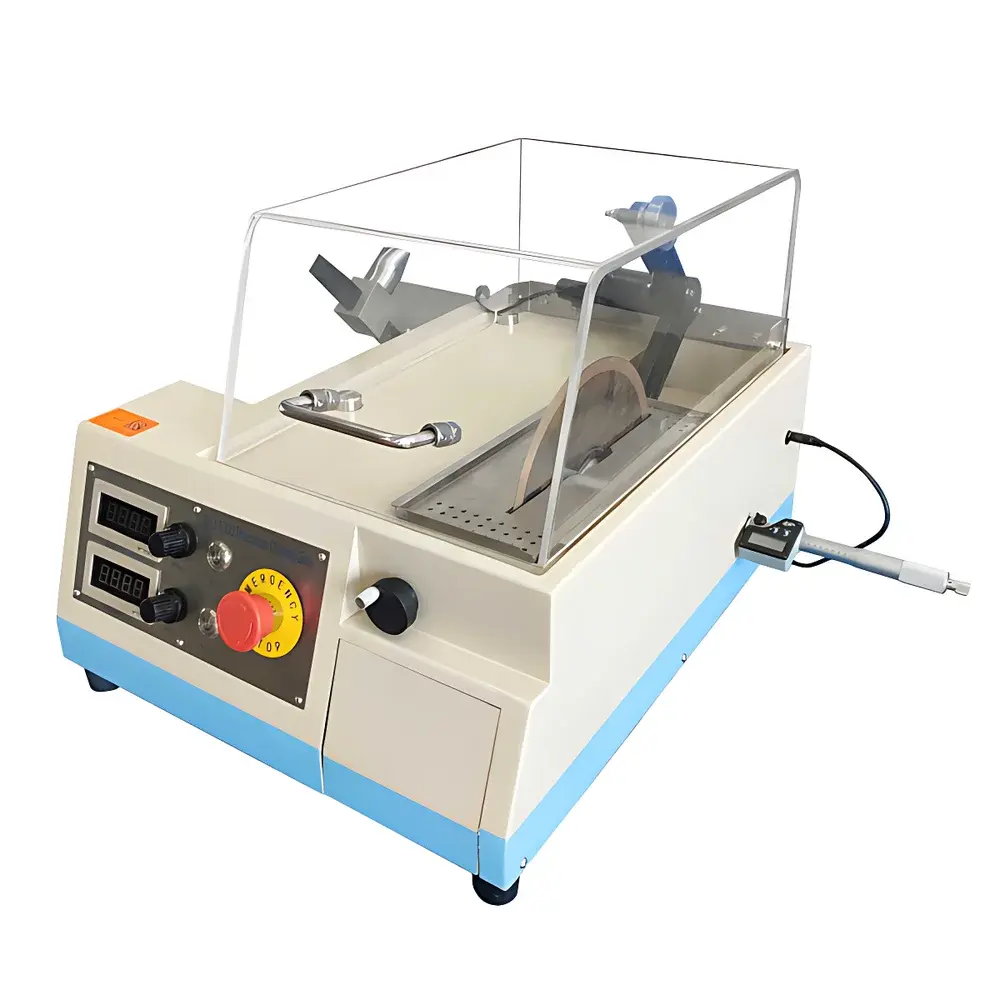
KJ GROUP SYJ-1000 Precision Cutting Machine
| Brand | KJ GROUP |
|---|---|
| Origin | Liaoning, China |
| Manufacturer Type | Direct Manufacturer |
| Country of Origin | China |
| Model | SYJ-1000 |
| Price | Upon Request |
| Power Supply | AC 220 V, 50 Hz |
| Main Spindle Speed Range | 50–1500 rpm (infinitely variable) |
| Maximum Cutting Depth | ≈50 mm |
| Feed Positioning Accuracy | 0.01 mm |
| Dimensions (W×D×H) | 410 × 330 × 290 mm |
| Weight | 39 kg |
| Standard Blade | Ø150 mm (with arbor sizes Ø12.7 mm, blade thickness 0.6 mm) |
| Compatible Blade Diameters | Ø100 mm, Ø150 mm, Ø200 mm |
| Cooling System | Integrated recirculating water reservoir with splash-fed coolant delivery |
| Operating Environment | 10–40 °C, 45–65 % RH |
| Required Workbench | ≥600 × 600 × 700 mm, load capacity ≥50 kg |
| Safety Features | Mechanical cutting limit stop, blade guard, emergency stop circuit |
| Compliance | Designed to meet general laboratory safety standards per IEC 61010-1 |
Overview
The KJ GROUP SYJ-1000 Precision Cutting Machine is a benchtop, manually operated precision sectioning system engineered for controlled, low-damage material segmentation in research and quality control laboratories. It operates on the principle of abrasive mechanical cutting—utilizing rotating bonded or electroplated diamond, silicon carbide, or aluminum oxide blades to achieve clean, planar cross-sections without significant thermal or mechanical distortion. Unlike high-speed automated saws, the SYJ-1000 prioritizes operator control, dimensional repeatability, and adaptability across heterogeneous sample classes—from brittle single crystals and sintered ceramics to ductile metals, polymer composites, and bio-ceramic dental specimens. Its core architecture integrates a DC-motor-driven spindle with infinitely variable speed control (50–1500 rpm), a micrometer-adjusted vertical feed mechanism (0.01 mm resolution), and modular fixture systems enabling both gravity-fed and powered rotational cutting modes. The machine is not intended for production-line throughput but rather for preparatory precision—where specimen integrity, orientation fidelity, and reproducible slice thickness are critical prior to subsequent analysis (e.g., SEM, XRD, metallography, or thin-film deposition).
Key Features
- Infinitely adjustable main spindle speed (50–1500 rpm) optimized for material-specific cutting kinetics—low rpm for heat-sensitive polymers and high rpm for hard ceramics.
- Digital micrometer feed system with 0.01 mm positioning resolution, enabling precise control over cut depth and slice thickness.
- Integrated recirculating coolant reservoir with passive splash-feed delivery: coolant is drawn upward by blade rotation and directed onto the cut interface, minimizing localized heating and preserving microstructural integrity.
- Multi-mode fixture platform supporting five distinct cutting configurations: manual hand-feed (with angular scale), gravity-assisted two-axis clamping (±15° tilt, 360° rotation), motorized rotational sample mounting, custom-shaped part holding, and miniature vise integration.
- Mechanical travel limiter prevents over-travel and protects both blade and chuck—enabling unattended operation for pre-set cuts under supervision.
- Standard Ø150 mm blade compatibility (with optional Ø100 mm and Ø200 mm adaptability) and universal arbor interface (Ø12.7 mm) for rapid tool change across abrasive types.
- Benchtop footprint (410 × 330 × 290 mm) and 39 kg mass ensure stable placement on standard ISO-certified lab workbenches (≥50 kg load rating).
Sample Compatibility & Compliance
The SYJ-1000 accommodates a broad spectrum of inorganic, organic, and composite materials—including sapphire, garnet, alumina, zirconia, cementitious matrices, borosilicate glass, geological core samples, ferrous and non-ferrous alloys, PCB laminates, PEEK and PMMA polymers, hydroxyapatite scaffolds, and dental porcelain. Its versatility stems from interchangeable blade chemistries: sintered diamond blades for ultra-hard crystals, electroplated diamond for fine-grained ceramics, silicon carbide for general-purpose rock/mineral sectioning, fused alumina for softer metals, and cubic boron nitride (CBN) for nickel-based superalloys. All cutting protocols align with ASTM E3-22 (Standard Guide for Preparation of Metallographic Specimens) and ISO 14577-1 (Metallic materials — Instrumented indentation test). When operated with documented SOPs—including blade selection rationale, coolant composition logs, and feed rate records—the SYJ-1000 supports GLP-compliant sample preparation workflows. While not FDA 21 CFR Part 11 certified as a standalone device, its output (i.e., sectioned specimens) may be integrated into regulated analytical pipelines when paired with audit-trail-enabled LIMS documentation.
Software & Data Management
The SYJ-1000 is a hardware-only instrument with no embedded firmware, touchscreen interface, or digital connectivity (USB/Ethernet). All operational parameters—speed setting, feed depth, dwell time, and blade type—are recorded manually or via external lab notebooks. This analog design eliminates cybersecurity vulnerabilities and ensures long-term operational continuity without software obsolescence. Users are advised to maintain standardized cutting logs referencing: specimen ID, material grade, blade lot number, coolant batch, spindle rpm, total feed distance, and visual assessment of cut surface quality (e.g., chipping, smearing, or discoloration). For labs implementing electronic recordkeeping, the SYJ-1000 integrates seamlessly with validated ELN platforms (e.g., LabArchives, Benchling) through manual entry or barcode-linked metadata tagging. No proprietary drivers or cloud services are required.
Applications
- Preparation of transmission electron microscopy (TEM) lamellae precursors via sequential low-speed sectioning of brittle ceramics.
- Orientation-controlled slicing of piezoelectric single crystals (e.g., LiNbO₃) for electrode patterning.
- Sectioning of reinforced concrete cores for pore structure analysis via micro-CT.
- Isolation of discrete layers from multilayered battery electrodes without interfacial delamination.
- Production of standardized tensile bars from additively manufactured metal coupons per ASTM E8/E8M.
- Cutting of orthopedic implant coatings (e.g., HA/Ti6Al4V) for cross-sectional adhesion testing.
- Microsectioning of dental prostheses (zirconia, lithium disilicate) for marginal fit evaluation.
FAQ
What types of coolant are recommended for use with the SYJ-1000?
Aqueous emulsions containing corrosion inhibitors (e.g., 5–10 % soluble oil or synthetic coolant) are strongly preferred. Pure water must be avoided due to risk of rust formation on steel components. Coolant concentration and pH should be monitored weekly and replenished per manufacturer guidelines.
Can the SYJ-1000 perform angled cuts?
Yes—via the included angular scale-equipped hand-feed table (±45° range) or the two-axis gravity clamp (±15° tilt, 360° azimuthal rotation), enabling Bevel-angle sectioning for metallurgical grain flow analysis.
Is nitrogen purging supported?
The compact enclosure allows safe operation inside inert-atmosphere gloveboxes (N₂ or Ar); however, no internal gas port or sealing gasket is provided—external box integration requires user-modified access ports.
What maintenance schedule is recommended?
After each use: rinse fixtures, dry thoroughly, apply light mineral oil to exposed steel surfaces. Monthly: inspect belt tension, verify micrometer calibration against gauge block, clean coolant reservoir. Annually: replace motor brushes (if applicable) and verify electrical grounding resistance (<1 Ω).
Does the SYJ-1000 comply with CE or UL safety directives?
It meets general laboratory equipment safety principles per IEC 61010-1:2010, but carries no CE/UL mark. Labs in EU/US jurisdictions must conduct local risk assessment and implement supplementary engineering controls (e.g., secondary splash guards, dedicated GFCI circuits) per site-specific EHS policy.



