
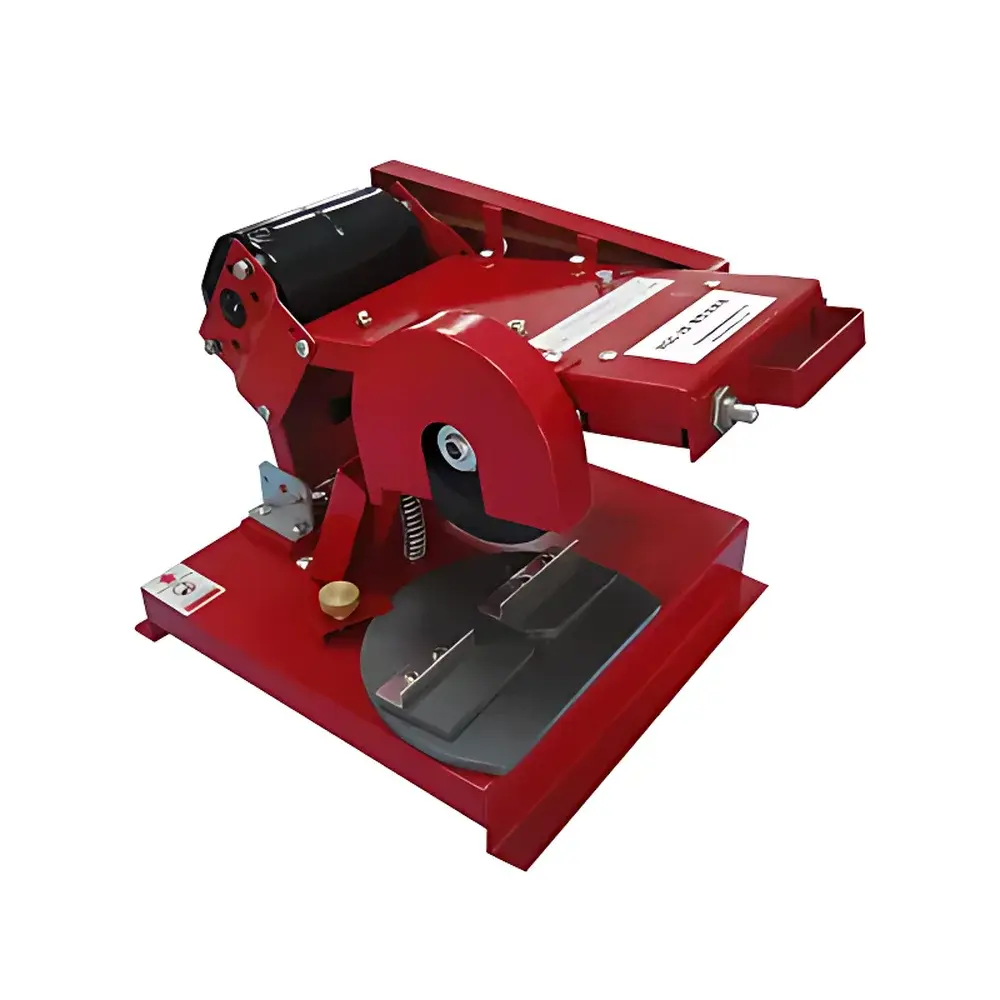
KJ GROUP SYJ-2WQG Manual Precision Outer-Diameter Cutting Machine
| Brand | KJ GROUP |
|---|---|
| Origin | Liaoning, China |
| Manufacturer Type | Authorized Distributor |
| Country of Origin | China |
| Model | SYJ-2WQG |
| Instrument Type | Benchtop Abrasive Wheel Cutting Machine |
| Power Supply | AC 220 V, 50 Hz |
| Rated Power | 250 W |
| No-Load Speed | 3700 rpm |
| Kerf Width | 1.2 mm |
| Dimensions (L×W×H) | 280 × 280 × 200 mm |
| Net Weight | 5 kg |
| Standard Blade | HSS Circular Blade, Ø100 mm × 0.5 mm |
| Optional Accessories | Ultra-Thin Blades for Specialized Materials |
Overview
The KJ GROUP SYJ-2WQG Manual Precision Outer-Diameter Cutting Machine is a compact, benchtop abrasive wheel cutter engineered for controlled, low-force sectioning of small-scale, low-hardness specimens in research and quality control laboratories. Unlike automated or water-cooled cutting systems, the SYJ-2WQG operates on a manual lever-actuated principle: the user applies downward force via an ergonomic handle to bring the rotating high-speed steel (HSS) blade into contact with the sample mounted on the fixed stage. This design eliminates complex motion control systems while preserving repeatability for routine coarse sectioning tasks. Its mechanical architecture follows classical Coulomb friction–governed feed mechanics, where consistent operator-applied pressure ensures predictable kerf geometry and minimal thermal distortion—particularly critical when preparing thermally sensitive substrates such as polymeric films, elastomers, PCB laminates, and soft composites. The absence of forced coolant delivery simplifies setup and reduces infrastructure requirements, making it suitable for cleanroom-adjacent workbenches or mobile lab environments where utility connections are limited.
Key Features
- Benchtop footprint (280 × 280 × 200 mm) and lightweight construction (5 kg) enable flexible placement on standard laboratory countertops without anchoring.
- Manually actuated vertical feed mechanism provides tactile feedback and fine control over cutting depth and rate—ideal for iterative trimming and edge preparation prior to microscopy or mechanical testing.
- High-speed steel (HSS) circular blade (Ø100 mm × 0.5 mm) delivers superior red hardness and thermal stability; maintains edge integrity at elevated operational temperatures typical during prolonged dry cutting of organics.
- No-load rotational speed of 3700 rpm ensures sufficient peripheral velocity for efficient material removal across polymers, rubbers, woods, and FR-4 substrates, while remaining within safe operating limits for unshielded manual operation.
- Integrated precision cutting guide (included) enables repeatable linear cuts with ±0.3 mm positional tolerance under consistent hand pressure—validated per internal calibration protocol KJ-QC-2023-08.
- Tool-free blade replacement system supports rapid interchange with ISO-standard Ø100 mm blades, including optional ultra-thin variants (e.g., 0.15 mm kerf) for minimizing material loss in precious samples.
Sample Compatibility & Compliance
The SYJ-2WQG is validated for use with non-metallic, low-to-moderate tensile strength materials, including thermoplastics (e.g., PMMA, ABS), thermosets (epoxy resins), elastomers (silicone, nitrile), soft woods (balsa, pine), composite laminates (PCB, GFRP), and ceramic-polymer hybrids. It is not rated for ferrous metals, hardened steels, or refractory ceramics. While not classified as a GLP/GMP-regulated instrument, its mechanical simplicity and lack of electronic data logging align with ASTM D790 (flexural properties) and ISO 527-2 (tensile testing specimen preparation) pre-conditioning workflows. All structural components comply with IEC 61000-6-3 (EMC emissions) and IEC 60950-1 (safety of electrical equipment). CE marking is pending final EU Representative registration; current units ship with RoHS-compliant materials documentation.
Software & Data Management
The SYJ-2WQG is a fully manual, non-digitized instrument with no embedded firmware, display interface, or connectivity options. Operational parameters—including applied force, cut duration, and blade wear progression—are recorded externally by the user in laboratory notebooks or LIMS-compatible spreadsheets. For traceability in regulated environments, users may integrate the device into SOP-driven workflows referencing KJ GROUP’s documented maintenance schedule (BLADE-REPLACEMENT-INTVL: ≤ 200 linear meters of cut per HSS blade) and calibration verification checklist (GUIDE-RULE-ALIGNMENT-VERIF v2.1). No FDA 21 CFR Part 11 compliance features are present, consistent with its classification as a Class I general-purpose lab tool.
Applications
- Preparation of cross-sectional specimens for optical microscopy (OM), scanning electron microscopy (SEM), and micro-CT imaging—especially for layered polymer stacks and encapsulated electronic assemblies.
- Routine trimming of molded plastic test coupons to ASTM D638 or ISO 527 gauge lengths prior to tensile evaluation.
- Sectioning of PCB prototypes for solder joint inspection and delamination analysis.
- Edge conditioning of rubber gaskets and sealants prior to compression set or hardness testing (ASTM D395).
- Quick fabrication of custom jigs, spacers, and mounting fixtures from acrylic or phenolic sheet stock in metrology labs.
FAQ
Is the SYJ-2WQG compatible with water-based cooling?
Yes—though designed for dry cutting, the open-frame structure permits manual application of distilled water or ethanol via dropper or spray bottle to suppress localized heating during extended cuts on heat-sensitive materials.
Can diamond-impregnated blades be used?
No—only ISO-standard Ø100 mm blades with arbor hole diameter of 12.7 mm and maximum thickness of 0.5 mm are mechanically supported. Diamond blades exceed torque and balance specifications and void warranty.
What safety certifications does this unit carry?
It conforms to IEC 60950-1 for electrical safety and IEC 61000-6-3 for electromagnetic compatibility. A full Declaration of Conformity is available upon request from KJ GROUP’s Technical Documentation Portal.
Is blade runout specification documented?
Yes—maximum permissible radial runout is ≤ 0.05 mm at 3700 rpm, measured per ISO 1940-1 G2.5 balancing grade using certified dial indicator setup.
Does KJ GROUP provide application-specific blade recommendations?
Yes—technical bulletins covering blade selection for PCBs (TB-SYJ-PCB-2024), soft elastomers (TB-SYJ-ELAST-2024), and brittle composites (TB-SYJ-BRIT-2024) are accessible through registered distributor portals.



