
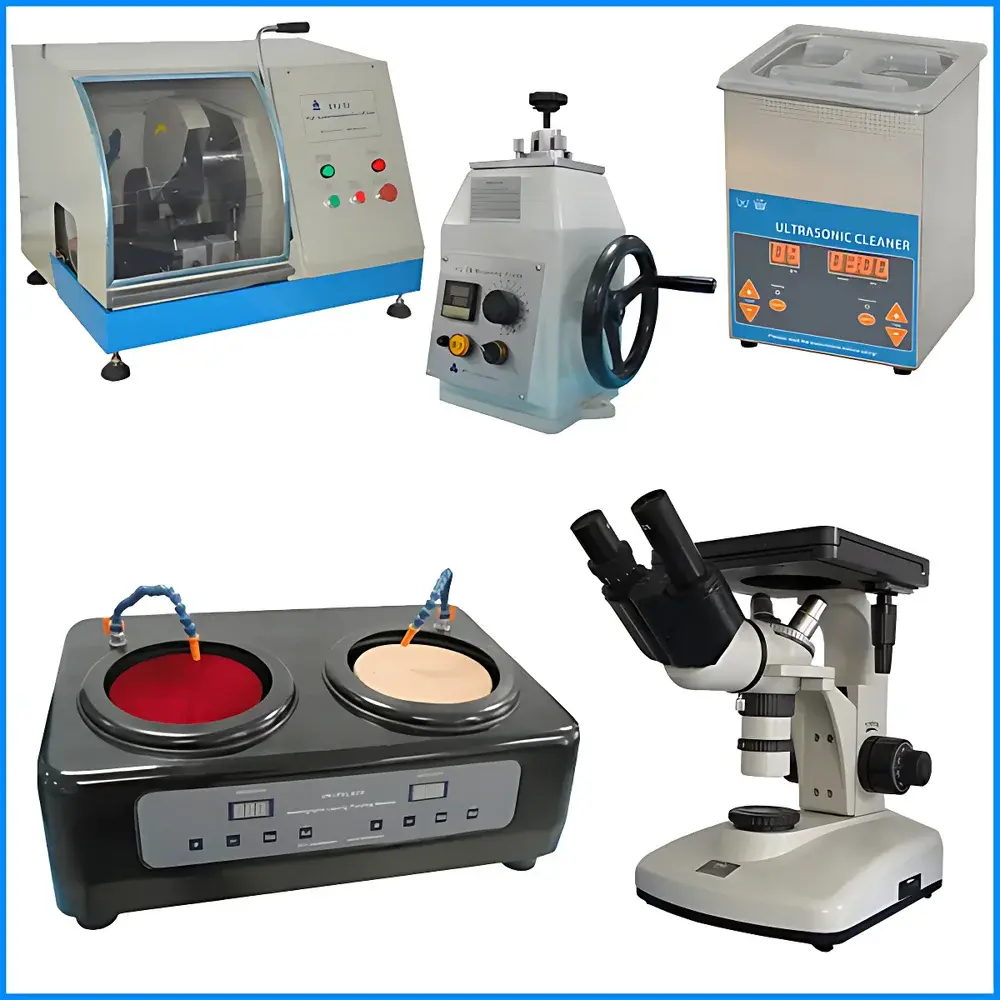
KJ GROUP SYJ-50/XQ-2B/UNIPOL-820/VGT-1620QTD/4XB Metallographic Sample Preparation and Analysis System (Economy Series)
| Brand | KJ GROUP |
|---|---|
| Origin | Liaoning, China |
| Manufacturer Type | Authorized Distributor |
| Country of Origin | China |
| Model Series | Economy-Series Integrated Metallography System |
| Pricing | Contact for Quotation |
Overview
The KJ GROUP Economy-Series Integrated Metallographic Sample Preparation and Analysis System is a purpose-engineered workflow solution for routine metallurgical laboratories, quality control departments, and academic teaching facilities requiring full-cycle metallographic specimen processing—from sectioning to microstructural evaluation—at optimized capital expenditure. This system integrates five core instruments operating on complementary physical principles: abrasive sectioning (SYJ-50), thermoplastic compression molding (XQ-2B), sequential planar grinding and polishing (UNIPOL-820), cavitation-based ultrasonic cleaning (VGT-1620QTD), and inverted optical microscopy (4XB). Each unit adheres to ISO 3079, ASTM E3, and ISO 13004 standards governing metallographic sample preparation methodology and optical resolution validation. The system is designed for reproducible specimen integrity, minimal edge rounding, and consistent surface finish—critical prerequisites for quantitative image analysis, grain size measurement per ASTM E112, and phase identification in ferrous/non-ferrous alloys.
Key Features
- SYJ-50 Precision Sectioning: Manual feed with adjustable cutting force and coolant flow control; accommodates samples up to Ø50 mm diameter; uses silicon carbide or diamond-impregnated blades for controlled kerf loss and thermal damage minimization.
- XQ-2B Mechanical Hot Mounting: Dual-mode heating (up to 180 °C) and hydraulic pressure (up to 12 MPa); compatible with phenolic, acrylic, and epoxy resins; programmable cycle timing ensures uniform resin flow and void-free encapsulation.
- UNIPOL-820 Dual-Station Grinding/Polishing: Independent motor-driven upper and lower plates (200 mm diameter); speed range 50–600 rpm with digital tachometer feedback; precision height adjustment enables consistent removal rate calibration across SiC papers and diamond suspensions.
- VGT-1620QTD Ultrasonic Cleaning: 40 kHz frequency generator with degas, sweep, and pulse modes; stainless steel tank (160 × 200 × 120 mm); integrated heater (20–80 °C) and timer (1–99 min) for residue-free removal of polishing lubricants and embedded abrasives.
- 4XB Inverted Metallurgical Microscope: Infinity-corrected optical path with 10× wide-field eyepieces; objective turret supporting 5×, 10×, 20×, 50×, and 100× (oil immersion) objectives; built-in LED Köhler illumination; mechanical stage with vernier scale (0.01 mm resolution).
Sample Compatibility & Compliance
The system supports specimens ranging from soft aluminum alloys and copper matrices to hardened tool steels (HRC ≤ 65) and sintered carbides. All instruments comply with CE safety directives (2014/35/EU Low Voltage Directive and 2014/30/EU EMC Directive). The 4XB microscope meets ISO 10934-1 for resolution verification using certified test targets (e.g., NIST SRM 1963). UNIPOL-820 polishing parameters align with ASTM E407 for etchant compatibility and surface deformation assessment. Documentation packages include factory calibration certificates, operation manuals in English, and traceable maintenance logs—supporting GLP-compliant audit readiness.
Software & Data Management
While the base configuration operates without proprietary software, the 4XB microscope is equipped with C-mount output compatible with third-party digital imaging platforms (e.g., ToupView, Stream Motion, or Olympus cellSens). Users may integrate USB 3.0 cameras (up to 5 MP resolution) for acquisition of calibrated micrographs with embedded scale bars (µm/pixel). Image metadata—including objective magnification, exposure time, and timestamp—is retained in TIFF/OME-TIFF formats. Optional add-ons include automated grain analysis modules compliant with ASTM E112 Annex A1 and ISO 643:2019 reporting templates.
Applications
- Routine QC inspection of castings, forgings, and weld joints per ASTM E340 and ISO 643
- Failure analysis workflows involving fracture surface characterization and inclusion rating (ASTM E45)
- Heat treatment verification through ferrite/pearlite ratio quantification and case depth profiling
- Research-grade microstructure correlation studies in additive manufacturing (AM) metal powders and LPBF builds
- Undergraduate and graduate metallurgy laboratory instruction aligned with ASM International curriculum guidelines
FAQ
Is this system suitable for ISO/IEC 17025-accredited testing laboratories?
Yes—the individual instruments meet essential metrological requirements for repeatability and traceability; however, full accreditation requires user-performed uncertainty budgets and documented method validation per ISO/IEC 17025 Clause 7.7.
Can the UNIPOL-820 accommodate automated endpoint detection?
No—the base model is manually operated; optional external thickness gauges or in-situ reflectance sensors may be integrated via analog I/O ports.
What is the maximum specimen height supported by the 4XB microscope stage?
The inverted design permits specimens up to 120 mm in height and 25 kg in mass when mounted on the reinforced base plate.
Does the VGT-1620QTD support aqueous and organic solvent cleaning baths?
Yes—compatible with water-based detergents, isopropanol, acetone, and xylene; solvent resistance verified per ASTM D543 for tank material (316L stainless steel).
Are spare parts and consumables available globally through KJ GROUP distribution partners?
Yes—blades, mounting resins, polishing cloths, diamond suspensions, and microscope filters are stocked in EU, NA, and APAC regional warehouses with lead times under 10 business days.
Related Products



