
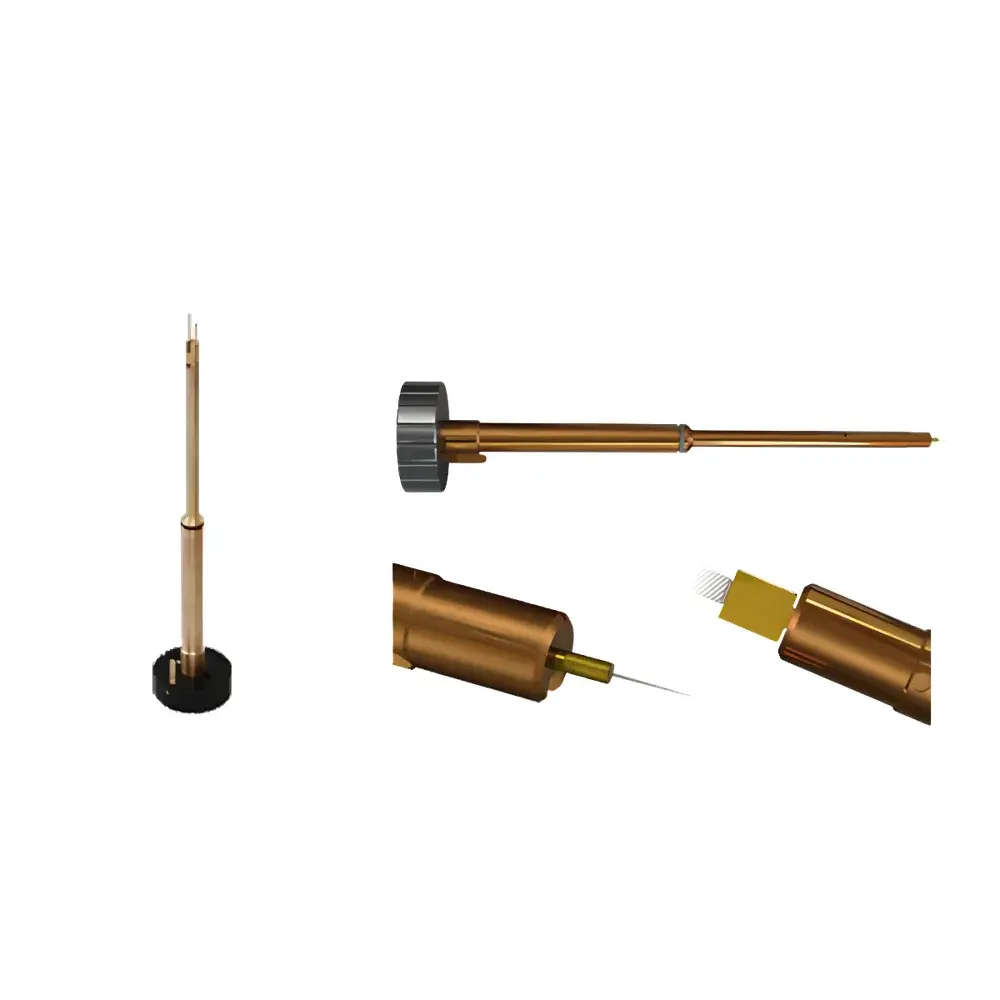
KJ GROUP TEM-APT Holder for Integrated Transmission Electron Microscopy and Atom Probe Tomography
| Brand | KJ GROUP |
|---|---|
| Origin | Liaoning, China |
| Manufacturer Type | Authorized Distributor |
| Country of Origin | China |
| Model | TEM-APT Holder |
| Pricing | Available Upon Request |
| Sample Compatibility | FIB-prepared needle specimens & electrochemically sharpened tips |
| Rotation Range | 360° continuous tilt |
| TEM Interface | Standard 3.5 mm diameter Gatan-style or JEOL-compatible double-tilt compatible geometry |
| APT Transfer Compatibility | Direct insertion into CAMECA LEAP or AMETEK IVAS systems |
| Structural Material | High-purity molybdenum alloy with low-outgassing surface finish |
| Vacuum Compatibility | UHV-rated (≤1×10⁻¹⁰ mbar) |
| Thermal Stability | Engineered for cryogenic operation (77 K–100 K) |
Overview
The KJ GROUP TEM-APT Holder is a precision-engineered dual-modality specimen holder designed to bridge high-resolution transmission electron microscopy (TEM) and atom probe tomography (APT) within a single, integrated workflow. It operates on the principle of correlative nanoscale analysis—enabling sequential, non-destructive structural imaging in TEM followed by atomic-scale compositional mapping in APT using the identical specimen volume. Unlike conventional TEM holders limited to morphological characterization or standard APT stubs lacking spatial context, this holder maintains full TEM imaging capability—including high-angle annular dark-field (HAADF) STEM, diffraction contrast, and electron energy-loss spectroscopy (EELS)—while preserving the geometric integrity required for field evaporation in time-of-flight mass spectrometry-based APT. Its mechanical architecture ensures sub-microradian angular reproducibility during multi-axis tilting, critical for accurate alignment between TEM-derived crystallographic orientation and APT-reconstructed atomic coordinates.
Key Features
- Full 360° continuous rotation with <0.1° angular resolution, enabling complete tomographic tilt series acquisition without missing wedge artifacts
- Modular tip-mounting interface accommodating both FIB-lifted needle specimens (diameter 50–100 nm) and electrochemically sharpened tips with apex radii <50 nm
- Low-outgassing molybdenum alloy construction certified for ultra-high vacuum (UHV) environments (≤1×10⁻¹⁰ mbar), ensuring compatibility with both TEM column vacuums and APT flight tubes
- Standardized 3.5 mm outer diameter with Gatan/JEOL-compatible kinematic coupling, permitting direct interchangeability with existing double-tilt stages
- Integrated thermal anchoring design supporting stable cryogenic operation from 77 K to 100 K—essential for minimizing thermal diffusion during APT data acquisition
- Quick-release specimen mount enabling tool-free transfer of the same needle specimen between TEM and APT instruments with positional fidelity ≤±200 nm
Sample Compatibility & Compliance
The TEM-APT Holder accepts specimens prepared via focused ion beam (FIB) milling or electrochemical polishing—both industry-standard methods for APT-ready tip fabrication. It supports specimens with base diameters ranging from 2 µm to 5 µm and tip lengths up to 15 µm. The holder complies with ASTM E2981-21 (Standard Guide for Correlative Microscopy Using TEM and APT) and aligns with ISO/IEC 17025 requirements for measurement traceability in materials characterization laboratories. All metallic components undergo vacuum-bakeout validation per NASA-STD-6002B and meet outgassing specifications outlined in ESA PSS-01-702. No proprietary adhesives or epoxies are used in the mounting mechanism—ensuring zero carbon contamination risk during APT analysis.
Software & Data Management
While the holder itself is hardware-only, its use enables seamless integration with widely adopted correlative analysis platforms. TEM image metadata (including stage tilt angles, magnification, and camera length) can be exported in DM3 or TIFF format with embedded EXIF tags, directly importable into APT reconstruction software such as IVAS 3.8.x or APSuite. When combined with DigitalMicrograph scripting and MATLAB-based registration algorithms, users achieve sub-pixel alignment between TEM micrographs and APT isoconcentration surfaces. The workflow supports audit-trail generation compliant with FDA 21 CFR Part 11 when deployed in regulated environments (e.g., semiconductor process development or nuclear fuel microstructure qualification), provided institutional LIMS integration is implemented.
Applications
- Correlative analysis of irradiation-induced defect clusters in nuclear cladding alloys (e.g., Zr-Nb, Fe-Cr-Ni)
- Atomic-scale quantification of solute segregation at grain boundaries and dislocation cores in high-strength aluminum and magnesium alloys
- Validation of precipitate chemistry and interfacial stoichiometry in Ni-based superalloys and TiAl intermetallics
- Direct correlation between oxide scale morphology (observed via HAADF-STEM) and cation/anion distribution (measured via APT) in solid oxide fuel cell electrodes
- 3D reconstruction of dopant distribution in semiconductor nanowires and quantum dot heterostructures
FAQ
Is the TEM-APT Holder compatible with aberration-corrected TEM systems?
Yes—it maintains mechanical stability under high-magnification conditions and does not introduce vibration or drift beyond instrument-specific tolerances.
Can it be used for in-situ heating or cooling experiments in TEM prior to APT transfer?
It supports cryo-transfer but is not rated for in-situ heating above 150 °C due to thermal expansion mismatch; dedicated heating holders must be used separately.
Does the holder require custom modification of the APT instrument’s specimen stage?
No—its base geometry conforms to CAMECA LEAP 5000/6000 and AMETEK IVAS 4.0/5.0 standard loading protocols without adapter plates.
What is the maximum allowable specimen aspect ratio for stable imaging and transfer?
Specimens with length-to-diameter ratios ≤30:1 demonstrate optimal mechanical stability during 360° tilt and vacuum transfer.
How is positional repeatability verified between TEM and APT sessions?
Via fiducial marker tracking using pre-characterized Pt or Au nanoparticles deposited on the specimen shank, referenced against stage encoder logs and calibrated with NIST-traceable interferometric metrology.



