
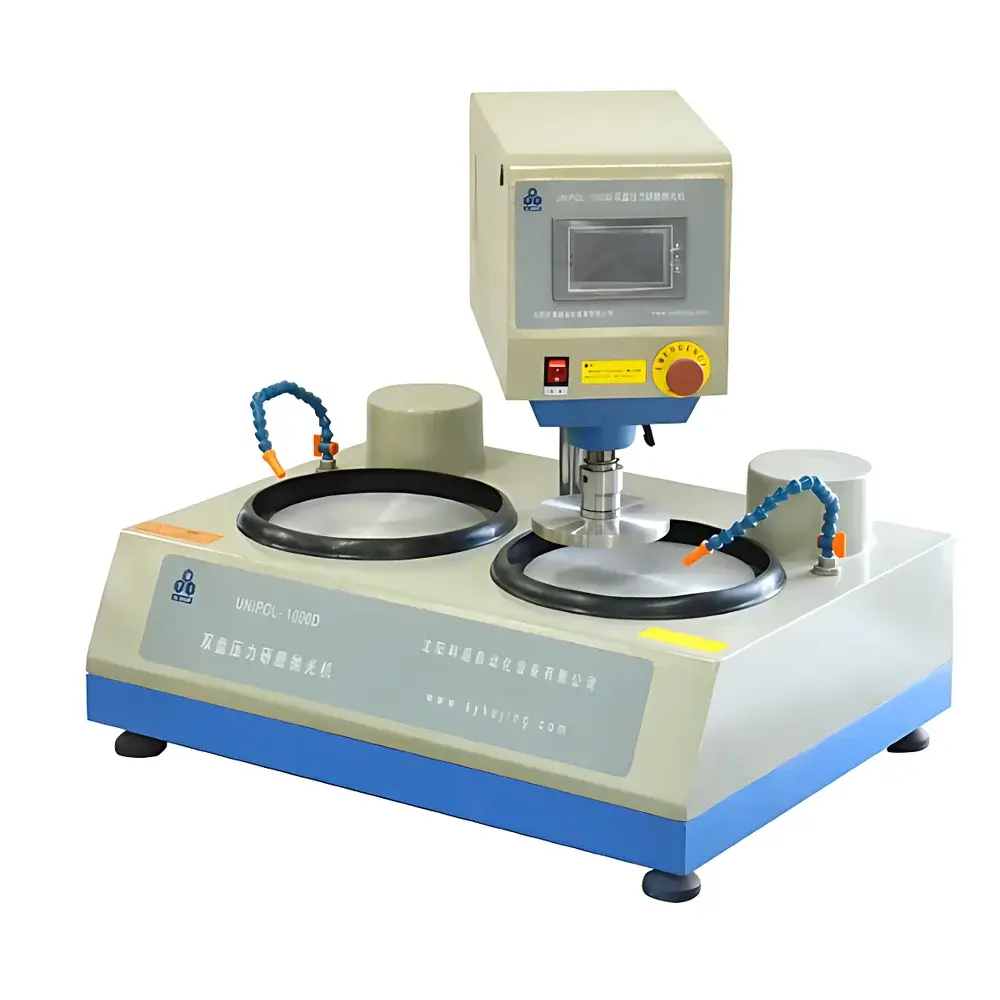
KJ GROUP UNIPOL-1000D Dual-Station Pressure-Controlled Grinding and Polishing System
| Brand | KJ GROUP |
|---|---|
| Origin | Liaoning, China |
| Model | UNIPOL-1000D |
| Dimensions (L×W×D) | 780 mm × 590 mm × 750 mm |
| Number of Grinding/Polishing Plates | 2 |
| Plate Diameter | Ø250 mm |
| Lower Plate Speed | 50–400 rpm (10 rpm increments) |
| Upper Plate Speed | 10–80 rpm (infinitely variable) |
| Applied Load Range | 0.5–20 kg (0.5 kg increments) |
| Sample Holder Diameter | Ø150 mm |
| Trunnion Hole Diameter | Ø25.4 mm |
| Weight | 100 kg |
Overview
The KJ GROUP UNIPOL-1000D Dual-Station Pressure-Controlled Grinding and Polishing System is an engineered solution for precision sample preparation in materials science laboratories. Designed around a dual-plate mechanical loading architecture, it implements controlled normal force application—centered directly on the upper carrier plate—to ensure uniform pressure distribution across the entire specimen interface during grinding and polishing. This principle eliminates edge-loading artifacts and supports reproducible material removal rates essential for cross-sectional analysis, metallography, semiconductor wafer thinning, and optical surface finishing. The system operates on a two-stage sequential workflow: coarse grinding on one station followed by fine polishing on the second—enabling strict procedural separation to prevent abrasive carryover and contamination between stages. Its robust cast-aluminum frame, low-noise geared motor drive train, and integrated timer-based endpoint control support unattended operation under GLP-aligned workflows.
Key Features
- Dual independent stations with synchronized but functionally segregated operation: one configured for grinding (e.g., SiC paper), the other for polishing (e.g., diamond suspension on synthetic cloth)
- Center-loaded mechanical pressure actuation system delivering stable, repeatable loads from 0.5 kg to 20 kg in 0.5 kg increments—calibrated and traceable to ISO 7500-1 Class 1 standards
- Independent speed control: lower plate rotates clockwise at 50–400 rpm (10 rpm steps); upper plate rotates either clockwise or counterclockwise at 10–80 rpm (infinitely variable), enabling optimized shear directionality for brittle vs. ductile materials
- Integrated touchscreen HMI with programmable time-based termination (0–999 min), real-time speed/load display, and user-defined protocol storage (up to 20 profiles)
- Standardized Ø150 mm specimen holder with Ø25.4 mm trunnion-mounting configuration compatible with ASTM E3, ISO 14577, and EN 10365 metallographic mounting systems
- Low-vibration structural design (<45 dB(A) at 1 m) and sealed gear housing minimize environmental interference in cleanroom-adjacent lab spaces
Sample Compatibility & Compliance
The UNIPOL-1000D accommodates a broad spectrum of rigid solid specimens—including metals (Fe, Al, Ti alloys), ceramics (Al₂O₃, ZrO₂), infrared optical crystals (ZnSe, ZnS, Si, Ge), geological sections (granite, basalt, shale), polymer composites (CFRP, GFRP), and sintered carbides. All contact surfaces comply with ISO 8502-3 for non-contaminating metallic finishes. The system meets CE machinery directive 2006/42/EC requirements for safety, and its electrical subsystem conforms to IEC 61000-6-2 (immunity) and IEC 61000-6-4 (emissions). While not FDA-registered, its operational parameters align with USP and ASTM E407 guidelines for standardized metallographic preparation used in regulated QA/QC environments.
Software & Data Management
The embedded controller firmware supports audit-trail-enabled operation: all parameter changes, start/stop timestamps, load/speed settings, and runtime durations are logged internally with UTC timestamping. Export is available via USB 2.0 to CSV format for integration into LIMS or ELN platforms. Optional SKZD-5 automated dispensing module enables closed-loop slurry delivery synchronized with rotation phase—supporting 21 CFR Part 11-compliant electronic records when paired with validated third-party software. No cloud connectivity or remote access is implemented; data sovereignty remains fully on-site per institutional IT policy requirements.
Applications
- Preparation of TEM cross-sections requiring sub-micron thickness control and minimal subsurface damage
- Routine metallographic evaluation per ASTM E3 and ISO 643 for grain size, inclusion rating, and phase distribution analysis
- Surface planarization of IR-transmissive substrates prior to anti-reflective coating deposition
- Rock/mineral thin-section fabrication for petrographic microscopy (ASTM D5777)
- Quality assurance of polished silicon wafers in microelectronics R&D labs
- Development and validation of novel polishing slurries and pad chemistries under controlled load/speed regimes
FAQ
What types of consumables are included with the base system?
The standard configuration includes two cast-aluminum polishing plates, one trunnion-style Ø150 mm carrier plate, four magnetic retention sheets, six adhesive-backed polishing bases, two sheets each of 240#, 400#, 800#, and 1500# SiC papers, two sheets each of suede, synthetic leather, and polyurethane polishing pads, and one tube of 3 µm diamond polishing paste.
Is the system compatible with vacuum chuck holders or electrostatic chucks?
No—the UNIPOL-1000D utilizes mechanical clamping only. Vacuum or electrostatic chucks require external retrofitting and are not supported by factory calibration or warranty.
Can the machine be operated in a nitrogen-purged glovebox?
Yes, provided ambient temperature and humidity remain within specified limits (25°C ±15°C, 55% RH ±10%). The unit contains no hygroscopic electronics or oil-lubricated components that would degrade under inert atmosphere.
Does the system meet ISO/IEC 17025 requirements for accredited testing labs?
While the UNIPOL-1000D itself is not ISO/IEC 17025-certified, its documented repeatability (±0.3 kg load accuracy, ±2 rpm speed stability), traceable calibration options, and audit-log functionality enable users to establish and validate their own measurement uncertainty budgets per ISO/IEC 17025 Clause 7.7.
What maintenance intervals are recommended?
Gear oil replacement every 2,000 operating hours; bearing inspection every 5,000 hours; touchscreen calibration annually or after impact events; torque verification of pressure linkage bolts quarterly. Maintenance logs are exportable via USB.



