
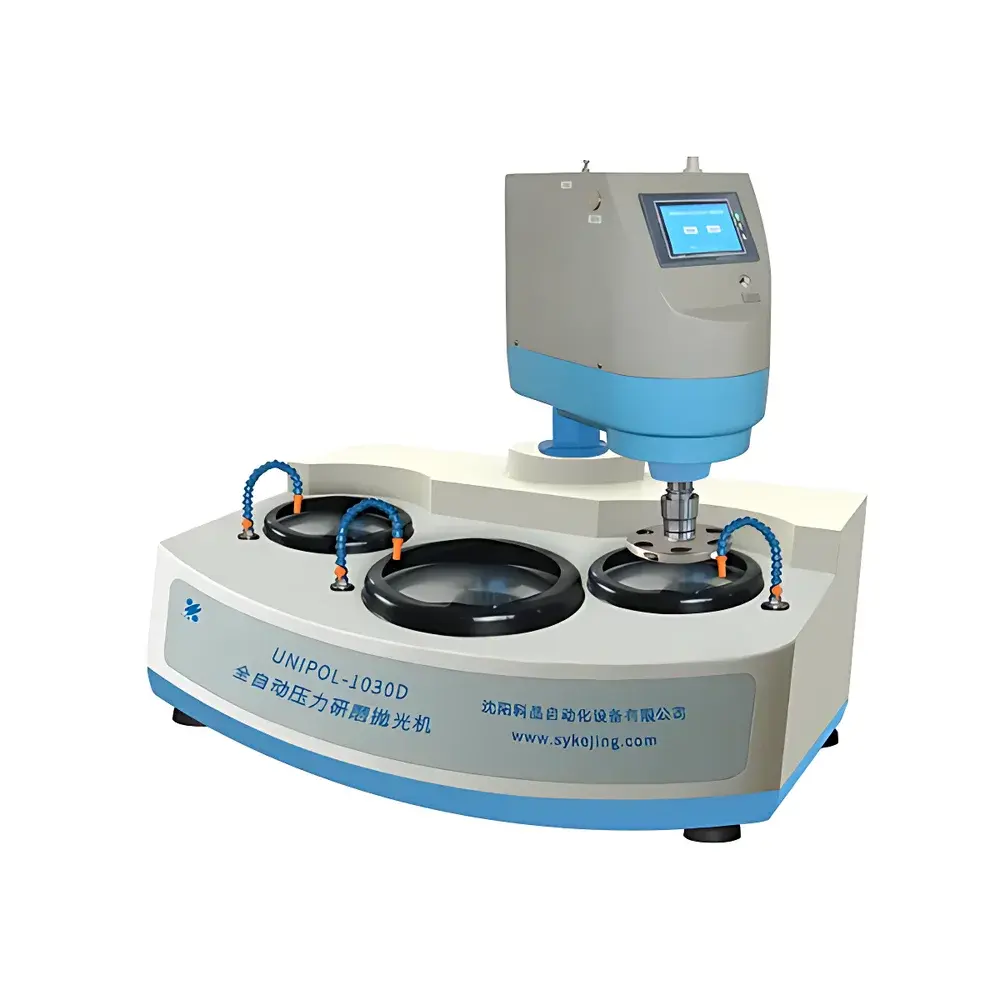
KJ GROUP UNIPOL-1030D Automated Pressure-Controlled Grinding and Polishing System
| Brand | KJ GROUP |
|---|---|
| Origin | Liaoning, China |
| Model | UNIPOL-1030D |
| Dimensions (L×W×D) | 780 mm × 590 mm × 750 mm |
| Number of Grinding/Polishing Plates | 3 |
| Plate Diameter | φ250 mm |
| Plate Speed Range | 20–240 rpm |
| Polishing Plate Speed Range | 50–500 rpm |
| Specimen Holder Diameter | φ150 mm |
| Grinding/Polishing Head Speed | 10–80 rpm |
| Applied Load Range | 0.5–20 kg |
| Power Supply | 220 V, 50 Hz |
Overview
The KJ GROUP UNIPOL-1030D Automated Pressure-Controlled Grinding and Polishing System is an industrial-grade, PLC-driven sample preparation platform engineered for high-reproducibility planar surface conditioning of rigid solid specimens. It operates on a dual-axis rotational principle: the grinding/polishing plate rotates horizontally at precisely regulated speeds while the specimen-holding head rotates coaxially with programmable torque and axial load control. This configuration enables consistent material removal rates and surface finish uniformity across diverse hard materials—including metals, ceramics, sintered oxides, geological thin sections, and optical glasses—by maintaining stable hydrodynamic film formation between abrasive media and sample surface. Designed for both R&D laboratories and pilot-scale production environments, the system meets foundational mechanical stability requirements for ASTM E3, ISO 1463, and GB/T 13298-compliant metallographic specimen preparation workflows.
Key Features
- Triple-station modular configuration supporting simultaneous coarse grinding, fine grinding, and final polishing—enabling fully sequential, unattended processing without manual repositioning
- Digital pressure feedback loop using calibrated load cells ensures real-time, closed-loop control of applied normal force (0.5–20 kg) with ±0.1 kg repeatability
- Independent speed regulation: grinding/polishing plate (20–240 rpm), polishing-specific plate (50–500 rpm), and specimen holder spindle (10–80 rpm), all adjustable via incremental encoder inputs
- Integrated touchscreen HMI with preloaded SOP templates compliant with GLP documentation standards; supports user-defined parameter sets with timestamped execution logs
- Automated mode switching between grinding and polishing phases based on preset time or cumulative rotation counts—eliminating operator intervention during multi-step protocols
- Robust cast-iron frame with vibration-damping feet and sealed bearing assemblies to maintain runout tolerance < 10 µm over extended operation cycles
Sample Compatibility & Compliance
The UNIPOL-1030D accommodates specimens up to φ150 mm mounted on standard metallographic holders (e.g., cold-mount resins, hot-press bakelite, or conductive epoxy). Its pressure-controlled architecture ensures minimal edge rounding and subsurface deformation in brittle materials such as silicon wafers, alumina substrates, and quartz crystals. The system conforms to general safety requirements per IEC 61000-6-2 (EMC immunity) and IEC 61000-6-4 (EMC emissions), and its mechanical design aligns with ISO 12100 risk assessment principles for laboratory machinery. While not certified to UL or CE for standalone medical device use, it is routinely deployed in ISO/IEC 17025-accredited labs for sample prep preceding SEM, XRD, and microhardness testing.
Software & Data Management
Control firmware runs on embedded Linux-based PLC architecture with non-volatile memory retention. All operational parameters—including speed profiles, load setpoints, dwell times, and cycle counters—are stored locally with optional USB export in CSV format. Audit trails record operator ID (via login), start/stop timestamps, parameter modifications, and alarm events—supporting 21 CFR Part 11 readiness when paired with networked authentication servers. No cloud connectivity is built-in; data residency remains fully on-device unless manually exported. Firmware updates are performed via secure USB key with SHA-256 signature verification.
Applications
- Preparation of cross-sectional specimens for failure analysis in aerospace alloys and additive-manufactured components
- Surface planarization of geological thin sections prior to petrographic microscopy and electron microprobe analysis
- Routine metallographic sample conditioning in QC labs serving automotive casting suppliers (per ASTM E384 microhardness validation)
- Substrate flattening for epitaxial film deposition studies requiring Ra < 5 nm post-polish roughness
- Standardized polishing protocols for ceramic matrix composites used in nuclear fuel cladding R&D
FAQ
Does the UNIPOL-1030D support automated endpoint detection?
No. It does not incorporate in-situ thickness monitoring or optical reflectance sensors. Endpoint determination relies on predefined time-based or rotation-count-based logic.
Can third-party consumables be used with this system?
Yes—standard φ250 mm grinding papers, diamond-impregnated pads, and colloidal silica suspensions from major suppliers (e.g., Struers, Buehler, Allied High Tech) are mechanically compatible.
Is remote monitoring or Ethernet connectivity available?
No native Ethernet port or remote access capability is included. Integration with external SCADA systems requires custom RS-485 or Modbus RTU interface development.
What maintenance intervals are recommended?
Lubrication of main drive bearings every 500 operating hours; calibration of load cell annually or after impact events exceeding 25 kg nominal force.
Is the system suitable for hazardous material processing?
Not inherently. Optional fume extraction ducting can be retrofitted, but the base unit lacks ATEX or IECEx certification for explosive atmospheres.



