
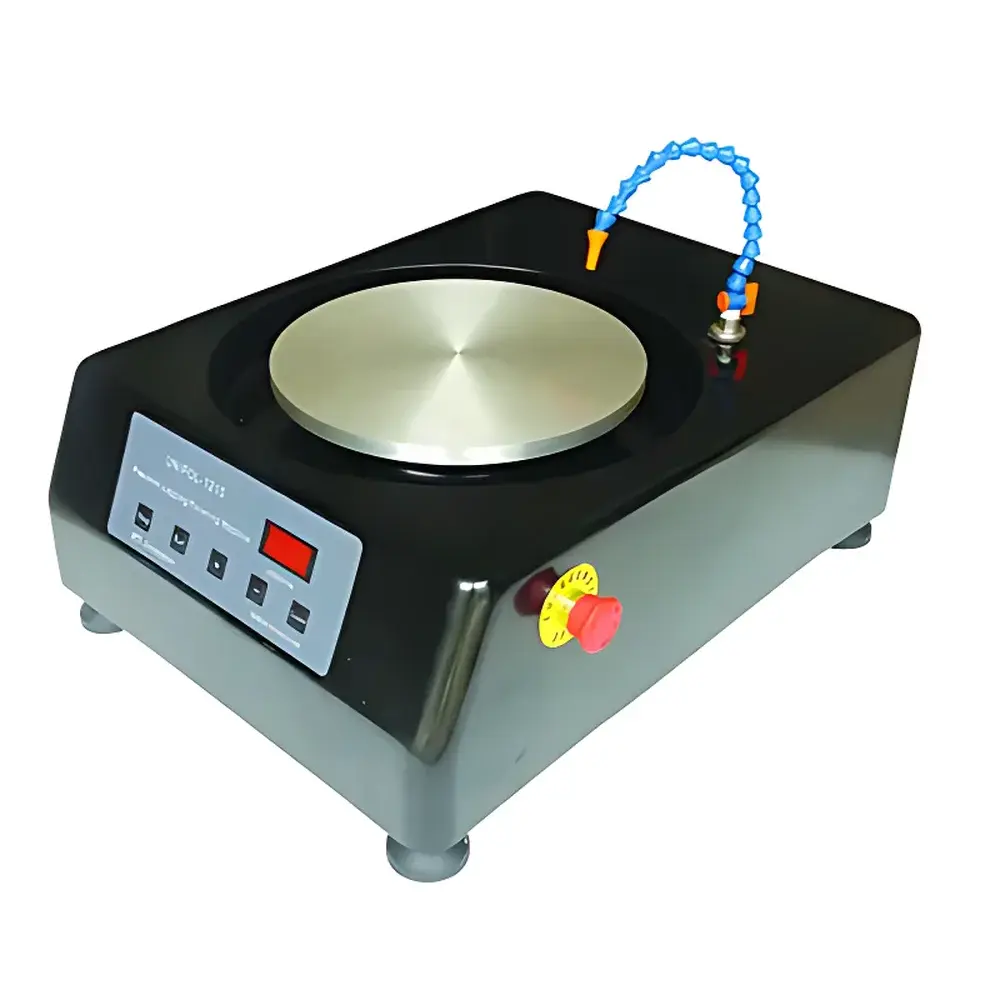
KJ GROUP UNIPOL-1210 Manual Metallographic Grinding and Polishing Machine
| Brand | KJ GROUP |
|---|---|
| Origin | Liaoning, China |
| Manufacturer Type | Authorized Distributor |
| Country of Origin | China |
| Model | UNIPOL-1210 |
| Dimensions (L×W×D) | 650 mm × 500 mm × 250 mm |
| Number of Platen Stations | 1 |
| Platen Diameter | Ø300 mm |
| Speed Range | 50–600 rpm (infinitely variable) |
| Power Input | AC 110/220 V, 50/60 Hz |
| Total Power Consumption | 180 W |
| Net Weight | ≈33 kg |
| Operating Temperature | 0–45 °C |
| Relative Humidity | 10–85 % RH (non-condensing at 25 °C) |
| Cooling | Tap water supply via inlet/outlet ports |
| Control System | Microcontroller-based with digital RPM display |
| Drive Motor | DC 110 V, 165 W |
Overview
The KJ GROUP UNIPOL-1210 Manual Metallographic Grinding and Polishing Machine is a precision-engineered, single-station benchtop instrument designed for reproducible specimen preparation in metallurgical, materials science, and geological laboratories. It operates on the principle of controlled mechanical abrasion—employing rotational motion of a rigid Ø300 mm aluminum platen to facilitate sequential grinding and polishing of solid-state samples under manually regulated pressure and coolant flow. Unlike automated or force-controlled systems, the UNIPOL-1210 prioritizes operator-defined process flexibility, making it especially suitable for teaching labs, method development, and low-throughput quality control environments where procedural transparency and hands-on technique training are essential. Its robust mechanical architecture ensures minimal vibration and thermal drift during extended operation, supporting consistent surface finish generation across diverse material classes—including metals, ceramics, semiconductors, optical crystals (e.g., ZnS, ZnSe, Si, Ge), geological specimens, composites, and polymer matrices.
Key Features
- Ø300 mm anodized aluminum platen with high torsional rigidity and dimensional stability, delivering uniform peripheral velocity across the entire working surface—even at lower rotational speeds.
- Infinitely variable speed control (50–600 rpm) with real-time digital RPM readout, enabling precise matching of rotational energy to abrasive stage requirements (e.g., coarse grinding vs. final colloidal silica polishing).
- Dual mounting options for abrasive media: magnetic retention system (using ferromagnetic backing plates) and mechanical clamping ring—both compatible with standard 300 mm sandpaper, polishing cloths, and polyurethane pads.
- Integrated tap-water cooling circuit with dedicated inlet and outlet ports; supports continuous flow during operation to mitigate localized heating and prevent microstructural artifacts such as smearing or phase transformation.
- DC motor drive (110 V, 165 W) coupled with microcontroller-based logic board for stable torque delivery and reduced electromagnetic interference—critical for shared lab environments with sensitive instrumentation.
- Compact footprint (650 × 500 × 250 mm) and low acoustic signature (<65 dB(A)) optimized for placement on standard laboratory workbenches rated for ≥100 kg static load.
Sample Compatibility & Compliance
The UNIPOL-1210 accommodates a broad spectrum of hard and brittle materials requiring planarization prior to optical microscopy, SEM, EBSD, or XRD analysis. Verified compatibility includes ferrous and non-ferrous alloys, sintered carbides, refractory oxides, silicon wafers, infrared-transmitting crystals, PCB substrates, and heterogeneous composites. While not certified to ISO/IEC 17025 or ASTM E3 for routine accreditation, its mechanical repeatability and documented operational parameters support compliance with internal SOPs aligned with ASTM E3-22 (Standard Guide for Preparation of Metallographic Specimens) and ISO 16398:2014 (Metallographic grinding and polishing machines — Safety requirements). The unit meets CE marking directives for electrical safety (EN 61000-6-3, EN 61000-6-4) and carries dual-voltage input capability (110/220 V AC) for global deployment without transformer dependency.
Software & Data Management
As a manually operated platform, the UNIPOL-1210 does not incorporate embedded software or network connectivity. All operational parameters—including speed setting, runtime estimation, and pressure application—are recorded externally by the user in lab notebooks or LIMS-integrated electronic logs. Digital RPM display provides traceable setpoint verification, satisfying basic GLP documentation requirements for method consistency. Optional accessories—including SKCH-1 thickness gauges and SKZD-3 suspension dispensers—can be integrated into standardized workflows to enhance measurement traceability and reduce inter-operator variability. No FDA 21 CFR Part 11 compliance features are included, consistent with its classification as a Class I general-purpose sample prep tool.
Applications
- Routine metallographic specimen preparation for undergraduate and graduate metallurgy courses.
- Preparation of cross-sectional samples from electronic packaging, MEMS devices, and thin-film stacks for failure analysis.
- Surface planarization of geological thin sections and mineralogical specimens prior to petrographic microscopy.
- Final polishing of infrared optical components (e.g., ZnS windows) to achieve sub-nanometer roughness required for transmission spectroscopy.
- Method validation studies comparing abrasive media performance (e.g., diamond vs. alumina suspensions) under fixed kinematic conditions.
- Custom fixture integration (e.g., UNIPOL-01 TEM wedge jig) for specialized orientation-specific thinning protocols.
FAQ
Is the UNIPOL-1210 suitable for automated, unattended operation?
No. It is strictly a manual operator-controlled instrument requiring continuous supervision during grinding/polishing cycles.
Can the platen be replaced with non-standard diameters or materials?
Yes—custom platens (e.g., stainless steel, cast iron, or segmented composite designs) can be fabricated per customer specification; lead time and validation responsibilities apply.
What type of water supply is recommended for cooling?
Filtered tap water at ambient temperature (15–25 °C) with ≤5 bar inlet pressure; deionized water is not required but may extend consumable life in high-humidity environments.
Does the machine include built-in safety interlocks or emergency stop functionality?
It features a front-panel power cutoff switch compliant with EN 60204-1; however, no door interlock or force-sensing overload protection is integrated.
Are consumables like magnetic backing plates and polishing cloths supplied with the base configuration?
Yes—the standard kit includes two magnetic plates, five platen backing sheets, eight sheets of graded sandpaper, one each of suede, synthetic, and polyurethane polishing pads, and one tube of diamond polishing paste.



