
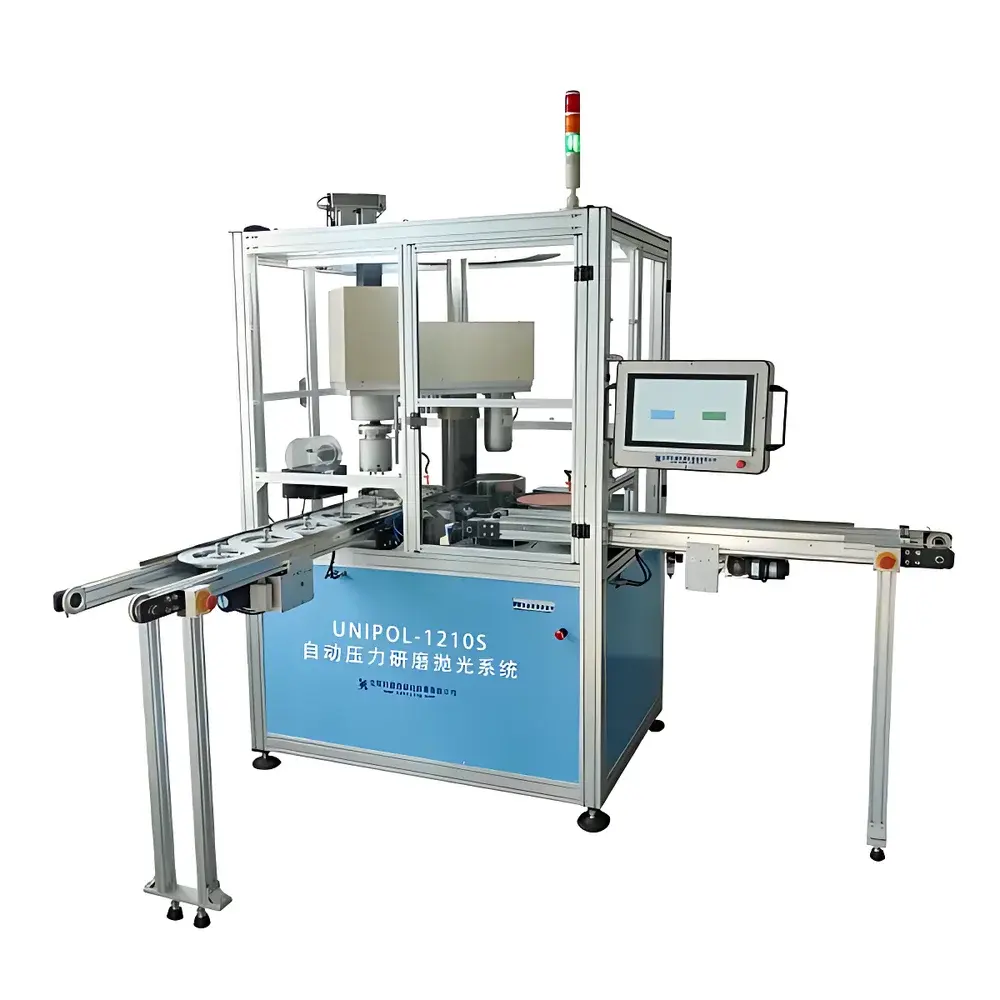
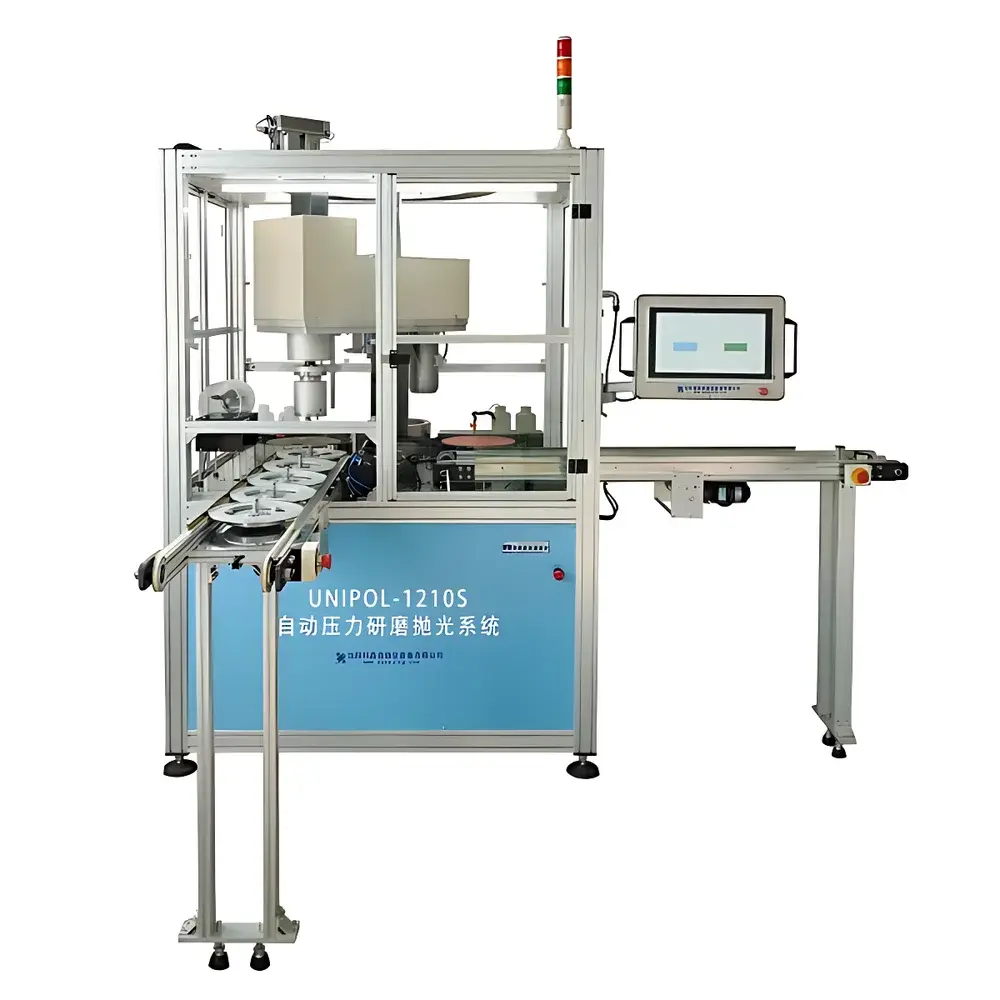
KJ GROUP UNIPOL-1210S Automated Pressure-Controlled Grinding and Polishing System
| Brand | KJ GROUP |
|---|---|
| Origin | Liaoning, China |
| Manufacturer Type | Authorized Distributor |
| Country of Origin | China |
| Model | UNIPOL-1210S |
| Dimensions (H×W×D) | 2.6 m × 2.6 m × 2.6 m |
| Number of Grinding/Polishing Plates | 1 |
| Plate Diameter | 160 mm |
| Power Supply | 220 V, 50 Hz |
| Pneumatic Source | 0.1–0.7 MPa |
| Water Supply | External reservoir (user-provided) |
| Pressure Spindle Speed | 10–100 rpm |
| Pressure Range (Spindle Load) | 0.1–30 kg |
| Grinding Station Speed | 10–300 rpm |
| Polishing Station Speed | 10–300 rpm |
| Specimen Holder Capacity | Up to five Φ160 mm samples |
| Sample Conveyor Belt | 1650 mm × 300 mm (infeed/outfeed) |
Overview
The KJ GROUP UNIPOL-1210S Automated Pressure-Controlled Grinding and Polishing System is an industrial-grade, programmable sample preparation platform engineered for high-precision planarization of hard and brittle materials in research laboratories and small-batch production environments. Utilizing a dual-axis rotational architecture with independent speed and force control, the system implements controlled mechanical abrasion through sequential coarse grinding, fine grinding, and final polishing stages—each governed by reproducible pressure application via pneumatic actuation. Its design adheres to fundamental principles of material removal kinetics, where surface integrity, subsurface damage minimization, and edge retention are optimized through regulated spindle load (0.1–30 kg), rotational velocity modulation (10–300 rpm across stations), and consistent slurry delivery. The system is particularly suited for preparing cross-sectional specimens for electron microscopy (SEM/TEM), metallographic analysis (ASTM E3, ISO 643), and failure analysis workflows requiring low-damage, flat, and parallel surfaces.
Key Features
- Automated pressure regulation via precision pneumatic control system (0.1–0.7 MPa input), enabling repeatable load application from 0.1 kg to 30 kg on the pressure spindle—critical for minimizing subsurface deformation in ceramics and single-crystal wafers.
- Dual independent motor drives: one for the pressure spindle (10–100 rpm) and another for the grinding/polishing plate (10–300 rpm), allowing decoupled speed optimization per process stage.
- Integrated conveyor belt (1650 mm × 300 mm) supports automated infeed and outfeed of Φ160 mm specimen holders—up to five simultaneously—reducing manual handling and improving throughput consistency.
- Modular consumables interface compatible with standard 160 mm diamond-impregnated grinding discs, silicon carbide papers, and cloth-based polishing pads (e.g., velvet, synthetic napped fabrics), supporting both aqueous and oil-based slurries.
- Robust steel frame construction with vibration-dampened base and sealed electrical cabinet (IP54-rated), ensuring operational stability in shared lab environments with variable ambient conditions.
- Front-access service panel and tool-free consumable mounting facilitate routine maintenance, alignment verification, and quick plate replacement without specialized calibration tools.
Sample Compatibility & Compliance
The UNIPOL-1210S accommodates a broad spectrum of rigid, non-ductile, and semi-ductile materials including ferrous and non-ferrous metals (e.g., stainless steel, aluminum alloys, titanium), oxide and nitride ceramics (Al₂O₃, Si₃N₄, ZrO₂), optical glasses (BK7, fused silica), geological specimens (granite, basalt, quartzite), and semiconductor substrates (Si, GaAs, sapphire). It supports standardized preparation protocols aligned with ASTM E3-22 (Standard Guide for Preparation of Metallographic Specimens), ASTM B769-21 (Shear Strength Testing of Adhesives), and ISO 148-1:2016 (Charpy Impact Testing—specimen machining). While not certified to FDA 21 CFR Part 11 or GLP/GMP out-of-the-box, its programmable parameter logging (via optional RS-232/USB data export) enables traceability suitable for internal QA documentation and audit readiness.
Software & Data Management
The system operates via a dedicated embedded controller with a 7-inch resistive touchscreen HMI. Process parameters—including spindle pressure setpoint, rotational speeds for both axes, dwell time per stage, and total cycle count—are stored in non-volatile memory with up to 99 user-defined programs. Real-time status indicators display actual pressure feedback (via integrated load cell), RPM deviation (< ±1.5%), and pneumatic line pressure. All program executions generate timestamped logs (date/time, operator ID, program name, final surface roughness estimate based on cycle completion), exportable as CSV files for integration into LIMS or electronic lab notebooks. No cloud connectivity or remote access is implemented—data remains locally resident to meet institutional IT security policies.
Applications
- Preparation of TEM lamellae and SEM cross-sections from bulk ceramic composites and multilayer thin-film stacks.
- Routine metallographic evaluation of heat-treated steels and weld zones per ASTM E112 (grain size determination).
- Surface planarization of rock core samples prior to micro-CT scanning or geochemical microprobe analysis.
- Finishing of optical components (lenses, prisms) requiring λ/10 surface flatness and sub-5 nm Ra roughness.
- Batch processing of small-volume production parts in R&D pilot lines for automotive or aerospace component qualification.
FAQ
What types of consumables are compatible with the UNIPOL-1210S?
Standard 160 mm diameter grinding discs (diamond, SiC), lapping films, and polishing cloths—available in both adhesive-backed and clamp-mounted configurations—are fully supported.
Is water cooling integrated into the system?
No. The unit requires an external water reservoir and gravity-fed or low-pressure pump delivery to the grinding zone; cooling flow rate and temperature are managed externally.
Can the system be used for soft materials like polymers or biological tissues?
Not recommended. Its pressure range and mechanical abrasion profile are optimized for hardness values ≥200 HV; softer materials require low-force, vibration-assisted systems.
Does the UNIPOL-1210S support automatic endpoint detection?
No. Endpoint determination relies on pre-established time-based cycles or post-process metrology (e.g., profilometry, interferometry); no in-situ thickness or reflectance sensors are included.
What safety certifications does the equipment carry?
It complies with CE marking requirements for machinery (2006/42/EC) and EMC Directive (2014/30/EU); full test reports are available upon request from KJ GROUP’s technical documentation portal.



