
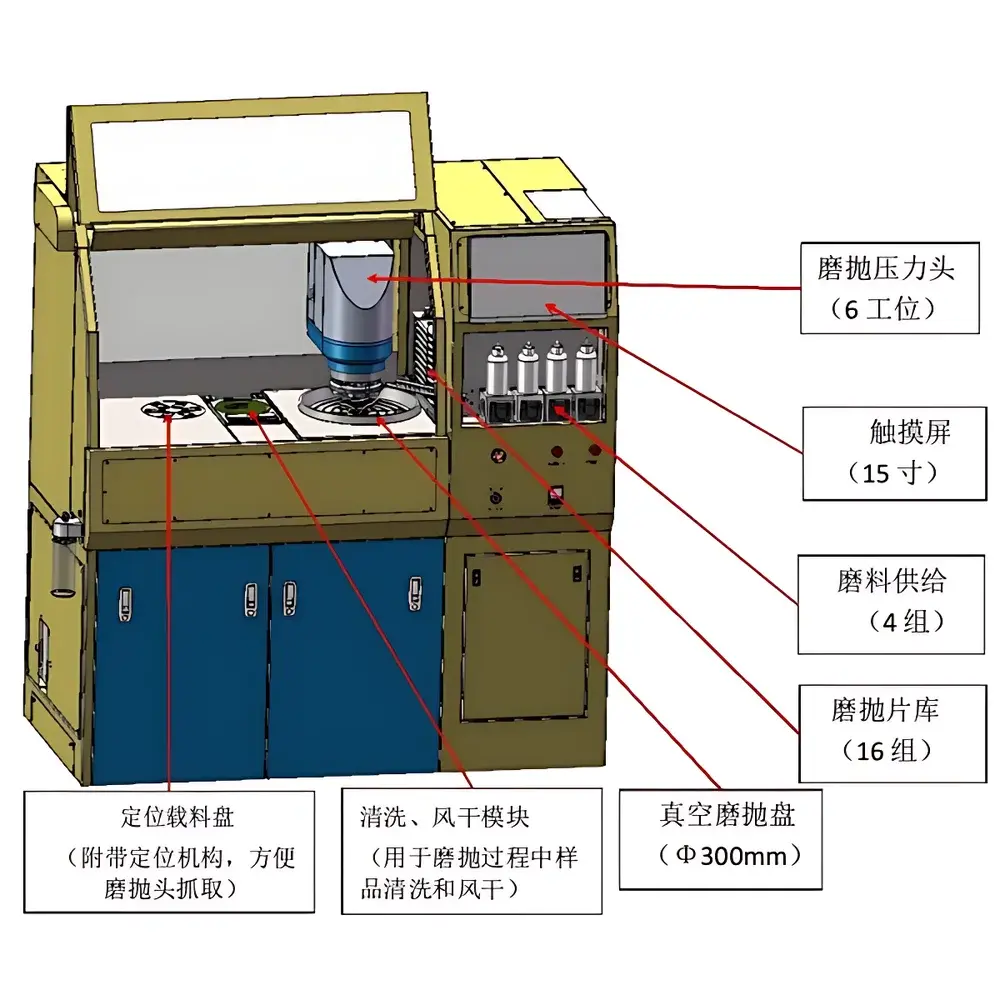
KJ GROUP UNIPOL-1220M Fully Automated Metallographic Grinding and Polishing System
| Brand | KJ GROUP |
|---|---|
| Origin | Liaoning, China |
| Manufacturer Type | Direct Manufacturer |
| Origin Category | Domestic (China) |
| Model | UNIPOL-1220M |
| Pricing | Upon Request |
| Sample Diameter | Φ25 mm |
| Platen Diameter | Φ300 mm |
| Max Simultaneous Samples | 6 |
| Pressure Head Speed | 10–60 rpm |
| Sample Pressure per Station | 10–50 N |
| Platen Speed | 50–300 rpm |
| Abrasive/Pad Magazine Capacity | 16 positions |
| Dispenser Modules | 4 independent fluid delivery channels |
| Cleaning Method | Ultrasonic + Air-Drying Module |
| Dimensions (W×D×H) | 1650 × 800 × 1750 mm |
| Water Supply | Clean water, 0.3–0.4 MPa |
| Compressed Air | ≥0.7 MPa, 5 µm filtration |
| Ventilation | Required for safe operation |
Overview
The KJ GROUP UNIPOL-1220M Fully Automated Metallographic Grinding and Polishing System is an integrated, programmable sample preparation platform engineered for high-reproducibility metallographic specimen preparation in research laboratories, quality control facilities, and industrial R&D environments. Based on a dual-platen rotational grinding-polishing architecture with pneumatic single-point loading and synchronized motion control, the system executes standardized ASTM E3, ISO 1127, and GB/T 13298-compliant preparation sequences—including coarse grinding, fine grinding, pre-polishing, and final polishing—without manual intervention. Its modular design integrates a robotic sample handler, multi-position abrasive/media magazine, precision fluid dispensing system, ultrasonic cleaning station, and forced-air drying module into a single footprint. The system is purpose-built for materials requiring strict microstructural fidelity: ferrous and non-ferrous metals, sintered ceramics, geological thin sections, semiconductor wafers, and electronic packaging substrates.
Key Features
- Fully automated workflow from specimen loading to final polish and drying—no operator involvement during cycle execution.
- Robotic gripper arm with positional repeatability ±0.1 mm, enabling precise alignment of Φ25 mm specimens onto the Φ300 mm grinding/polishing platen.
- Independent speed control of upper pressure head (10–60 rpm) and lower platen (50–300 rpm), supporting low-speed/high-torque regimes critical for brittle or layered materials.
- Pneumatically actuated, digitally regulated load application (10–50 N per sample) via calibrated needle valve—ensuring consistent material removal rates across heterogeneous batches.
- 16-slot consumables magazine accommodates graded SiC papers, diamond-impregnated pads, and colloidal silica cloths; automatic tool change executed under closed-loop position feedback.
- Four independently programmable liquid dispensers deliver water, lubricants, diamond suspensions, or electrolytic slurries at defined flow rates and timing windows.
- Integrated ultrasonic cleaning bath (40 kHz) followed by warm-air drying eliminates cross-contamination between preparation stages and prevents residue carryover.
- 10.1-inch capacitive touchscreen HMI with intuitive drag-and-drop recipe builder, real-time cycle monitoring, and audit-trail-enabled parameter logging.
Sample Compatibility & Compliance
The UNIPOL-1220M supports standardized preparation of metallic alloys (e.g., aluminum 6061, stainless steels, titanium Ti-6Al-4V), advanced ceramics (Al₂O₃, ZrO₂, SiC), geological samples (granite, basalt, shale thin sections), and microelectronic materials (PCB laminates, solder joints, MEMS devices). All operational parameters—including dwell time, pressure ramp profiles, slurry delivery schedules, and rotational direction sequencing—are configurable to align with ASTM E3-22 (Standard Guide for Preparation of Metallographic Specimens), ISO 15510 (Metallographic Examination of Metallic Materials), and internal GLP/GMP documentation requirements. The system’s event-driven data logger records timestamped parameter sets per specimen, satisfying traceability needs for ISO/IEC 17025-accredited labs.
Software & Data Management
The embedded control software (v4.2+) features password-protected user roles (Operator, Technician, Administrator), encrypted recipe storage (>500 programmable protocols), and exportable CSV logs containing force curves, RPM histories, fluid volume consumed, and cycle completion timestamps. Optional Ethernet/IP or Modbus TCP connectivity enables integration into Lab Information Management Systems (LIMS) and centralized instrument monitoring dashboards. Software complies with FDA 21 CFR Part 11 requirements for electronic records and signatures when configured with audit trail activation and digital signature authentication.
Applications
- High-throughput metallographic lab workflows requiring >50 specimens/day with inter-operator variance <3% in scratch density and phase contrast uniformity.
- Failure analysis labs preparing cross-sections of solder joints, wire bonds, or thermal interface materials for SEM/EDS characterization.
- Geoscience core analysis where mineral grain boundary integrity must be preserved during thin-section polishing.
- Automotive and aerospace QC labs validating heat treatment homogeneity across batch-forged components.
- Academic metallurgy research involving comparative studies of grain refinement mechanisms under varied polishing kinetics.
FAQ
Does the UNIPOL-1220M support custom platen sizes or non-standard specimen diameters?
No—the system is mechanically optimized for Φ25 mm specimens and Φ300 mm platens; deviation requires hardware modification not covered under warranty.
Can the ultrasonic cleaning module be bypassed for solvent-based cleaning protocols?
Yes—cleaning sequence logic is fully programmable; users may deactivate ultrasonics and activate only air-drying or external rinse nozzles.
Is remote diagnostics or firmware update capability available?
Yes—via optional secure VPN connection; firmware updates require technician-level credentials and undergo checksum validation prior to installation.
What maintenance intervals are recommended for pneumatic and fluidic subsystems?
Compressed air filters require replacement every 6 months; fluid dispenser tubing and check valves should be inspected quarterly; platen surface flatness verification is advised annually using optical interferometry.
How does the system ensure force consistency across all six stations during multi-sample runs?
Each station employs individual pressure transducers and closed-loop PID control; real-time force deviation >±2% triggers automatic cycle pause and alert notification.



