
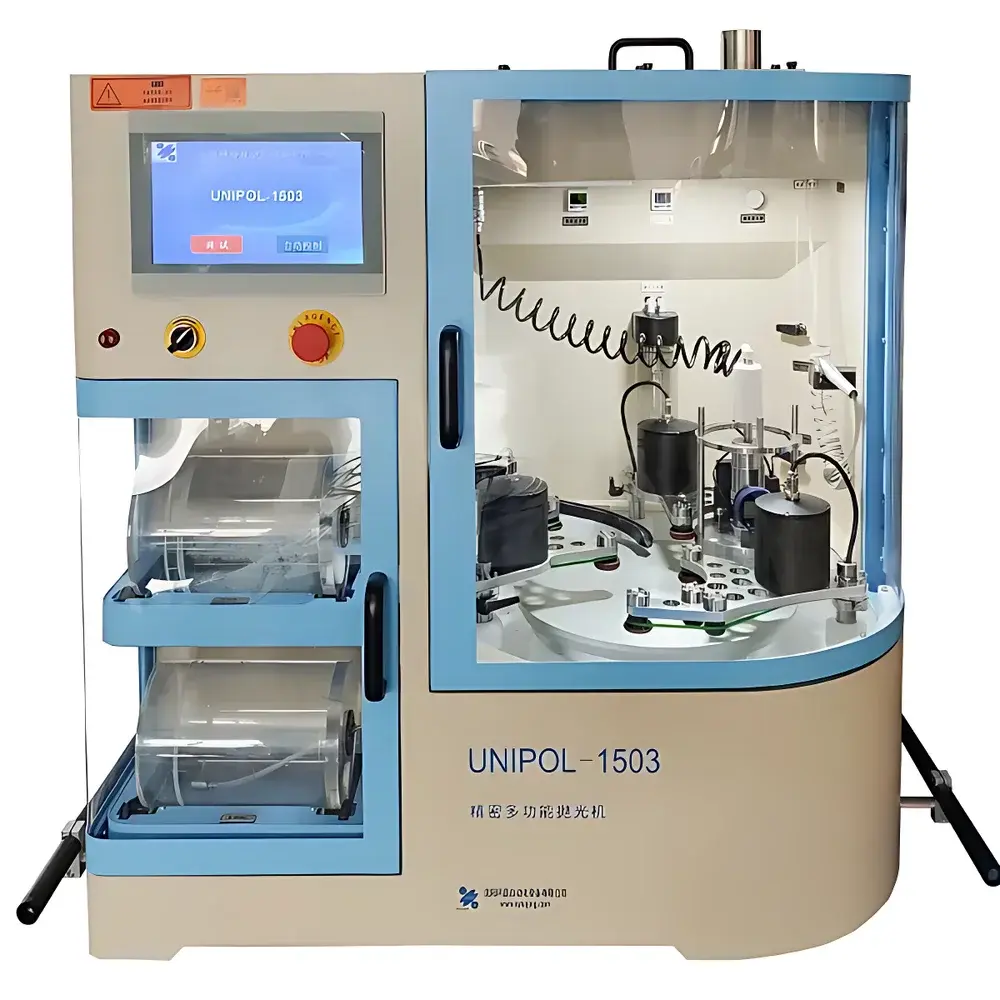
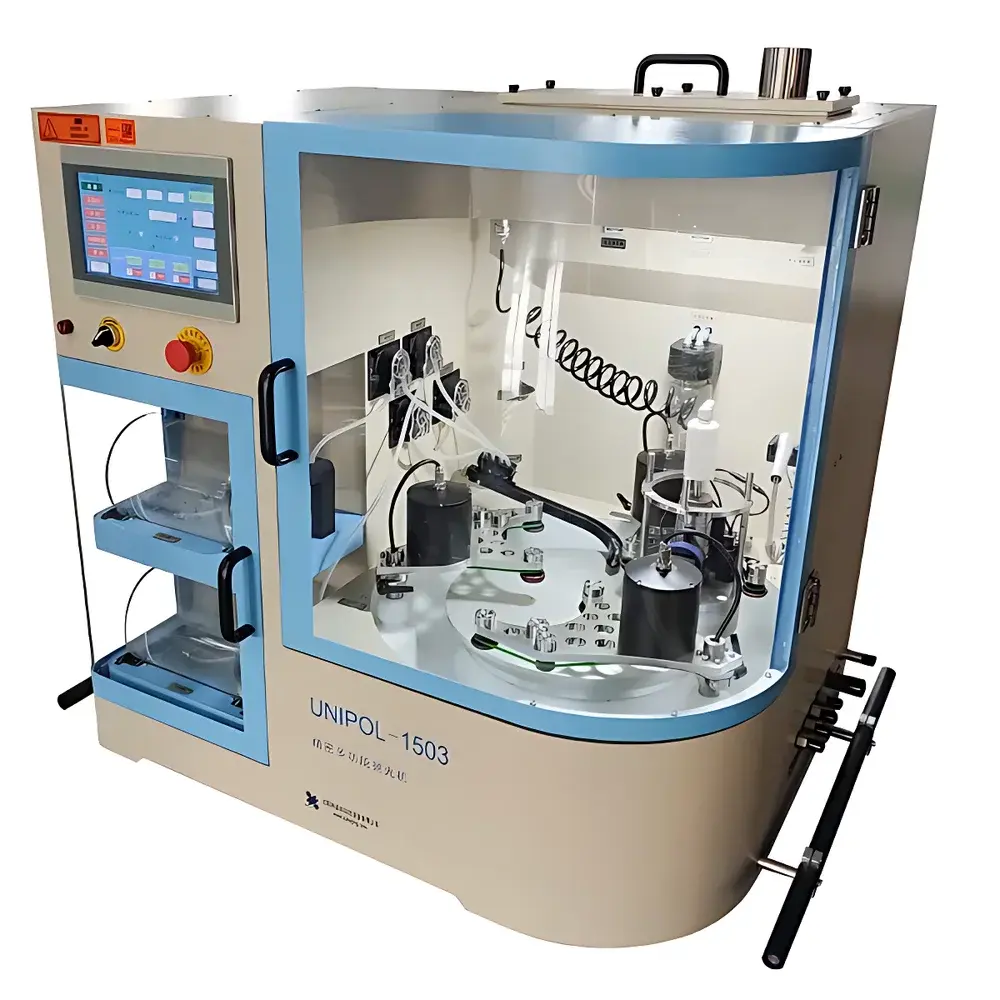
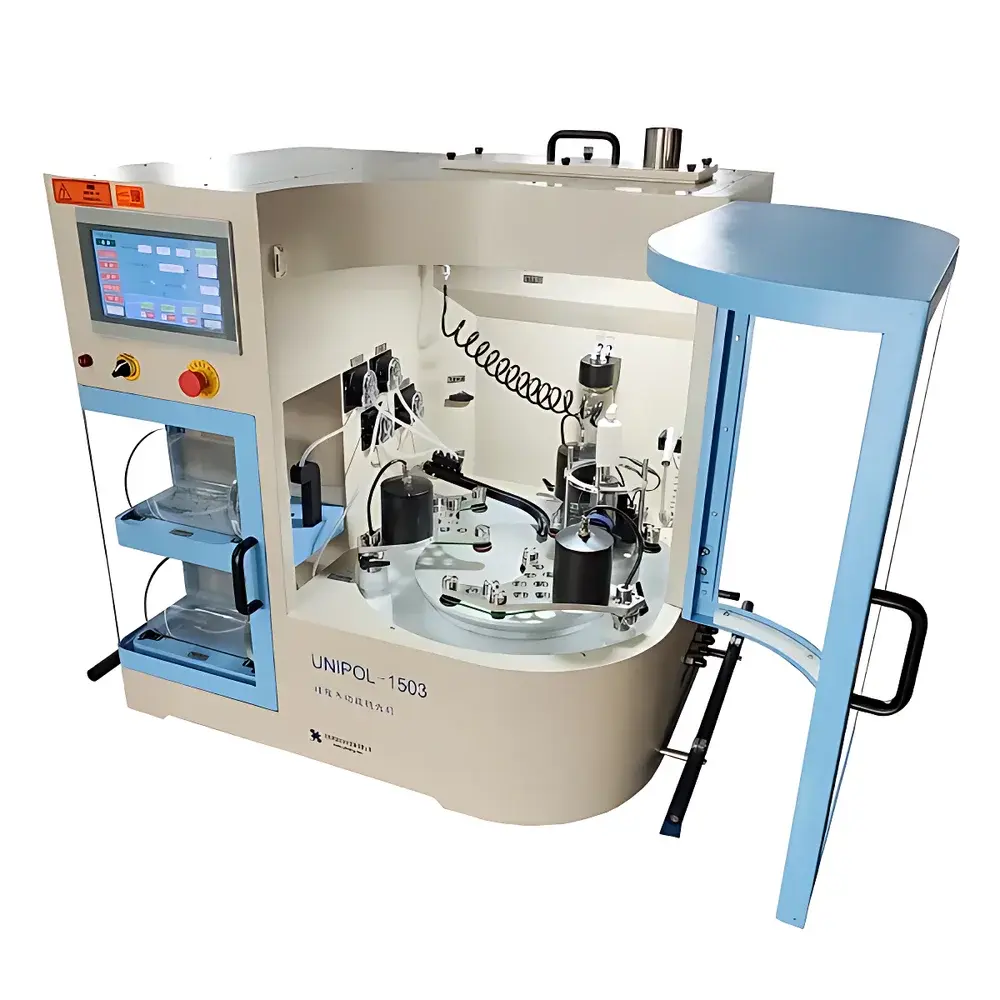
KJ GROUP UNIPOL-1503 Precision Multi-Function Lapping and Polishing System
| Brand | KJ GROUP |
|---|---|
| Origin | Liaoning, China |
| Manufacturer Type | Direct Manufacturer |
| Model | UNIPOL-1503 |
| Rotational Speed | 5–125 rpm |
| Platen Diameter | Ø381 mm |
| Number of Platens | 1 |
| Dimensions (L×W×H) | 1030 mm × 790 mm × 1050 mm |
| Sample Capacity | Up to 4-inch wafers |
| Workstations | 3 lapping/polishing stations + 2 slurry mixing stations |
| Control Interface | 10-inch integrated touchscreen |
| Slurry Delivery | 4 peristaltic pumps (0.1–20 rpm), dual 500 mL reservoirs |
| Air/Vacuum Interfaces | Vacuum pump (≥70 L/min), compressed air (≤0.2 MPa) |
| Compliance | Designed for ISO/IEC 17025-aligned lab environments |
Overview
The KJ GROUP UNIPOL-1503 Precision Multi-Function Lapping and Polishing System is an engineered solution for high-fidelity sample preparation in materials science laboratories. It operates on the principle of controlled mechanical abrasion—employing rotational lapping combined with programmable oscillatory motion and precise slurry delivery—to achieve sub-micron surface planarity and thickness uniformity across brittle and ductile substrates. Unlike conventional single-station polishers, the UNIPOL-1503 integrates three independent lapping/polishing workstations, two dedicated slurry mixing stations, and a Bluetooth-enabled thickness monitoring module—enabling closed-loop, endpoint-controlled thinning of optical crystals, semiconductor wafers, and advanced ceramics. Its architecture supports both manual process development and automated, repeatable protocols essential for R&D reproducibility and QC validation.
Key Features
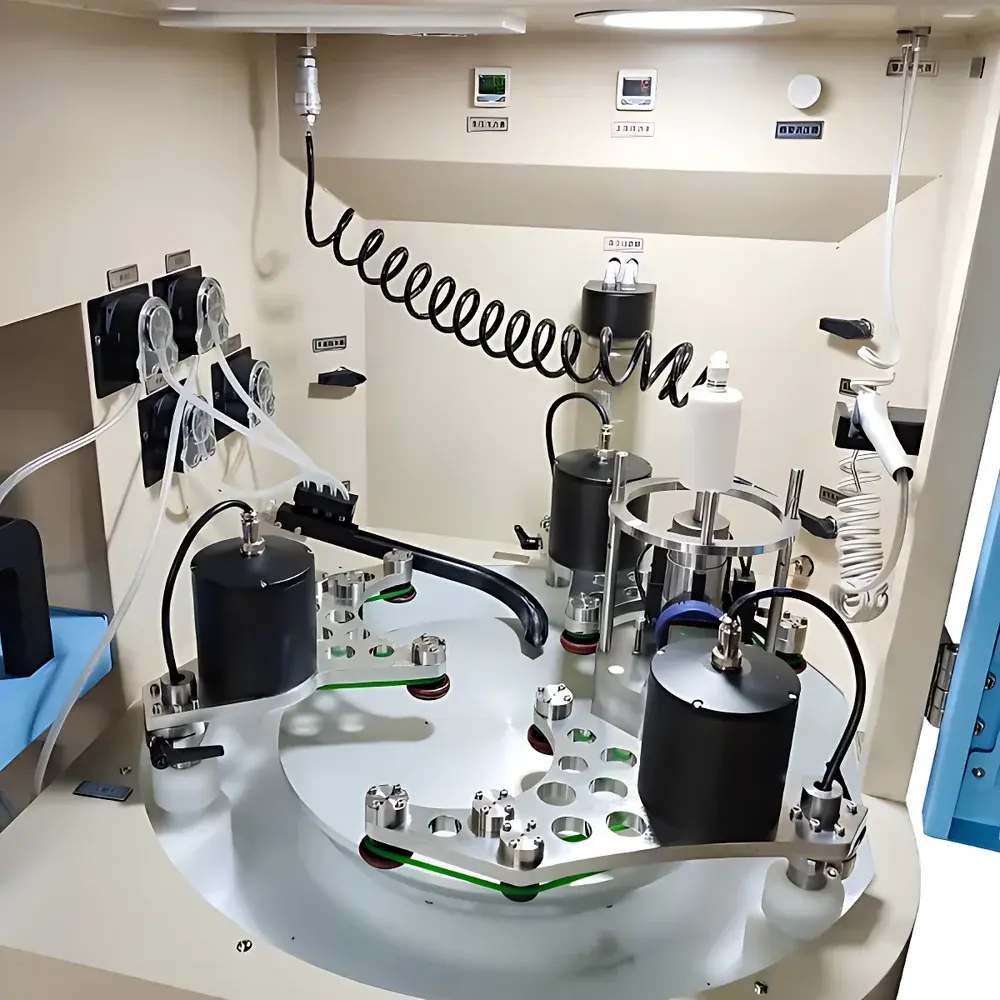
- Triple-station lapping/polishing configuration with independent motion control per station, supporting simultaneous multi-sample processing or sequential multi-step protocols.
- Ø381 mm cast-iron and aluminum platens with flatness tolerance ≤3 µm over full diameter—certified for consistent material removal rate (MRR) distribution.
- Programmable oscillatory arm (3–10 speed settings, max ≈10 cycles/min) with stepper-motor-driven active wheel (1–300 rpm), enabling variable contact pressure and trajectory optimization for fragile substrates.
- Integrated 10-inch industrial-grade touchscreen HMI with real-time parameter logging, user-defined recipe storage (≥100 profiles), and timestamped operation history—compliant with basic audit trail requirements under GLP frameworks.
- Dual 1.4 L slurry mixing stations operating at 5–30 rpm, coupled with four independently controllable peristaltic pumps (0.1–20 rpm) and dual 500 mL suspension reservoirs for stable, bubble-free abrasive delivery.
- Bluetooth-enabled precision control module (standard on Station 1) featuring vacuum-chuck fixation (Φ103 mm), real-time thickness feedback via external metrology integration, and automatic process termination upon reaching target dimension.
- High-efficiency filtration exhaust system with HEPA-grade particulate capture and optional inert gas purging port (N₂/Ar) for oxygen-sensitive materials such as GaAs, InP, or lithium niobate.
Sample Compatibility & Compliance
The UNIPOL-1503 accommodates a broad spectrum of hard and composite materials, including but not limited to silicon, germanium, ZnS, ZnSe, sapphire, fused silica, alumina, tungsten carbide, PCB laminates, geological thin sections, and refractory composites. Maximum supported sample diameter is 100 mm (4-inch), with standard load plates accommodating up to Φ110 mm specimens. All wet-process components—including fluid paths, reservoirs, and pump tubing—are chemically resistant to common polishing slurries (colloidal silica, alumina, ceria) and mild acids used in post-lapping cleaning. The system meets ambient environmental specifications per IEC 61000-6-2 (immunity) and IEC 61000-6-4 (emission); its electrical interface complies with GB/T 17025 and aligns with infrastructure prerequisites for ISO/IEC 17025-accredited testing laboratories. While not FDA 21 CFR Part 11 certified out-of-the-box, its data logging architecture supports third-party validation for regulated environments when paired with qualified electronic record systems.
Software & Data Management
The embedded control firmware provides non-volatile storage of operational parameters—including rotational speed, oscillation frequency, slurry flow rate, duration, and endpoint criteria—with automatic timestamping and user ID tagging. Exportable logs (CSV format) include MRR-calculated estimates derived from time-based thickness change inputs. The touchscreen interface supports password-protected user roles (Operator, Technician, Administrator) and allows export of process reports via USB. For traceability, all parameter modifications are logged with pre-change/post-change values. Optional API integration (RS-485/Modbus RTU) enables centralized lab equipment monitoring within existing LIMS or MES platforms. Firmware updates are delivered via secure USB media—not over unsecured networks—to maintain integrity in validated settings.
Applications
- Semiconductor R&D: Controlled thinning of SOI wafers, compound semiconductor substrates (GaN, SiC), and MEMS device layers prior to TEM cross-sectioning.
- Infrared Optics Fabrication: Planarization of ZnS, ZnSe, and Ge windows with minimal subsurface damage for laser transmission applications.
- Geological Petrography: Preparation of ultra-flat thin sections (<30 µm) from silicate, carbonate, and metamorphic rock samples for quantitative mineralogical analysis.
- Advanced Ceramics QA: Surface conditioning of Al₂O₃, Si₃N₄, and ZrO₂ components to meet ASTM C1327-22 surface roughness specifications prior to hardness or fracture toughness testing.
- PCB Failure Analysis: Delayering of multilayer boards with precise stop-on-copper or stop-on-dielectric capability using endpoint feedback.
FAQ
What is the maximum sample thickness reduction accuracy achievable with the Bluetooth thickness feedback module?
The module itself does not measure thickness directly—it interfaces with externally calibrated metrology tools (e.g., SKCH-1 precision thickness gauge). Accuracy depends on the connected instrument’s specification (typically ±0.1 µm for contact-type gauges).
Can the UNIPOL-1503 operate without the Bluetooth module?
Yes. All core lapping/polishing functions—including time-based and manual endpoint control—are fully operational without Bluetooth connectivity.
Is vacuum filtration integrated into the base unit?
A vacuum filtration tank is included as standard; users must supply a compatible vacuum pump (≥70 L/min, oil-free recommended for cleanroom use).
Are replacement platens and consumables available through KJ GROUP global distribution partners?
Yes. Cast-iron platens, aluminum platens, repair rings (Φ143 mm), and Φ110 mm load plates are stocked items with documented dimensional tolerances and surface finish certifications.
Does the system support remote diagnostics or firmware updates over network?
No. Firmware updates require physical USB media to ensure integrity and prevent unauthorized modification—consistent with laboratory cybersecurity best practices for instrument control systems.
Related Products



