
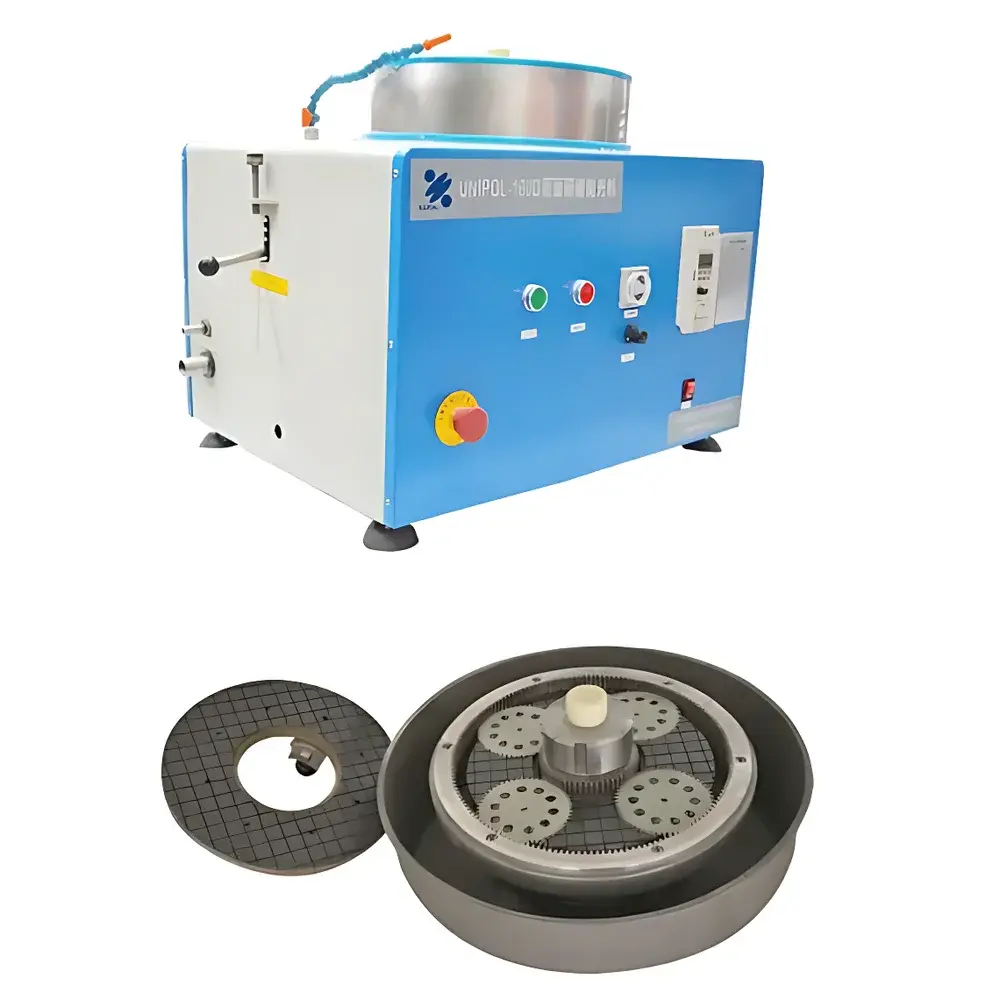
KJ GROUP UNIPOL-160D Dual-Side Lapping and Polishing Machine
| Brand | KJ GROUP |
|---|---|
| Origin | Liaoning, China |
| Model | UNIPOL-160D |
| Dimensions (L×W×D) | 650 mm × 500 mm × 580 mm |
| Number of Lapping/Polishing Plates | 1 |
| Plate Diameter | Ø225 mm |
| Rotational Speed | 0–72 rpm, continuously variable |
Overview
The KJ GROUP UNIPOL-160D Dual-Side Lapping and Polishing Machine is an engineered precision instrument designed for controlled, parallel double-sided material removal and surface finishing of flat, disc-shaped specimens. It operates on the principle of planetary motion lapping—where a central carrier (sun wheel) rotates at a defined speed while upper and lower lapping plates rotate independently at differential angular velocities. This velocity differential generates relative shear motion between the specimen surface and abrasive media, enabling uniform material removal across both faces simultaneously. The system is optimized for high-precision thickness control, parallelism maintenance (typically ≤1 µm TIR over Ø50 mm), and minimal subsurface damage—critical for preparing optical windows, semiconductor wafers, piezoelectric substrates, and geological thin sections. Its robust cast-iron frame, gear-driven triple-axis transmission (upper plate, sun wheel, lower plate), and AC inverter-controlled motor ensure stable torque delivery and long-term repeatability under load.
Key Features
- Triple-axis independent rotational control via gear-coupled planetary drive system: upper plate, sun wheel, and lower plate operate at programmable speed ratios to optimize material removal rate and surface flatness.
- Continuously variable speed range from 0 to 72 rpm with manual frequency adjustment of the AC inverter—enabling fine-tuned process optimization for soft metals (e.g., Cu, Al), hard ceramics (e.g., Al₂O₃, SiC), and brittle single crystals (e.g., Si, Ge, quartz).
- Standard capacity for up to four Ø50 mm (2-inch) specimens per cycle; compatible with custom-machined specimen carriers for non-standard geometries or stacked configurations.
- Dual-mode operation: configurable for lapping (using bonded diamond or silicon carbide abrasives) or polishing (with suspended colloidal silica, alumina, or diamond slurries on synthetic leather or polyurethane pads).
- Integrated mechanical counterweight system for upper plate (1.3 kg / 1.6 kg / 2.0 kg selectable rings) to maintain consistent downforce without hydraulic or pneumatic components—reducing maintenance complexity and improving process transparency.
- Timer-based batch control with countdown function supports reproducible cycle durations; all operational parameters are manually set and mechanically locked—ensuring full traceability in GLP-compliant environments.
Sample Compatibility & Compliance
The UNIPOL-160D accommodates rigid, planar specimens up to 50 mm in diameter and 15 mm in thickness—including monocrystalline silicon and germanium wafers, sapphire and quartz optical blanks, ceramic substrates (AlN, ZnO), metallurgical cross-sections, and petrographic thin sections. Specimens are secured within precision-machined phenolic resin carrier gears mounted on the sun wheel, minimizing edge chipping and ensuring concentric rotation. The machine meets general laboratory safety requirements per IEC 61010-1 and conforms to electromagnetic compatibility standards EN 61326-1. While not certified for ISO 17025 or FDA 21 CFR Part 11 out-of-the-box, its deterministic mechanical control architecture supports audit-ready documentation when paired with external calibrated thickness gauges (e.g., SKCH-1A) and slurry dispensing systems (e.g., SZKD-2/SZKD-3).
Software & Data Management
The UNIPOL-160D is a standalone electromechanical system with no embedded microprocessor or digital interface. All operational parameters—including speed setting, run time, and weight configuration—are set manually via front-panel controls and physical dials. This design eliminates firmware dependencies, software validation overhead, and cybersecurity exposure—making it suitable for regulated QC labs where deterministic, repeatable mechanical processes are preferred over algorithmic automation. Process records (e.g., operator ID, start/end time, speed, duration, carrier type) are maintained externally using lab notebooks or LIMS-integrated forms. Optional accessories such as the SKCH-1A digital thickness gauge provide RS-232 output for automated data logging into third-party analysis platforms.
Applications
- Preparation of semiconductor-grade Si, Ge, GaAs, and InP wafers for TEM cross-sectioning and XRD analysis.
- Thickness reduction and planarization of optical crystal blanks prior to coating or bonding.
- Production of geologically representative thin sections (30 µm) from rock and mineral samples for petrographic microscopy.
- Surface conditioning of metallographic specimens for grain structure analysis under ASTM E3 and ISO 643.
- R&D-scale fabrication of MEMS substrates requiring sub-micron parallelism and low-stress surface integrity.
- Quality assurance lapping of ceramic insulators and piezoelectric transducer elements prior to electrical testing.
FAQ
What is the maximum specimen thickness supported by the UNIPOL-160D?
The machine accepts specimens up to 15 mm thick, provided they remain rigid and flat under applied pressure during processing.
Does the system support automatic slurry dispensing?
No—the UNIPOL-160D does not include integrated fluid delivery. Slurry application must be performed manually or via optional external dispensers (e.g., SZKD-2 or SZKD-3).
Can the upper and lower plates rotate in opposite directions?
Yes—the gear train allows independent direction selection for upper and lower plates, enabling advanced shear-mode lapping protocols.
Is the machine compatible with vacuum chucks or magnetic carriers?
Standard configuration uses mechanical carrier gears; however, custom carrier designs—including vacuum-assisted or ferromagnetic variants—can be developed upon request.
What cooling method is required during extended operation?
Continuous tap water flow through the supplied inlet/outlet ports is mandatory for thermal management of the motor and gearbox; a recirculating chiller is recommended for >4-hour continuous runs.
Related Products



