
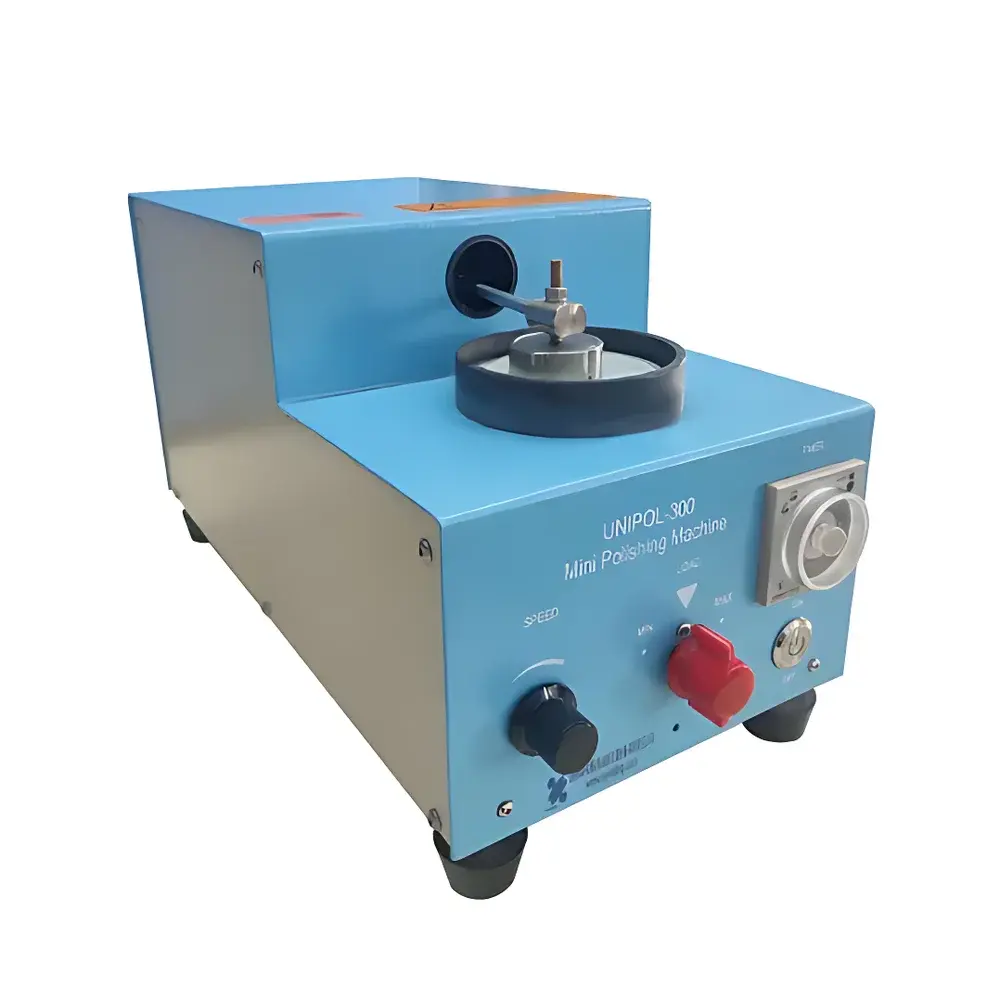
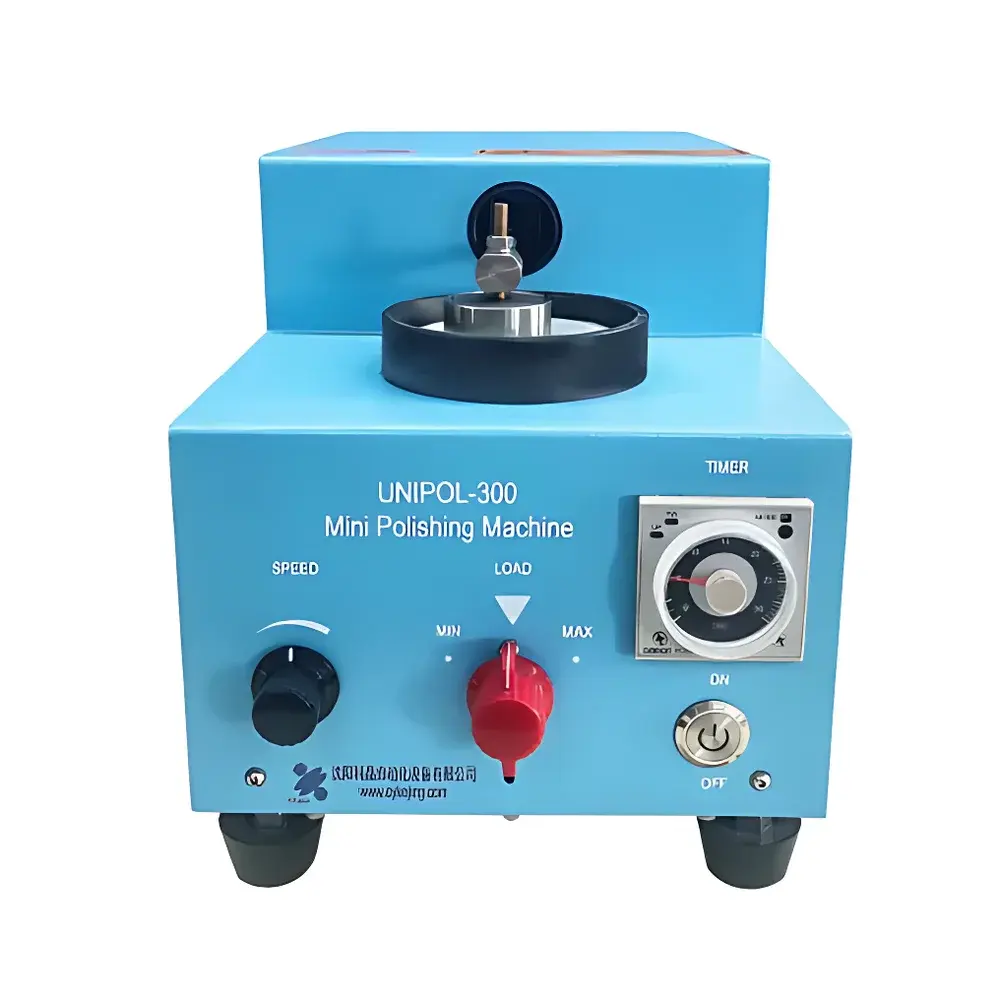
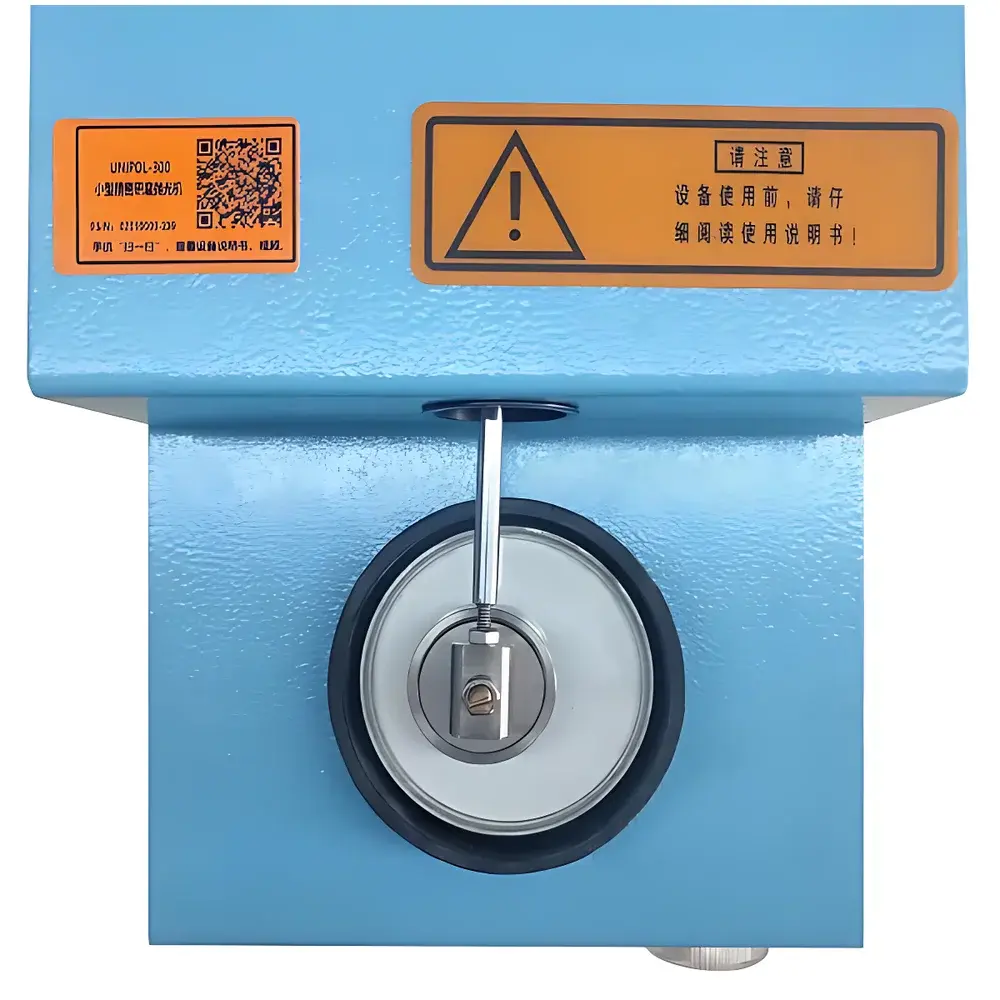
KJ GROUP UNIPOL-300 Precision Grinding and Polishing Machine
| Brand | KJ GROUP |
|---|---|
| Origin | Liaoning, China |
| Manufacturer Type | Authorized Distributor |
| Country of Origin | China |
| Model | UNIPOL-300 |
| Dimensions (L×W×D) | 400 mm × 200 mm × 230 mm |
| Grinding Plate Count | 1 |
| Grinding Plate Diameter | 70 mm |
| Rotational Speed | 0–160 rpm |
| Sample Holder Diameter | 30 mm |
| Maximum Sample Diameter | 30 mm |
| Maximum Sample Thickness | 2 mm |
| Pressure Range (adjustable) | 0.55–1.05 kg (5.4–10.3 N) |
| Oscillation Frequency of Sample Holder | 0–280 cycles/min |
| Motor | DC 24 V, 10 W, 50 rpm nominal |
| Power Input | DC 24 V, 2.5 A |
| Total Power Consumption | 25 W |
| Operating Temperature | 0–45 °C |
| Relative Humidity | 10–85 % RH (non-condensing at 25 °C) |
| Weight | 11 kg |
Overview
The KJ GROUP UNIPOL-300 Precision Grinding and Polishing Machine is an electromechanically controlled, single-station laboratory instrument engineered for high-accuracy thinning and surface finishing of small-scale specimens—particularly those destined for transmission electron microscopy (TEM), scanning electron microscopy (SEM), and optical metallography. Unlike conventional rotary polishing systems, the UNIPOL-300 employs a unique orbital “figure-eight” motion of the sample holder relative to a stationary grinding plate, replicating manual polishing kinematics while eliminating operator-induced variability. This motion—combined with precisely regulated normal force and speed—enables reproducible material removal rates across heterogeneous and brittle materials without edge rounding or subsurface damage. The system operates on a low-power DC drive architecture (24 V, 25 W total), ensuring thermal stability during extended runs and compatibility with standard lab power infrastructure. Its compact footprint (400 × 200 × 230 mm) and lightweight design (11 kg) allow seamless integration into confined cleanroom workspaces, gloveboxes, or shared TEM preparation suites.
Key Features
- Orbital “figure-eight” sample motion driven by a precision DC motor (50 rpm nominal), minimizing directional artifact formation and enhancing planarity control.
- Adjustable downward pressure (0.55–1.05 kg / 5.4–10.3 N) via calibrated spring mechanism—no hydraulic or pneumatic components required—ensuring consistent load application without risk of overloading fragile specimens.
- Independent, continuous adjustment of both oscillation frequency (0–280 cycles/min) and rotational equivalence (0–160 rpm effective), enabling optimization for hard ceramics, soft polymers, or layered composites.
- Digital timer-based operation with automatic shutdown upon completion—supports unattended overnight thinning protocols critical for TEM lamella preparation.
- Modular sample holder (Φ30 mm) compatible with standard TEM stubs, metallurgical mounts, and custom fixtures; optional accessories include heated platforms (HEATER-3040), precision thickness gauges (SKCH-1(A)), and inert-gas drying stations (SKCS-1).
- Robust aluminum alloy chassis with vibration-dampening feet; designed for stable operation on standard laboratory benches rated ≥50 kg load capacity.
Sample Compatibility & Compliance
The UNIPOL-300 accommodates a broad spectrum of inorganic and organic solid-state materials—including single crystals (Si, Ge, ZnSe, ZnS), optical glasses, sintered ceramics, refractory metals, geological thin sections, PCB substrates, and fiber-reinforced composites. Its low-force, low-heat protocol preserves phase integrity in temperature-sensitive specimens (e.g., perovskites, MOFs, or polymer blends) and avoids amorphization artifacts common in high-rpm mechanical thinning. While not certified to ISO/IEC 17025 or ASTM E3-22 as a standalone metrology tool, the instrument supports GLP-compliant documentation when integrated with external calibration logs and time-stamped process records. All electrical components comply with IEC 61010-1:2010 safety standards for laboratory equipment; CE marking applies via distributor conformity assessment.
Software & Data Management
The UNIPOL-300 operates via hardware-integrated push-button controls with LED status indicators—no embedded firmware, touchscreen, or proprietary software stack. This design eliminates cybersecurity vulnerabilities, reduces maintenance overhead, and ensures long-term operational continuity independent of OS updates or vendor licensing. Process parameters (time, pressure setting, oscillation rate) are manually recorded by users in laboratory notebooks or LIMS-compatible spreadsheets. For traceability-critical applications (e.g., failure analysis in semiconductor QA labs), integration with external digital loggers or programmable logic controllers (PLCs) is supported via 0–10 V analog output interface (available upon request). Audit trails comply with FDA 21 CFR Part 11 requirements when paired with validated electronic record systems.
Applications
- Pre-thinning of TEM cross-sections and plan-view samples to electron transparency (≤50 µm final thickness).
- Surface planarization of optoelectronic wafers prior to epitaxial layer characterization.
- Controlled material removal for residual stress evaluation in coated aerospace alloys.
- Edge preservation polishing of brittle mineral thin sections for petrographic analysis.
- Routine metallographic specimen preparation in academic teaching labs and industrial QC environments.
- Custom substrate finishing for infrared optics, where sub-nanometer roughness and absence of subsurface deformation are mandatory.
FAQ
Is the UNIPOL-300 suitable for preparing TEM lamellae from bulk ceramic samples?
Yes—its low-pressure orbital motion minimizes chipping and delamination in brittle phases; recommended sequence: coarse SiC paper → fine diamond suspension → colloidal silica polish.
Can the pressure be calibrated traceably to SI units?
Factory-set spring loading provides repeatable force within ±0.05 kg; for NIST-traceable calibration, users may employ a calibrated load cell during setup verification.
Does the unit require water cooling or compressed air?
No—operation is dry and ambient-cooled; no auxiliary utilities are needed beyond standard AC mains (via included 24 V DC adapter).
What is the expected lifetime of the grinding plate under typical usage?
With proper dressing and abrasive replenishment, the 70 mm diameter plate maintains dimensional stability for >2,000 operating hours; replacement plates are available in alumina, silicon carbide, and synthetic diamond matrices.
Are custom sample holders available for non-circular specimens?
Yes—KJ GROUP offers OEM machining services for specialized fixtures; lead time and NDA terms apply.



